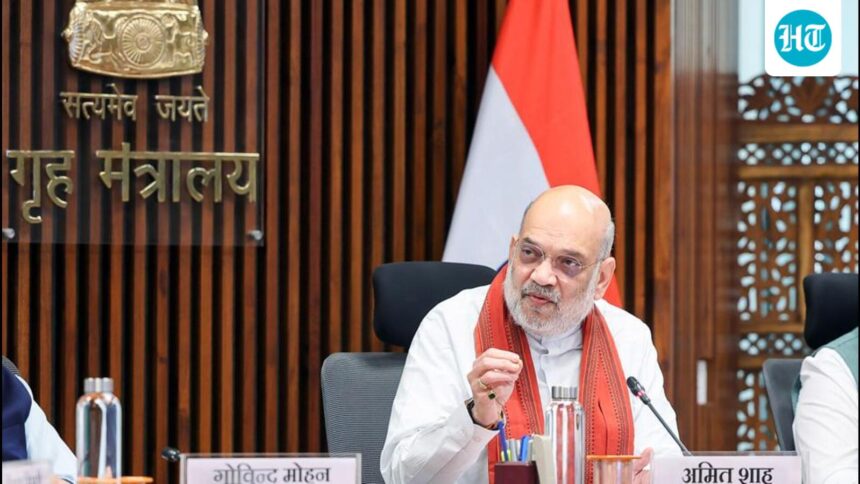
Union Home Minister Amit Shah on Tuesday launched the FCRA 2.0 portal to make processes related to applications, renewals and filing of annual returns fully digital, adding that the move will enable faster and more accurate verification and improve compliance monitoring of receipt and use of foreign funds, thereby strengthening national security and governance.

Shah also launched the e-OCI (Overseas Citizen of India) card which will eliminate the need to reissue the OCI booklet on receipt of a new passport when it expires after 20 years, while allowing the government to reduce paperwork and enhance data management and centralized tracking.
The initiatives were launched in Delhi in the presence of Foreign Minister Vikram Misri, Home Minister Govind Mohan, new Intelligence Bureau chief Mahesh Dixit and other senior officials.
The FCRA 2.0 portal will “solve the difficulties faced by those receiving donations through the FCRA portal,” Shah said.
“It has been developed to simplify compliance under the Foreign Contribution (Regulation) Act [FCRA] Strengthening the monitoring and enforcement mechanism. All key processes related to orders, renewals, annual returns and other services have become fully digital (end-to-end). At present, about 14,500 active FCRA organizations operate across the country. Each year, approximately 15,000 to 20,000 applications and approximately 17,000 returns are received annually. Given this large size, a modern, secure, technology-enabled system has long been needed.
Read also:The history of India will be studied in two phases, before and after 2014: The Shah
He said the portal includes features like process re-engineering, integrated dashboard, Aadhaar-based authentication, e-signature facility and OCR-based document analysis. “Key provisions of the new FCRA Amendment Rules, 2026 have also been integrated into it. The portal has been integrated with major government databases and banks, including PAN, Aadhaar, OCI, NGO Darpan and ICAI’s UDIN system,” Shah said.
Emphasizing how useful this portal is for NGOs, Shah said: “This portal reduces paperwork, saves time, and provides a simple and more convenient experience.”
For the government, Shah said: “API-based integration with key databases enables faster and more accurate verification, improved compliance monitoring, and effective oversight of the receipt and use of foreign contributions – thus enhancing national security and good governance. The platform is also designed to accommodate future features such as an AI-powered chatbot and mobile-based access.”
Before 2014, the FCRA system was “tangled in files and procedures and outside the scope of proper oversight,” which is critical to both national security and development, Shah said.
“After the formation of the government led by Prime Minister Narendra Modi in 2014, the system was strengthened. Today’s revamp of the FCRA portal will significantly enhance the ease of operations for organisations. In the past years, there has been a significant increase in the number of applications and inflow of donations. Keeping this in mind, reducing paperwork and ensuring effective real-time monitoring of foreign contributions is very important for the security of the country,” it said.
Regarding the new FCRA law, which is likely to be taken up in the upcoming monsoon period, Shah said: “Due to the FCRA law, surveillance of foreign contributions coming in with wrong intentions will increase.”
Shah said the new e-OCI card “will provide great relief to more than 50,000 people [5 million] OCI cardholders.”
“The e-OCI Card for Overseas Citizens of India (e-OCI) is a major citizen-centric initiative that aims to transform OCI services for the global Indian diaspora through a fully digital system. Under this system, applicants can complete the entire OCI process online – from submitting the application and uploading supporting documents to downloading the digitally generated card after approval. Existing cardholders can also get their e-OCI card digitally in most cases without the need for a fresh application or physical verification,” he added.
“Under the new arrangement, the requirement to reissue the OCI booklet on receipt of a new passport after the age of 20 has been removed. However, cardholders will need to update their passport details online when a new passport is issued.”
For the government, the e-OCI system will ensure “complete online processing, reduce paperwork and administrative costs, enhance data management and centralized tracking,” Shah said, besides integration with digital immigration systems for real-time verification at airports.
“This improves identity verification, enhances security and reduces the risk of fraud,” he added.