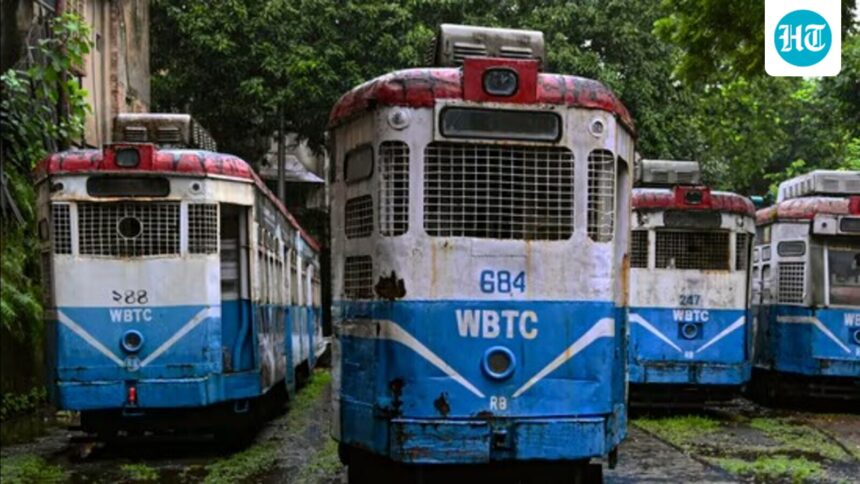
Kolkata’s electric-powered trams, which were started by the British in 1873 and closed in 2024 under the Trinamool Congress (TMC) government, except for two tracks, may make a comeback under the BJP, Transport Minister Arjun Singh said on Sunday.

“We want to revive the environment-friendly public transport system. RITES (Indian Railway Technical and Economic Service) has been asked to conduct a survey,” Singh said.
Transport Ministry officials said the country plans to renovate old tracks first and then develop a model for operating modern trolleys, similar to those seen in Australia and some European cities, to boost tourism in addition to being a daily means of transportation.
RITES, a public sector undertaking (PSU) under the Ministry of Railways, provides engineering and consultancy services in transport infrastructure, including roads, airports and railways.
“There were 40 routes during the Left Front government, but only a limited number of trams are currently running on two routes: one from Gariahat to Esplanade via Park Circus in south Kolkata, and the other from Shyambazar to Esplanade in the north. The feasibility study will determine whether some of the old routes can be revived through modernization,” said a transport department official requesting anonymity.
Read also:‘Anti-social activity’, Uniform Civil Code: A look at the major bills scheduled to be introduced in Bengal next week
West Bengal Transport Corporation Limited (WBTCL) has been running tram services since 2016 when it took over the original Calcutta Tramways Company (CTC), which was formed by the British government and registered in London on 20 December 1880.
According to WBTCL records, the first horse-drawn tram was launched on 24 February 1873, for a distance of 3.9 km between Sealdah and Armenian Ghat. It was closed in November of that year and returned with meter gauge tracks on the Sealdah-Bobazar-Dalhousie-Armeni Ghat route in November 1880.
In 1882, steam engine-powered trams were introduced and were replaced by electrically powered trams in 1900. CTC built its own power station at the Nonapukur tram depot, which is still in operation, however, the Calcutta Electric Supply Company, Kolkata’s sole power supplier so far, began running trams in 1927.
In 1922, CTC introduced buses, which were later discontinued.
In February 1943, tram services were linked to Howrah, bringing the total length of tracks in the two cities to 68 kilometres, according to records.
After independence, the state passed a law in 1952 stating that it would take over the administration of the CTC from the British within 15 years.
By 1960, CTC had 450 streetcars in operation. The British administration left India in 1967.
Trams are an integral part of Kolkata’s landscape and British Indian history, and have featured in numerous films, including Satyajit Ray’s MahanajapRitwik Ghatak Bari thik bali And Mrinal Sen interview, Calcutta 71 and BadaticAnd famous Bollywood movies like Pico, Kahani, Barfi and Yufa.
New routes were added and many old ones were discontinued over the next five decades as new modes of transportation such as metro lines (Kolkata was the first Indian city to have them) led to a sharp decline in tram users.
“The loss of revenue and rising maintenance costs prompted the government to shut down all the tram lines except the two which still function as a symbol of Kolkata’s heritage,” an official said.