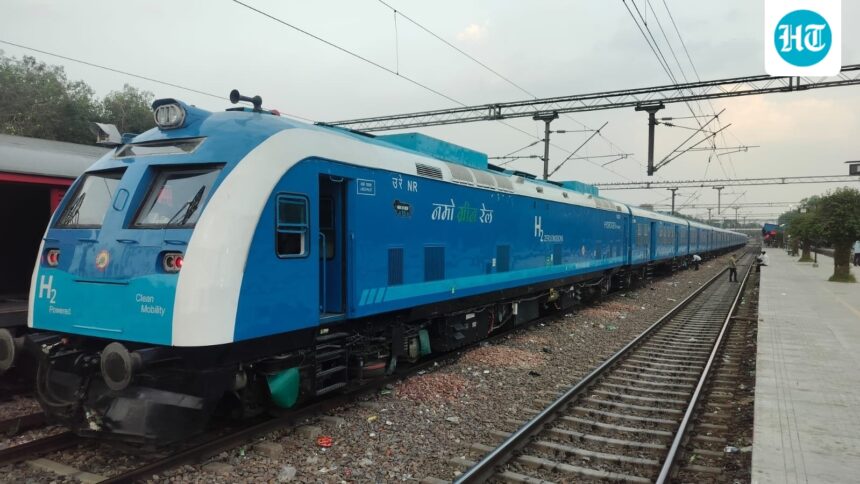
Indian Railways tested train braking and stability on the Jind-Sonepat line this week. A look at how a hydrogen fuel cell works

India’s first hydrogen-powered train conducted a new set of trials between New Delhi and Jind on Friday, with engineers tracking emergency braking distance and oscillations as the project approaches commercial service.

The train reached a maximum speed of 120 kmph on the Jind-Sonepat section during the test, though its operational speed will be capped at 75 kmph. An earlier round of trials between Sonipat and Jind has already been completed.
The Railway Board approved the introduction of the ten-coach train set in a letter dated 22 May. The Ministry of Railways announced the approval five days later, on May 27, but it has not yet announced a date for the start of passenger services.
Here’s what is known about the project so far and how the technology works:
Project
The train set is a modernized Diesel-Electric Multiple Unit (DEMU) – a type of ram already popular on short and medium-distance routes in India – which has been converted to run on hydrogen fuel cells instead of diesel.
The upgrade has been contracted to Medha Servo Drives, a Hyderabad-based railway electronics manufacturer, which has partnered with Canadian fuel cell technology company Ballard Power Systems.
The train will have two driving cars (DPCs) each with a capacity of 1,200 kW, and the remaining eight cars will be passenger cars. On this basis, the railway says that it will be the longest and most powerful hydrogen train set (2,400 kW) in the world on a wide-gauge line.
The railways intend to electrify most of its network, so hydrogen trains are planned largely for lines that are difficult to electrify or involve heritage routes. Currently, only 35 train routes are envisioned under the “Hydrogen for Heritage” programme.
Refueling will be handled by a plant set up in Jind, where a 1MW polymer electrolyte membrane (PEM) electrolyser will produce approximately 420-430 kg of hydrogen per day, according to GreenH Electrology, a joint venture between Spain’s H2B2 Electrology Technologies and GR Promotion Group which built the facility under a 2023 contract with Medha.
The site has a storage capacity of 3,000 kg and two dispensers for faster refueling.
On one cycle of fuel, a train can travel about 250 kilometers.
Currently, the cost is estimated at $80 Crore per train and $70 crore for road infrastructure, besides other developments. In a written reply from the Lok Sabha in December 2025, Railway Minister Ashwini Vaishnaw said that a fair comparison of the cost with conventional traction systems is not yet possible, as the project and its infrastructure are still being developed on a pilot basis.


Read also: India’s next great electrification
Why does it matter?
This is mainly because it is a clean technology. A hydrogen fuel cell produces electricity through a chemical reaction with oxygen, and the only byproduct is water vapor, so the train emits no carbon emissions at the point of use.
This project places India among a small group of countries that have built or are building hydrogen-powered passenger trains, along with Germany, Japan, China and the United States. The German company Alstom Coradia iLint, which entered commercial service in 2018, was the first in the world.
For Indian Railways, which has set itself a target of becoming a net zero carbon producer, electrification is the key priority and hydrogen is being mooted as a solution to the remaining gaps. These include non-electrified stretches, difficult terrain and heritage lines such as those in the Nilgiris Valley, Darjeeling and Kangra.
Read also: Pune is celebrating 96 years of grand service of the iconic Deccan Queen
How does the hydrogen train work?
A hydrogen fuel cell, in effect, works like electrolysis in reverse. Where electrolysis uses electricity to split water into hydrogen and oxygen, a fuel cell combines hydrogen stored on board with oxygen drawn from the air, generating electricity and releasing water vapor and heat as the only byproducts.
This electricity then powers the train’s traction motors, in the same way that electric locomotive motors are powered by current from an overhead wire, except that the hydrogen train makes its own supply rather than relying on one.
The placement of hydrogen tanks and fuel cells on board varies depending on the design. German company Coradia iLint has installed its fuel cells and tanks on the roof of two of its cars, arguing that hydrogen is much lighter than air and diffuses upward quickly if it leaks, reducing the risk of explosion, said a 2024 review article in ScienceDirect.
Swiss company Stadler has dedicated an entire car in its FLIRT H2 train set to storage and fuel cells, completely isolating that equipment from the passenger cars.
Batteries are a standard part of the package in almost every design, including the Indian one. It stores excess electricity generated by the fuel cells and energy recovered through regenerative braking, providing extra power during acceleration when the fuel cells alone can’t keep up, the ScienceDirect review said.


Read also: Indian Railways modernizes 100 Shatabdi and Jan Shatabdi trains
Restrictions
Hydrogen railways are not a new technology being brought into service. Alstom has been operating hydrogen trains commercially in Germany since 2018, and Stadler’s FLIRT H2 set a Guinness World Record by covering a distance of 2,803 kilometers over more than 46 hours without refueling.
Green hydrogen, which is produced by splitting water using renewable electricity, is the only version of the fuel compatible with true decarbonization. Most hydrogen produced today is “grey,” meaning derived from natural gas or other conventional fuels. Large-scale production of green hydrogen remains expensive, largely due to the cost of electrolyzers and renewable energy.
Another concern is storage and compression. Hydrogen has a very low volumetric energy density and must be compressed to high pressures, typically 350-700 bar, to be practical for on-board storage. This pressure itself consumes m Approximately 6-10% of the energy content of the gas, according to records from the US Department of Energy’s Hydrogen Program.
The small molecular size of hydrogen also leaches through metals, a phenomenon called hydrogen embrittlement, which can weaken storage cylinders due to repeated use, and is a recognized safety concern in industries that handle compressed hydrogen, according to reviews in the International Journal of Hydrogen Energy and PubMed Central (PMC).
Both reviews said that corrosion of metal storage and refueling components from prolonged exposure to hydrogen is a relevant and long-documented problem. This is why newer pressure vessel designs are increasingly turning to composite materials rather than just metals.
The third concern is operational stress. Extreme weather events and challenging business cycles in India could test the resilience of fuel cells in ways that have not been fully proven outside more moderate operating environments such as Germany.
The cost-effectiveness and scalability of hydrogen-powered trains appears to be a long-term issue. Although the technology has been around for years, it has yet to catch up with public transportation powered by conventional fuels or renewable energy sources.

Follow the latest breaking news and developments from India and around the world with Hindustan Times Newsdesk. From politics and politics to economics and the environment, from local issues to national events and global affairs, we’ve got you covered.Read more