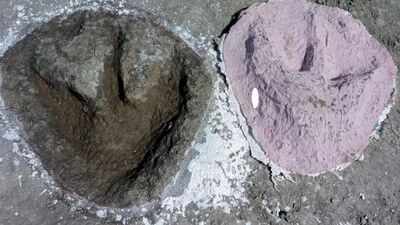
A routine day at a limestone quarry in Oxfordshire has led to one of the most important dinosaur discoveries in Britain in decades. Hundreds of fossilized footprints, hidden beneath layers of clay, emerge from a landscape that existed around 166 million years ago, when the area was located next to a warm, shallow lake rather than rolling countryside.
The prints span multiple paths, capturing the movements of giant plant-eating dinosaurs alongside one of the most famous predators of the Jurassic period. Scientists believe the site could answer long-standing questions about how these animals travel, behave and share their environment, with detailed digital records expected to support research for years to come.
How a British quarry uncovered the site of a 166-million-year-old dinosaur
The footprints at Dewars Farm Quarry were uncovered after quarry worker Gary Johnson noticed an unusual ridge pattern while removing clay. According to the Natural History Museum at the University of Oxford, specialists from the Universities of Oxford and Birmingham were called in, leading to a week-long excavation in which more than 100 researchers participated.About 200 footprints were uncovered across five wide-ranging tracks dating back to the Middle Jurassic period, about 166 million years ago. The longest continuous track extends over 150 metres, making it the largest dinosaur trace site yet recorded in the UK.
The excavation team also took more than 20,000 photos. Aerial drone surveys were used to create detailed 3D models, allowing scientists to continue studying the site long after excavations had finished.
Dinosaurs that roamed Oxfordshire 166 million years ago
Four of these tracks are thought to have been made by large sauropod dinosaurs, most likely Cetosaurus, a long-necked herbivore that reached a length of about 18 metres. The remaining trace belongs to Megalosaurus, the carnivorous dinosaur first described by scientists in 1824 and identified by its distinctive three-toed footprints.One section of the quarry contains traces of both animals crossing each other. While there is no evidence that they met each other, the overlapping tracks provide an unusual snapshot of different types of dinosaurs moving across the same muddy ground.Speaking to NPR, Professor Kirsty Edgar of the University of Birmingham said that the environment in which the animals walked was “most likely a lake” and may have resembled “the Florida Keys of today.”
How Jurassic footprints help scientists understand Dinosaur behavior
Bones can reveal what a dinosaur looked like, but footprints preserve moments from its daily life. Scientists can estimate walking speed, direction of travel, body size, and in some cases, whether animals move together.According to the Natural History Museum, the tracks are particularly valuable because they capture behavior that skeletal fossils cannot preserve. As paleontologist Dr. Susannah Maidment explains, “The tracks are important because they preserve fossilized behavior, something we cannot get from animal bones alone.”The Oxfordshire footprints have survived in exceptional condition. The Oxford University Natural History Museum said researchers could even observe how the soft clay shifted beneath each step. Earth scientist Dr. Duncan Murdock noted that the preservation is detailed enough to see “how the clay deformed as the dinosaur feet squeezed in and out,” helping scientists reconstruct the ancient lake environment.
Why Oxfordshire was a hotspot for Jurassic dinosaurs
Modern Oxfordshire is known for its farmland and villages, but the landscape was once part of a tropical coastline bordering a shallow sea. The muddy flats where these footprints formed were also home to other dinosaurs, early mammals, pterosaurs, and marine life.The province indeed occupies a special place in paleontology. According to the Natural History Museum, the first dinosaur officially described by science was Megalosaurus, identified from Oxfordshire excavations in 1824 by geologist William Buckland. The newly discovered tracks reinforce evidence that both giant sauropods and large carnivorous theropods inhabited the region during the Middle Jurassic.