Chennai

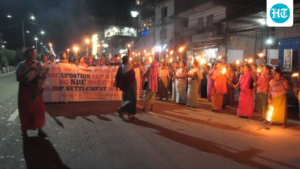
The Tamil Nadu government has moved the Supreme Court against Madras High Court orders that allowed the lighting of Karthigai Deepam at a stone pillar near a dargah atop Thiruparankundram hill in Madurai, reviving a dispute that had been the subject of months of litigation and political debate in the state.
The Tamil Nadu Vetri Kazhagam government filed a special leave petition in the Supreme Court on June 11, soon after the government led by Chief Minister C Joseph Vijay took office.
The state had challenged the original order passed in December last year, by a single bench judge Justice GR Swaminathan, which had allowed lamp lighting at the ‘deepathoon’ (stone lamp post) on the hill, and the order passed on January 6, 2026 by a division bench of the Supreme Court, which had upheld the single-bench order.
The case concerns the right of devotees to light the ‘Karthijai Deepam’, the traditional temple lamp placed on a stone pillar located about 50 meters from the dargah on Thiruparankandram hill. A group of devotees had moved the Madras High Court last year alleging that local police were preventing them from lighting the lamp even though they were traditionally worshiping at the site. They said that prohibiting these rituals violates their religious rights.
The DMK party, which was ruling Tamil Nadu at the time, opposed the petition through the Hindu Religious and Charitable Endowments Department, saying allowing such rituals could lead to law and order problems.
In a series of orders passed between December 1 and 9 that year, Justice Swaminathan dismissed these concerns and held that the rights of the dargah were not affected by the rituals. He also rejected state arrests, describing them as an “imaginary specter,” noting that unrest would only occur if it was “sponsored by the state itself.”
The case escalated when the fanatics initiated contempt proceedings after the authorities failed to implement the order.
The Supreme Court allowed a group of devotees to light the lamp and ordered the CISF to provide protection. When the district administration imposed prohibitory orders under Section 144 of the Criminal Procedure Code, the sole body quashed them, saying they were issued to circumvent its directions.
On January 6 this year, a division bench of the Supreme Court upheld the single judge’s ruling and held that fears of communal tension expressed by the state lacked substance.
Incidentally, even as the TVK government moved the Supreme Court, on Monday, June 22, another bench of the Supreme Court urged all parties to end the dispute.
While hearing the appeals arising from the contempt proceedings, a bench of Justices N Satish Kumar and M Gothiraman of the Madras High Court questioned the need to continue the litigation.
“You can sit together and give peace to this matter,” the bench orally observed, asking the parties to explore mediation and arrive at a solution that serves the interests of residents familiar with the situation on the ground.