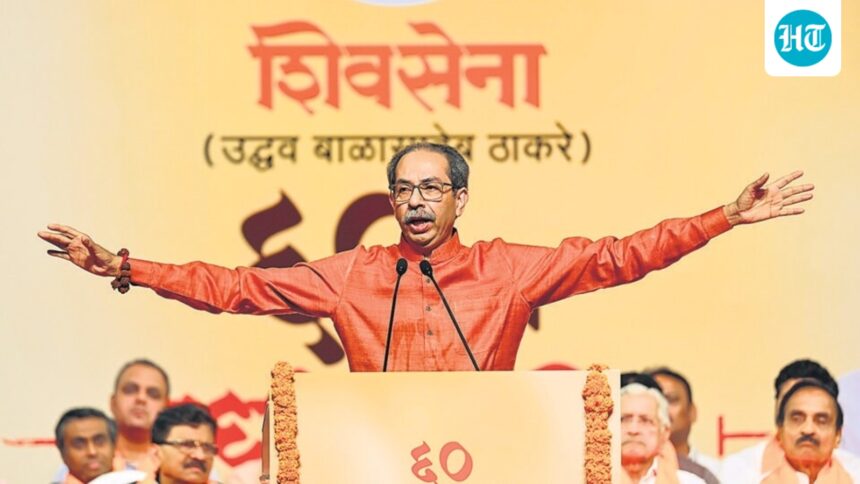
Uddhav Thackeray, who lost the Shiv Sena’s original name and symbol in 2022, rejected the rebel MPs’ claim that they fear a Congress merger.

History may be accidental, but it has meaning.

June 20 marked exactly four years since Eknath Shinde began his march out of the Maha Vikas Aghadi government of the Shiv Sena-Congress-NCP alliance, moving a group of Shiv Sena MLAs to Surat and then Guwahati – both in BJP-ruled states – before ousting Uddhav Thackeray-led Uddhav Thackeray nine days later.
In the same week this year, six of the nine Lok Sabha MPs from Uddhav’s Sena reportedly submitted a letter to the Lok Sabha Speaker to form a separate group, and it appears they will eventually merge with Shinde’s Sena to support the BJP-led NDA regime led by Prime Minister Narendra Modi.
This is the second major break in Bal Thackeray’s original Sena in four years. Reports said that Maharashtra MP CM Shinde was in touch with the rebel MPs and assured them of full support, and his son and MP Shrikant Shinde also played a key role in coordinating the discussions in Delhi.

The rebels – Sanjay Jadhav (MP from Parbhani), Bhausaheb Wakshwar (Shirdi), Sanjay Deshmukh (Yavatmal-Washim), Nagesh Patil Ashtekar (Hingoli), Sanjay Dina Patel (North East Mumbai) and Umraji Nepalkar (Dharashiv) – had already skipped the Shiv Sena’s parliamentary meeting on Thursday, and the party’s parliamentary meeting. Uddhav’s 60th Foundation Day event was held on Friday.
Arvind Sawant, Anil Desai and Rajabhau Waje with Rajya Sabha MP Sanjay Raut openly remained in Thackeray’s fold.
Read also | Shiv Sena vs Sena (UBT) on Foundation Day: Shinde and Thackeray brawl as rebel MPs stay away
What Thackeray says
Uddhav Thackeray, in his first comments on the impending split, rejected the rebels’ stated rationale They fear Congress merger, asserting that the Shiv Sena was not born to merge with anyone. “It was created to fight for the rights of Marathi people and protect Hindutva,” he told party workers.
He then criticized the ruling Bharatiya Janata Party at the Centre. “I fear that the Maharashtra BJP will merge with the Shinde Sena,” he said.
Sanjay Raut presented a legal defence, reiterating the argument that two-thirds of the party itself should merge, not just MPs or MLAs, for the anti-defection law not to apply. He also described the six representatives as “traitors.”
Shinde, in his event to celebrate Sena’s Foundation Day, dared Uddhav Thackeray to take action against the rebels. He described Defections as “just a trailer” for a longer film. Some leaders gave the defection the unofficial name “Operation Tiger”, playing off the trappings used by Bal Thackeray, although Sanjay Raut used “dogs” in his digs against dissident MPs.
The Tenth Schedule comes into force
The number six out of nine is accurate, because under the anti-defection law in the Tenth Schedule of the Constitution of India, voluntarily renunciation of party membership or voting against the whip can be treated as defection, with consequent disqualification.
The only legislative defense is merger with a two-thirds requirement. With six out of nine members of parliament signing on, the rebels made it clear that two-thirds would ban it completely – completely This is what Raghav Chadha and his group did as they defected from the RJD to the BJP in April, just as the Bangladesh Trinamool Congress faces a split in its ranks in the Lok Sabha.
But there is still an outstanding legal question as to whether it is necessary to merge two-thirds of an entire political party with another party, or whether groups of MPs or parliamentarians can be treated as the same party. The Supreme Court is scheduled to decide on a similar matter from Goa.
Slow bleeding
What distinguishes the disintegration of the Senate, for example, from the almost immediate parliamentary collapse of the TMC is the pace. The 2022 GA split was a blitz. It took nine days from the first mutiny until Uddhav Thackeray resigned. But the parliamentary bleeding took four years after the first shock.
After the 2022 split, 40 of the 56 Shiv Sena MPs sided with Shinde and 16 sided with Thackeray, while 13 of the 18 Lok Sabha MPs joined Shinde’s camp and five remained with Uddhav. Both claimed to be heirs to Bal Thackeray’s political legacy, with Uddhav asserting that he is a descendant, while Shinde said he adheres to the ideological line.

Thackeray was rebuilt from that base of five members. Contesting with a new name ‘Shiva Sena (UBT)’ and a burning torch as a symbol after the Election Commission handed Shinde the name and bow and arrow in February 2023, Team Uddhav won nine seats in the 2024 Lok Sabha elections. It was seen as an honorable performance for a bare-bones party.
However, the Maharashtra Assembly elections in November 2024 were tougher. The Shiv Sena (UBT) won only 20 of the 95 seats it contested, against the Shindhi Sena’s 57 of 87 seats. January 2026 completed the rout, with the BJP-Shiv Sena alliance winning the BMC elections decisively, ending the Thackeray clan’s control over India’s richest civic body. Each election cycle eroded the organization further, until the parliamentary ground gave way as well.
The current rebellion is the most severe in a series of events over the years. The first serious challenge to Bal Thackeray’s authority came in 1991, when senior leader Chhagan Bhujbal walked out with 17 NCP MLAs to join the camp of Sharad Pawar, who later served as a minister and deputy prime minister in the Congress and NCP governments. And then he came too Narayan Rane was fired and left in 2005.
But Bal Thackeray kept the organization together until his death in November 2012. His nephew Raj Thackeray had already left in 2005 to form the Maharashtra Navnirman Sena after his son Uddhav got to inherit the party. Uddhav’s son Aaditya emerged as the leader of the Sena’s youth wing later.

Raj and Uddhav recently came together in an alliance as politics has shifted rapidly in Maharashtra in recent years.
Read also | “If Sina is not divided,” “If Some have been switched”, What the data says: Deciphering many ‘ifs’ in BMC, Maharashtra results
Cong’s “combinatorial” shadow of the NCP and TMC
The parliamentary crisis facing the Senate did not unfold in isolation. In July 2023, Ajit Pawar broke away from his uncle Sharad Pawar’s NCP and joined the Shinde-BJP government. The split left Sharad Pawar leading only 12 of the 53 MLAs but seven of the nine Lok Sabha MPs. Sharad Pawar lost the party’s name and symbol just like Uddhav did.
Since then his SP party has lost further ground, and reports have recently emerged that some MPs are in touch with Ajit Pawar’s faction, with speculation that Sharad Pawar’s group may face a similar challenge of its own for the two-thirds vote.
At the same time, speculation about a NCP merger is swirling around the NCP, confirming that Sharad Pawar was once a supporter of the NCP. However, speaking to ANI, his daughter Supriya Sule said: “No one from our party has made any such proposal, nor have we received any such proposal.” This came at a time when Mamata Banerjee and her embattled TMC are also facing the existential question of whether or not to merge with the party she broke away from in the late 1990s.

Sulli has charted a pattern when it comes to splits. “The way the Shiv Sena split first, and then the NCP split, the same thing is happening to the TMC. This is very sad.” Sharad Pawar himself had earlier suggested that several regional parties could merge with the Congress in the next two years, saying he saw no ideological difference between the Congress and the NCP – statements that sparked fresh speculation.
Uddhav has denied any talk of merger, but this is the crisis he has been presented with Step down as president “if that’s what party workers want.”

Arish Chhabra is an associate editor on the Hindustan Times online team, where he writes news reports and explanatory features, as well as overseeing the site’s coverage. His career spans nearly two decades across India’s most respected newsrooms in print, digital and broadcast. He has reported, written, and edited across formats—from breaking news and live election coverage, to analytical long-reads and cultural commentary—building a body of work that reflects editorial rigor and a deep curiosity about the community for which he writes. Areesh studied English Literature, Sociology and History along with Journalism at Punjab University in Chandigarh, and began his career in that city, eventually moving to Delhi. He is also the author of Little Big City: What Life is Like from Chandigarh, a collection of critical essays originally published as a weekly column in the Hindustan Times, which examines the culture and politics of a city that is much more than just its famous architecture – and in doing so, holds up a mirror to modern India. During his stints at BBC, The Indian Express, NDTV and Jagran New Media, he has worked across formats and languages; Mainly English, as well as Hindi and Punjabi. He was part of the crack team for the BBC Explainer project which was replicated around the world by the broadcaster. At Jagran, he developed editorial guides and trained journalists on integrity and quality content. He has also worked at the intersection of journalism and education. At the Indian School of Business (ISB) in Hyderabad, he developed a website to streamline academic research in management. At Bennett University’s Times School of Media in Noida, he taught students the craft of digital journalism: from newsgathering and writing to social media strategy and video storytelling. Having moved from small town to larger town to megalopolis for education and work, his intellectual passions lie at the intersection of society, politics, and popular culture—a perspective that guides his writing and worldview. When he’s not working, he’s constantly reading long-form journalism or watching cerebral content, sometimes both at the same time.Read more