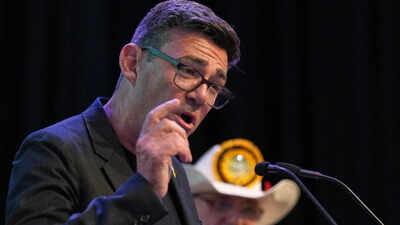
Andy Burnham’s decisive by-election victory in Makerfield did more than just return him to Parliament after an absence of almost a decade; It has positioned the Mayor of Greater Manchester as the strongest contender yet for Prime Minister Keir Starmer’s leadership of the Labor Party.The 56-year-old Labor leader won the seat with almost 55% of the vote, clearing a crucial hurdle in his bid to challenge the leadership.Under Labour’s rules, only current members of Parliament can compete for the party’s leadership, making Burnham’s return to Westminster a defining moment in the British political landscape.Starmer congratulated Burnham on the win, but the result is expected to deepen questions about his future.“Congratulations to Burnham on the X,” Starmer wrote. “Voters chose Labour’s campaign of hope and optimism rather than division and hate.”
Who is Andy Burnham?
Born in Liverpool in 1970 and raised in nearby Colcheath, Burnham joined the Labor Party at the age of 15 before studying at Cambridge University.The son of a telephone engineer and a doctor’s receptionist, he rose through the Labor ranks during the New Labor years under former prime ministers Tony Blair and Gordon Brown.
Burnham was first elected to Parliament in 2001 as MP for Leigh, and has subsequently held several senior ministerial posts, including Culture Secretary, Chief Secretary to the Treasury and Health Secretary. He also served in Labour’s shadow cabinet after the party lost power in 2010.
Why is he called the King of the North?
Burnham earned the nickname “King of the North” during the Covid-19 pandemic when he emerged as one of Boris Johnson’s government’s harshest critics over funding for the north of England.His public campaign for greater financial support during the lockdowns has turned him into a symbol of regional resistance and earned him widespread popularity across the north of England.The title has stuck ever since, reflecting his influence in the region and his image as a hero to communities outside London.As Mayor of Greater Manchester since 2017, Burnham has overseen major transport reforms, including the launch of the Bee Network, an integrated London-style public transport system.
Supporters credit him with helping drive economic growth and regeneration in Manchester.
Twice contender for the Labor Party leadership
Burnham is no stranger to Labor leadership battles.He first ran for the party leadership in 2010 after Gordon Brown’s resignation, and came in fourth place. Five years later, he launched another campaign and was considered the favorite before losing to Jeremy Corbyn.Despite these defeats, Burnham remained one of Labour’s most popular figures and gradually built a political base outside Westminster through his role as mayor.
Why is he a challenge to Starmer?
Burnham’s appeal extends beyond Labour’s traditional support base. Many party members see him as a stronger communicator and a more relatable political figure than Starmer at a time when Labour’s popularity has declined.His supporters argue that his success in Greater Manchester and ability to connect with working-class voters makes him well placed to confront the growing threat posed by Nigel Farage’s UK Reform Party.However, critics say Burnham has adapted his policies to suit different eras of Labour, having served under Blair, Brown and Corbyn. They also wonder whether his success in Manchester can be replicated on the national stage.
What will happen next?
Burnham is expected to be sworn in as the Makerfield MP within days. This will make him eligible to contest the Labor leadership if he gains the support of enough Labor MPs.With Starmer facing increasing pressure after a series of political setbacks, Burnham’s return to Westminster has fueled speculation that Britain may soon witness a leadership battle at the heart of the ruling party.Now, the man once dubbed the “King of the North” has taken his biggest step yet towards a job at 10 Downing Street.