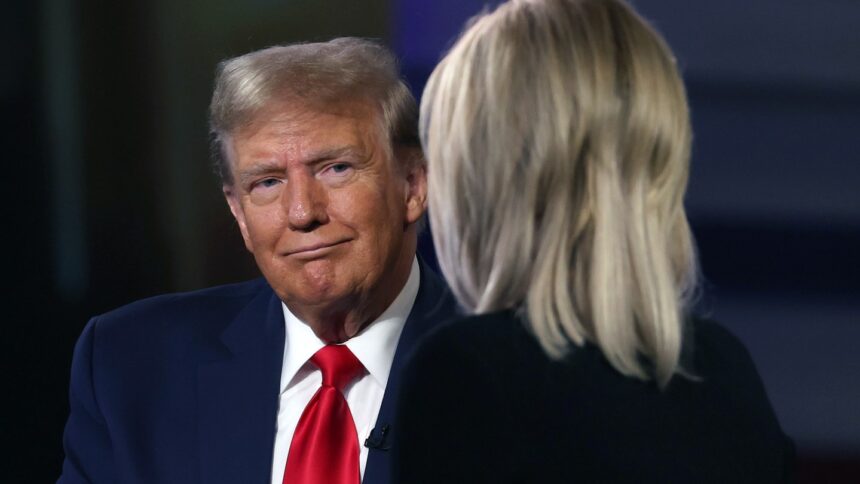
During President Trump’s “Executive Time” on a recent Sunday evening, one speech during a marathon fact-posting spree on social media told the story of what he was eating at the start of the week. His main post had overtones of heartbreak, and its target was one that had long mocked him from inside the room: Fox News — his constant companion, his comfort zone, the powerful media engine that had seized upon him a decade earlier and, for better or worse, fueled what followed in his once improbable political career. Theirs is a marriage of convenience that has been on the rocks since the wedding. Now, with Trump’s polls turning slim and a turbulent Congress beginning to splinter, the midterm elections are proving to be the tipping point that could push this marriage of mutual advantage into a messy divorce.
“You can listen to Fox News all day, and absolutely devour it, but then, when you hear lying, like Congressman Ro Khanna, the ‘wolf in sheep’s clothing,’ lying, lying, lying, and lying again, without any dissent, or competent rebuttal from an anchor,” the president wrote, adding on Fox News host Jackie Heinrich and her guest, the Democratic congresswoman from California. The two had discussed the United States abandoning domestic production and buying cheap steel from China, with Khanna noting that the Trump administration does not look at “America first.”
“America First” has arrived where it was designed — against Trump’s core political identity, at a time when his approval rating has fallen to 37% in the latest New York Times/Siena poll, the lowest it has been in either period, with numbers falling short of the economy and inflation that have traditionally been his strengths.
Trumpism did not come from nothing. Fox News rose to dominance by offering a 24-hour news channel what millions of Americans wanted: a romanticized version of American history, dog-whistle politics, and a place to channel the anger of economic displacement. It became a 24/7 safe haven, and year after year, its audience — which certainly included Donald Trump — grew and learned to rely on it.
The decade-long dance between the network and the political outsider-turned-party-usurper began when Trump reluctantly took hold of the Murdoch family-owned cable outlet, which mopped up the uninspiring GOP primaries in 2015. His nascent MAGA movement played well with Republicans at Fox News, whose enthusiasm for the Tea Party had cooled but remained glued to their screens watching his rallies. The Fox audience, already predisposed to distrust anyone outside the Republican Party, found in Trump a natural fit. The honeymoon was short — just ask former Fox News anchor Megyn Kelly — and a decade later, through years of public rebuke, the network has stood by its man as an unprecedented retooling of Republican values unfolds.
But Trump was always playing the longer game. He realized that by maintaining the loyalty of some opinion anchors — Sean Hannity, Laura Ingraham, and Tucker Carlson before his departure — Fox’s institutional cohesion could crack from within. These on-air allies were not just friends. They were assets in a long-running play to dismantle the network’s editorial authority and replace it with personal loyalty. Despite the intimidation, theatrical casualties, and periodic threats to withdraw, Fox and Trump have never been able to completely say no to each other. The only difference now is that we may be entering the end of this ranking.
To understand how Fox lost control of the audience it built, you have to fully understand how it built them. Mastermind Roger Ailes, chosen by Rupert Murdoch to run the network, used his background in local television and Republican presidential politics to create something that didn’t exist: glossy news programs filled with looming conflicts, liberal bogeymen, flashy sketches, and celebrity-like on-air personalities who winked at their audiences like conspirators. Meanwhile, Murdoch was paying cable operators up to $11 per subscriber to carry the channel — exactly mirroring the industry standard and buying its way into American homes.
It worked at historic speed. During the disputed Bush-Gore election of 2000, Fox saw viewership rise by 440 percent. The 9/11 attacks were the decisive turning point, and the Afghanistan and Iraq wars that followed were a gift to a network that positioned itself as the nationalist alternative to what it derided as a liberal media. Fox’s prime-time audience grew to 2.4 million versus 791,000 on MSNBC and 481,000 on CNN.
What Ailes and Murdoch built in those years wasn’t just an audience, it was an emotional infrastructure. The Obama-era Tea Party movement served as a proof of concept: Fox provided blanket coverage of taxpayer marches and Tea Party rallies, with anchors like Sean Hannity and Greta Van Susteren broadcasting from the demonstrations themselves. Academic research has later documented that Fox News viewership is directly related to fundraising and primary votes for Tea Party candidates. The crowd has learned that it can move. Trump saw this and walked straight through the door.
The resistance at Fox did not last. When Megyn Kelly challenged Trump in the first Republican debate — where she asked him about his treatment of women — Trump launched an all-out war against her, boycotting a subsequent debate on Fox, and watching the network’s audience take his side. The audience had already made up its mind, and the network followed suit.
That power dynamic — audience first, network second, press last — has governed Fox’s relationship with Trump ever since. Kelly was eventually fired. Shep Smith, the network’s most prominent live news anchor, left in 2019 after sustained pressure. Trump openly gloated about both exits. Former Fox boss Bill Shine became Trump’s White House communications director. Sean Hannity, Fox’s top prime-time anchor, was best friends with the man who now runs White House communications.
The fragility of this arrangement was demonstrated on Election Night 2020, when Fox was the first to call Arizona for Biden. The backlash from Trump’s team — and from the public — was immediate and violent. Audience share was captured by conservative startup Newsmax. What followed was arguably the most consequential editorial capitulation in the history of cable news: The Dominion Voting Systems lawsuit revealed that Fox stars and executives were privately dismissive of Trump’s claims of a stolen election while amplifying them on air. Carlson, then the network’s most influential host, texted a producer days before Jan. 6 that they were “pretty close to being able to ignore Trump most nights,” adding, “I fucking hate him.” Fox CEO Susan Scott emailed a colleague demanding that she pull the fact-checking clip: “This has to stop now. The public is angry and we’re just feeding them material. It’s bad for business.” The two editors who called Arizona right — Washington managing editor Bill Sammon and political director Chris Stirewalt — were gone before Biden’s inauguration. Fox settled for $787.5 million.
Now, which of these two parties will retain guardianship of the GOP’s fickle voting base? It’s 2026, and the network and the president are staring at each other as the midterm elections approach. Trump is exerting his influence over the GOP primaries by fully endorsing his MAGA-groomed rivals who are grooming his perceived enemies in Congress. He has had great success in ousting career politicians, mostly over grievances dating back years. This is the power that Fox News once had. Some of the 2026 primaries show new divisiveness, and the results should ring alarm bells across the network.
The congressional primaries for Kentucky’s 4th District and Texas Senate seat — which saw Thomas Massie and John Cornyn defeated by Trump’s hand-picked challengers Eh – where is this headed? Trump is running two overlapping, and sometimes contradictory, fundamental strategies, and the fault line between them is precisely where Fox’s corporate interests and Trump’s revanchist interests diverge. The network ownership class wants a functioning republican majority. Trump wants a sanitized, organized, and highly loyal Congress.
In Kentucky, Trump endorsed Ed Gallerin, a former US Navy SEAL, over Massie, who has been an outspoken critic of the administration — particularly regarding the Epstein files. Gallerin won the primary on May 19. The bottom line here is stark: Massie, a libertarian-leaning conservative with a real ideological identity in a safe Republican district, was fired not because of liberal leanings but because he was insufficiently loyal to Trump. Conservative good intentions no longer go too far. MAGA loyalty is the only test.
Finally, Fox News gave Massey airtime on the final day of his primary, his first appearance on the network in 14 months. Massey told Cincinnati Public Radio that he was blacklisted, and the explanation for this was internal discord between the two parties. “They are afraid that if they give me a place to speak, the White House will exclude them,” he said. “And they want access more than anything else.”
The Texas Senate race showed how completely Fox had lost his ability to reason with the public he created. Scandal-plagued but MAGA-aligned Ken Paxton defeated John Cornyn — a senator with a 99 percent Trump voting record — after Trump’s late endorsement. Fox’s news division, sympathetic to Cornyn’s concerns about his electability, was moved to Fox Digital. On the opinion side, Paxton was heavy-handed and portrayed Cornyn as an enemy of the president. When Paxton won in a landslide on May 26, Fox’s coverage dropped to the desired level within 24 hours. The network didn’t lead the conversation. It waited to see which direction the audience would go, then it followed.
After the midterm elections, Fox faces a structural crisis that no electoral outcome will be able to resolve. A succession within the Murdoch family has put Lachlan at the helm, and he will have to navigate the post-Trump landscape and find a path to audience and revenue growth. It won’t be easy: Only 32 percent of adults ages 30-49 and 28 percent of those under 30 watch Fox News, according to a Pew Research analysis as of August 2025. In weekly primetime, Fox recorded 278,000 viewers in the 25-54 age group — down 5 percent year over year. The core audience is getting older. The alternative does not come
Carlson’s independent operation makes this point uncomfortably clear. It went from zero independent distribution in April 2023 to nearly 34 million monthly views — no cable carriage, no affiliate deals, and no bundle. He grew up entirely on the brand that Fox built for him. What used to require a network now requires a laptop and a mailing list, at a fraction of the cost.
The independent voices now vying for that audience – Carlson, Candace Owens, and others – have broken with Trump’s agenda at times, and not on friendly terms. They are smaller, more flexible and not tied to management. They inherit an audience that has been trained for two decades to distrust every institution — including, ultimately, Fox itself.
Fox’s attempted solution — its $22 billion acquisition of Roku, aiming to make it a primary gateway between consumers and streaming services — reflects the scale of the problem and the willingness to spend big on distribution, data and ad technology as audiences begin to shrink. But the strategy will not solve the problem of public loyalty, which is primarily a political problem.
Trump’s closing shot in the same Truth Social post — the ritual nod to his friends at Fox after a public attack on the establishment — was itself the story. He knows that the network is still valuable to him. He simply intends to use it on his own terms.
After the midterms, Foxx may step aside further, diluting any remaining opposition voices and giving the president more of what he wants. But Trump should examine the logic of what he helped create. A norm that has been trained over two decades to distrust every institution — ripe for anger and betrayal — is not a rule that remains tamed indefinitely. He radicalized them with Fox’s help. If this partnership collapses completely, the next target of their concern may not be a political enemy.
It might be him.