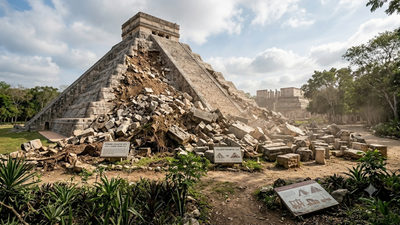
For more than a thousand years, a stone pyramid guarded the ancient settlement of Ihuatsio in western Mexico. Built by the Purépecha civilization, one of the few Mesoamerican powers to successfully resist Aztec expansion, this monument has survived centuries of conflict, weather and human change.
But within hours, part of this magnificent structure collapsed. After a period of severe drought and unusually heavy rains, part of the pyramid collapsed into a pile of rubble, alarming archaeologists and local communities alike. While experts point to environmental pressures and structural degradation, some descendants of the region’s indigenous people view the event through a different lens, describing it as a worrying omen reminiscent of warnings recorded in ancestral traditions.
How the 1,100-year-old Pyramid of Purépecha in Ihwazio suddenly collapsed into rubble
The collapse occurred on July 29, 2024 at the archaeological site of Ihuatsio in the Mexican state of Michoacán. This damaged monument, about 15 meters high, is one of the best-preserved structures associated with the ancient kingdom of Burepeša. Archaeological investigations confirmed that the southern part of the pyramid collapsed, leaving large amounts of stone and building materials scattered around its base.
Ihuatzio was first occupied over 1,100 years ago and later became an important ceremonial and political center of the Purépecha civilization. The site contains pyramid platforms, tombs, and defensive structures that provide valuable insight into one of Mexico’s most important pre-Hispanic cultures. According to the Institute of Geophysics of the National Autonomous University of Mexico, inspections revealed damage affecting multiple sections of the monument, including parts of the exterior walls, retaining walls and the interior core.
Archaeologists reveal why drought, heavy rains and structural damage caused the disaster
Researchers believe the collapse was caused by a combination of a prolonged drought and subsequent heavy rains.In an official statement recorded by IDR, INAH explained:“High temperatures, previously recorded in the area, and subsequent drought caused cracks that contributed to water seeping into the interior of the pre-Hispanic building.” After months of exceptionally dry conditions, severe summer storms have battered large parts of Mexico.
Water seeped into cracks that formed inside the pyramid’s structure, weakening the internal components and eventually causing part of the monument to fail. Archaeologists noted that at least six stepped sections showed signs of deterioration. The incident has renewed concerns about the vulnerability of archaeological sites to increasingly extreme weather patterns. Heritage specialists have warned that sudden shifts between drought and heavy rainfall could accelerate the deterioration of ancient building materials, especially in exposed monuments.
Why are descendants of indigenous people called… Collapse of the pyramid “Bad omen” is associated with ancient beliefs
While scholars focus on environmental explanations, some members of the modern Burepecha community explain the collapse through traditional cultural beliefs.A member of the Purépecha community told Science Alert that ancestors would have viewed this event as a warning sign. He explained according to reports:“For our ancestors, the builders, this was a bad omen indicating the nearness of an important event.” They also noted that similar stories appear in Burepecha oral traditions, where unusual events affecting sacred structures are sometimes interpreted as signs of approaching major changes. Despite these explanations, restoration experts are focusing on stabilizing and repairing the damaged monument. INAH stated that restoration efforts will focus on preserving the structure and protecting an important part of Mexico’s cultural heritage for future generations.