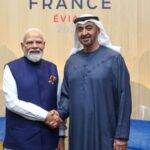
Wars can only be addressed through dialogue, diplomacy and international cooperation, and all countries must ensure the safety of sea routes and sailors, Prime Minister Narendra Modi told a crowd that included US President Donald Trump on Tuesday, days after three Indian sailors were killed in the waters off the coast of Oman in a US strike on a commercial ship.

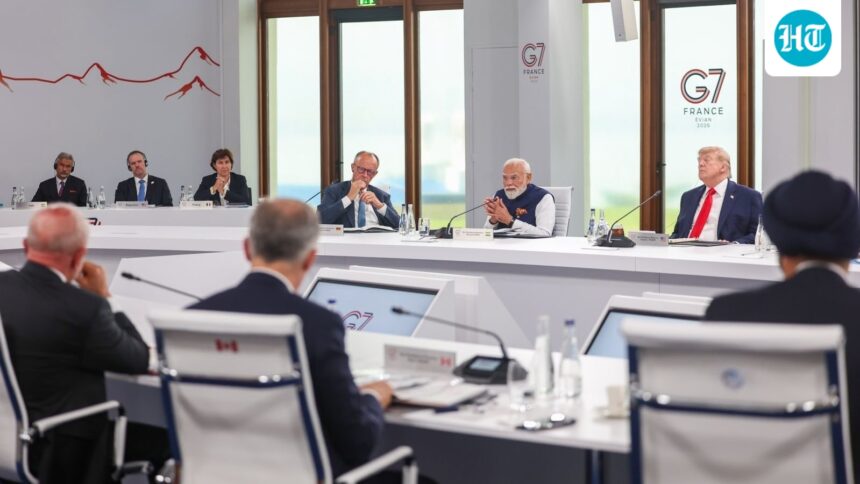
Modi made the remarks while addressing an outreach session of the G7 Summit at the French resort of Evian on the theme “Forging New Partnerships and Rebuilding International Solidarity.” India, along with Brazil, Egypt, Kenya and South Korea, was among the partner countries invited to attend the session, which was held two days after Iran and the United States agreed on a peace deal.
“The safety of seafarers, who connect all countries through global maritime trade, is our responsibility,” Modi said at the session, with Trump sitting right next to him. “We must ensure that sea lanes remain safe, and seafarers can do their work without fear.” “India is fully prepared to work with all partners on these issues.”
Welcoming the progress made in peace efforts in West Asia, Modi noted that the conflict had claimed the lives of “many Indian civilians” and led to loss of life and property in friendly countries in the region. He added that the disruption of maritime trade through the Strait of Hormuz also harmed the global economy.
While stressing the importance of partnerships based on trust and global solidarity in facing common challenges, Modi said: “India firmly believes that reaching a lasting solution to the ongoing tensions and wars in various parts of the world can only be achieved through dialogue, diplomacy and international cooperation.”
Modi’s comments came a day before a planned bilateral meeting with Trump on the sidelines of the G7 summit. The two leaders briefly exchanged pleasantries before the outreach session, their first in-person meeting since their meeting in Washington in February 2025.
Three Indian sailors were killed when the tanker MT Settebello was attacked by a US aircraft last week. The US Navy targeted three commercial ships carrying more than 65 Indian crew members near the coast of Oman on charges of trying to evade the US blockade, prompting the State Department to summon the top US diplomat in New Delhi twice for official protest. External Affairs Minister S Jaishankar also raised the issue during a phone call with his US counterpart Marco Rubio. However, there was no expression of regret from the United States, and Rubio stressed that the United States would not tolerate any violations of its blockade on Iran.
Thirteen Indians have been killed in West Asia since attacks by Israel and the United States on Iran on February 28 sparked the conflict.
Modi stressed the importance of trust in international partnerships in a world that is more interconnected and interconnected than before. He said that energy, food and health security, cybersecurity and economic prosperity are not limited by national borders, and mobility, data, capital and technology connect countries.
“In times like these, the importance of partnerships naturally increases. But partnerships only succeed when trust is at their core. Today, the most important strategic assets are not minerals, technologies or markets, but mutual trust,” Modi said. This includes not using technology and supply chains as “weapons,” he added.
Modi said that after the two world wars in the last century, the international community developed systems to move towards peace, stability and prosperity “on the basis of trust.” He added: “But the trust built over decades through the contributions of several generations is being eroded today. Covid has shown us how hollow claims of trust and solidarity are.” “The world today does not suffer from a lack of resources; it suffers from a lack of trust. The future of our partnership depends on building this trust.”
Modi cited former US President Ronald Reagan’s famous saying, “Trust but verify,” and said: “This remains relevant today. We have a responsibility to future generations to build a trustworthy, rules-based system fit for the new era.”
Although the Prime Minister did not mention any country by name, his statements came against the backdrop of unprecedented tensions that have characterized India-US relations over the past year, especially after Trump imposed 50% tariffs on Indian goods. The two countries are now working on a bilateral trade agreement to address issues such as tariffs, following an understanding reached in February.