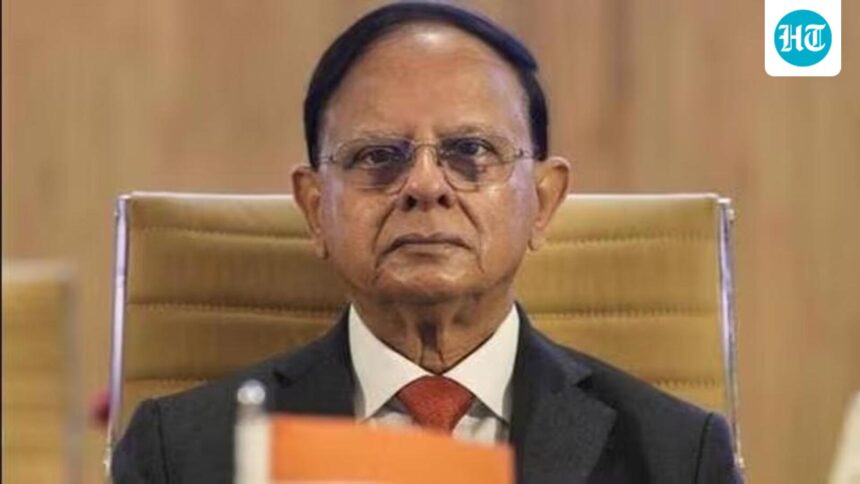
India must go beyond simply building resilience and create “anti-fragile” systems that emerge stronger from disruption and uncertainty, Principal Secretary to the Prime Minister BK Mishra said on Saturday, stressing that future development models must be designed to anticipate and adapt to increasingly complex risks.

Mishra said resilience should be understood not just as the ability to absorb shocks, but as the ability to anticipate, adapt and transform in response to change.
He said the emerging development paradigm requires a shift from “bouncing back” after disruptions to “bouncing forward,” where institutions and systems continually learn and improve.
He said: “The goal today is not only to recover, but to build stronger institutions, infrastructure and governance systems capable of managing future shocks and uncertainties.”
Speaking at the golden jubilee celebrations of the National Institute of Urban Affairs (NIUA), Mishra said the occasion was not only an opportunity to celebrate the institution’s 50-year journey but also a moment to reflect on India’s urban transformation and the path that lies ahead as the country works towards achieving the goal of Vixit Bharat by 2047.
He said that India today stands at an exceptional point in its development journey, which is characterized by rapid economic growth, infrastructure expansion, technological transformation and urbanization.
However, as societies become more interconnected and dynamic, the nature of risks and vulnerabilities is also evolving, with climate change, public health emergencies, technological disruptions, economic pressures and resource pressures increasingly interacting across systems and geographies.
He said that recent global experiences, including the COVID-19 pandemic, have shown that disruptions are no longer isolated or temporary events, and that they can flow quickly across sectors, institutions and economies.
Citing the Climate Risk Index 2026, Mishra said India recorded nearly 430 extreme weather events between 1995 and 2024, affecting about 1.3 billion people and causing economic losses of nearly $170 billion. Globally, more than 9,700 extreme weather events during the same period resulted in the deaths of more than 832,000 people and economic losses exceeding $4.5 trillion.
He added that as India’s urban population continues to grow, cities are increasingly at the forefront of climate risks such as heatwaves, floods, droughts, cyclones, sea level rise and infrastructure stress, disproportionately affecting vulnerable and low-income populations.
He said development must increasingly focus on creating systems that can learn, adapt and emerge stronger through disruption, moving toward what he described as anti-fragile systems. Such an approach requires stronger urban local bodies, systems-based governance, data-driven decision-making, and broader use of technologies such as artificial intelligence, geospatial systems, and predictive analytics.