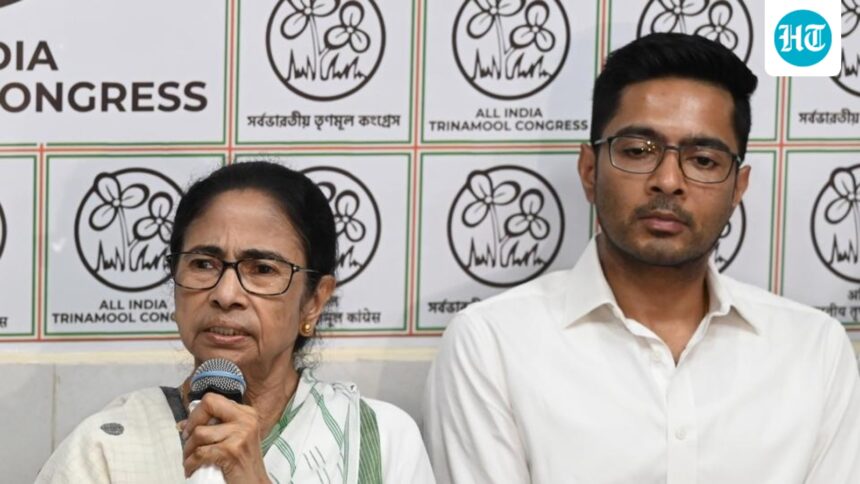
Two Trinamool Congress MPs, who are part of the rebels against the party, said they had signed a letter expressing support for a separate parliamentary party faction in the TMC, and also demanding the party symbol, adding that it had been sent to the Speaker.

The Speaker of Parliament’s office has not confirmed receipt of the letter, but Friday’s developments indicate momentum is building ahead of the TMC’s split, with the rebels succeeding in their efforts to be recognized as a military council, although that depends on them getting the required numbers. The TMC ruled West Bengal for 15 consecutive years until its defeat by the BJP in May.
The other scenario is more chaotic – resignations from the party, re-elections, and so on.
“Yes, I signed the letter and sent it to the Speaker long ago,” Kakoli Dastidar told HT.
Another TMC member, Jagadish Chandra Barma Basonia, added that the letter “makes it clear” that “we are the TMC in the Lok Sabha”.
Neither of them commented on the number of representatives who signed the letter. HT has not seen a copy of the letter.
The message fuels split speculation
According to people familiar with the matter, the letter was dated May 18 and signed by 19 representatives; Interestingly, the serial numbers of the two signatories are from 1 to 20, with no signature corresponding to the number 13, sparking speculation that the multi-term MP may be the 20th person to join the rebel group.
According to people familiar with the details, according to procedures, the Speaker will receive a call upon the request to identify the rebel group as the original TMC; Part of this involves meeting with them face to face. There are 28 TMC legislators in the Lok Sabha, including Abhishek Banerjee, the MP from Diamond Harbor who is also the party president and nephew of former Prime Minister Mamata Banerjee. He is in the range of the rebel group.
Read also: The message will be published if they have 20: Mahua Moitra challenges TMC rebels’ claim
“The Speaker’s decision will be announced after examining the letter, authenticity of signatures etc. So far, these MPs have only indicated that they want to be seen as a separate parliamentary group. There are no communications indicating their desire to merge with the BJP, although the rebel group’s leader, Kakoli Dastidar, has said they want to support the NDA,” said one of the people cited above, who requested anonymity.
The letter, according to the persons mentioned above, was signed by Kakoli Ghosh Dastidar; Satabdi Roy; Babi Haldar; Sharmila Sarkar; Prasoon Bandyopadhyay; Jagadish Parma Basonia; Asit Kumar Mal; Arup Chakraborty; Rachna Banerjee; Sayoni Ghosh; Khalil Rahman; Abu Tahir Khan, Yusuf Pathan; metal bag; mala roy; Kalipada Surin; Deepak Adhikari; John Mallya and Partha Bhowmick.
Those familiar with the TMC continued to stress that the rebel faction did not have 19 deputies.
Options for the rebellious representatives
If the group chooses to merge with the BJP, the rebels will not face disqualification as they will meet the criteria for a two-thirds merger of the party with another party. To escape the provisions of the anti-defection law, two-thirds of legislators must be part of the faction; Which amounts to 18.66 (rounded to 19). In the event that the faction claims to be the original party (as the Shiv Sena and Nationalist Congress Party splinter factions have successfully done), they will have to approach the Election Commission with proof of legislative majority.
TMC MP Mohua Mitra said in a post on Things were certainly not like that in the case of the Shiv Sena and the NCP.
In the Rajya Sabha, the number of TMC seats came down from 13 to 10 with the resignation of three MPs – Sukhendu Sekhar Rai, Sushmita Dave and Prakash Shek Barak. The BJP, which has a majority in the assembly, will win all three when the by-elections are announced.
The TMC’s defeat in the Assembly elections precipitated a revolt within the party as many leaders claimed that their views and proposals were ignored. Many blamed Abhishek Banerjee. Senior MP Kalyan Banerjee told the media that he had asked former Prime Minister and party chief Mamamta Banerjee to choose between him and Abhishek Banerjee.
The BJP, which is expected to benefit from the support of the rebel groups, has chosen to watch the situation from the sidelines. National general secretary Tarun Chugh, who was elected unopposed from Madhya Pradesh on Thursday, told the media that the “internal collapse” within the TMC was a result of the “sins” of party leaders.
“…The party leaders, who turned West Bengal into a hub of corruption and appeasement, are now facing the burden of their sins after being ousted by the people,” he said.
A second BJP official said the rebels were in touch with senior party leaders of their own volition. The rebels, led by Kakoli Dasgupta, met Union Minister Bhupinder Yadav at his residence in Delhi this week. Yadav was the state in-charge and is credited with overseeing the BJP’s electoral strategy which led to the party’s first ever victory in Bengal.
“The BJP fought and won the state assembly elections fairly and squarely. We did not want to break the TMC, the leaders approached us. They want to support the NDA and the nationalist ideology. It is up to them to decide whether they want to follow what Eknath Shinde (Shiv Sena) and late Ajit Pawar (NCP) did or whether they want to merge like AAP (Rajya Sabha members),” the leader said.
In April, 10 RJD legislators announced in the Rajya Sabha that they were “merging” with the BJP and conveyed this to the Senate president, CPM Radhakrishnan. Since two-thirds of the members resigned, they were not subject to disqualification under the anti-defection law, which stipulates that two-thirds of a party’s elected members must agree to merge with another party.
In 2022, Shinde led a group of rebels against party president and Prime Minister Uddhav Thackeray. The Election Commission recognized Shinde’s faction as the main party, giving it the symbol of a bow and arrow, while the other faction led by Thackeray was renamed the Shiv Sena (Uddhav Balasaheb Thackeray) with a burning torch as its symbol.
A year later, Ajit Pawar rebelled against his uncle and joined the NDA and was later allowed to keep the party’s name and symbol by the poll panel. The Sharad Pawar-led faction is now known as NCP-Sharadchandra Pawar and has been allotted a new symbol.
The second functionary admitted that there was some concern among BJP cadres in the state. “A section of party leaders are against merging the TMC rebels with the BJP and making them part of the Union government if they join the NDA.”
However, support from 19 Lok Sabha MPs will help the NDA pass key bills including the delimitation bill and the simultaneous elections bill.