1 year ago, Air India Flight 171 It fell from the sky just 30 seconds after takeoff, killing 241 of the 242 people on board and others on the ground. An HT reporter, who was among the first journalists to reach the scene, spent the afternoon at the Ahmedabad Civil Hospital – and met the man at Seat 11A. account:

I was in Gandhinagar on the morning of June 12, 2025, waiting outside the office of a senior government official for a meeting. His staff asked me to wait a few minutes. While I was waiting, a news alert appeared on my phone about a plane crash in Ahmedabad. My editor called and I told him I was headed to the scene. At that moment, the assistant official came out and said: “I can come in.” I apologized and rushed out.
Read also | Everything Was Normal, Until It Wasn’t: The Mystery of the 32-Second AI 171 Crash in Ahmedabad
When I left, I texted the administrator to explain why. He replied that he was watching it on TV.
I couldn’t understand it. My first assumption was that it must be a small plane, or there was some misunderstanding. While driving towards Ahmedabad, I made a few calls, and soon the misunderstanding I had hoped for was over. The Air India flight AI-171, a Boeing 787-8 Dreamliner, was bound for London Gatwick Airport. The flight landed at 1.38 pm, about half a minute after it took off from Sardar Vallabhbhai Patel International Airport. It was carrying 242 passengers and crew. Air India later confirmed that 169 of the 230 passengers were Indian nationals, 53 Britons, seven Portuguese and one Canadian.
The wing is under my feet
I reached the spot around 2.45 pm. The plane had crashed in Meghani Nagar, a densely populated residential neighborhood less than two kilometers from the airport runway. The area was crowded with police and security personnel, and thick smoke obscured vision.
She spotted a senior government official on site and approached him. He told me that, from what he was told, the plane first hit a tree before hitting a hostel building – the resident doctors’ hostel at PG Medical College, where many young doctors and medical workers live. When I asked him about the victims and survivors, he said that nothing was clear at that stage. I looked down and realized I was standing on one of the wings of the plane.
There was a buzz among journalists that former Gujarat Chief Minister Vijay Rupani was on board. I asked the official if he had heard the same thing. He said he did, but nothing was confirmed. I tried contacting Sailesh Mandelia, Rupani’s former CEO, but received no response.
I spoke to bystanders who witnessed the accident. A man who runs a courier office near the site said he initially thought it was a bomb explosion. It was not difficult to understand why, especially since a bomb exploded in the nearby civil hospital in July 2008.
The Dreamliner was carrying nearly 1,25,000 liters of fuel – enough for a ten-hour flight to London – when it went down. The resulting fireball was visible from several kilometers away. After speaking to a few people, the police began cordoning off the entire area. I saw a senior police official I knew; He was watching a video on someone’s phone while another officer tried to zoom in on it. He told me that the footage was confidential.
She later learned it was a teenager who shot her and showed the RAT — an air turbine, a small emergency propeller that is deployed to power the plane when it loses engine or electrical power — in the plane’s final seconds. Firefighters are working to put out the fire, while ambulances are moving in and out continuously.
Read also | One year after the Air India crash that killed 260 people: No cause, no closure
Menus on the wall
The Civil Hospital Ahmedabad – one of the largest public hospitals in Asia – had by then become the focal point of the city in the wake of the incident.
When I arrived, I was immediately struck by the smell. Hundreds of people gathered and there was no room to move. It was almost impossible to enter the morgue due to the large crowd.
The scale of what happened is beginning to settle down. It is feared that all 242 people on board were killed. The plane also crashed into the PJ Medical College mess at lunchtime, killing several people on the ground – doctors, nurses, resident staff, and people who had simply sat down to a meal. The sirens of ambulances and police vehicles drowned out the screams of those gathered outside.
Near the gate, a woman in her forties came running towards me, her husband beside her. They asked me if I knew where the injured were being held and where they could find a doctor. I tried to contact some doctors I know at the hospital but did not receive any response. I asked them to come with me and I took them to where patients were treated. A doctor there said there were no victims in that ward and directed them to the other side of the hospital. He added that a list of the names of the injured was hung on the walls outside the wards, and they should check it.
The couple scanned the menu. Then a doctor told them that if the name wasn’t there, they should try the morgue. Upon hearing this, the woman collapsed. She asked her husband who they were looking for. He said it was her sister who was on the London flight. When I saw her condition, I couldn’t bring myself to ask for more. I stopped myself from taking out my notebook.
I turned to leave that suite, and almost immediately, in the corridor, I ran into Sailesh Mandliya – Rupani’s former assistant, the man I’d been trying to reach all afternoon. As soon as he saw me, I told him I was trying to get to him. He didn’t say anything. I just collapsed, right there in the hallway. I didn’t need to ask for anything more.
Mandela composed himself after a moment and said he was going from ward to ward searching for the former prime minister. “If you find out something, let me know,” he said before walking off and disappearing into the crowd. There was nothing more to say. I felt like the answer was already written somewhere on those lists on the wall.
Rupani’s family confirmed his death later that evening, when BJP leaders, including Union Minister CR Patil, announced the news.
I climbed a few floors and reached the trauma ward. Inside, young trainees were treating patients. I asked if there were any accident victims. One of the doctors said yes, as everyone on the right side of the ward was a victim of the accident. I can spot three or four of them. I asked if they were on board. He said no; They were victims of the earth.
I spoke with a father whose daughter had multiple fractures. She was a nurse in the civil hospital and went to the hostel to have lunch with a friend and the doctor friend’s brother. She had jumped from the third floor at the moment of the collision and was injured. Her friend, who climbed the stairs, escaped unharmed. The Boeing had entered at a shallow angle, and the chaos that had occupied the lower floors of the lodge building bore the full force of the impact and the burning fuel that followed.
Federal Home Minister Amit Shah, who arrived in Ahmedabad that evening, said the temperatures generated by burning fuel left no chance of rescue inside the building and made identifying the bodies difficult.
In the next bed was an autorickshaw driver suffering from bone injuries and minor burns. He said that he had come to drop off passengers nearby and was heading towards the hostel when a massive explosion caused his vehicle to fall and he was injured.
On the bed next to him was a young man who seemed upset with the hospital administration and kept saying that the facilities needed to be improved. I asked the attending physician who he was. Another young trainee said he had been involved in a plane crash.
At this point, Ahmedabad Police Commissioner GS Malik – now the state’s Director General of Police – told the media that there was no chance of any survivors of the flight. There were two hundred and forty-two people on board A wide-body jet fully fueled, a ball of flame burning for hours: this was not an unreasonable statement.
Seat 11A
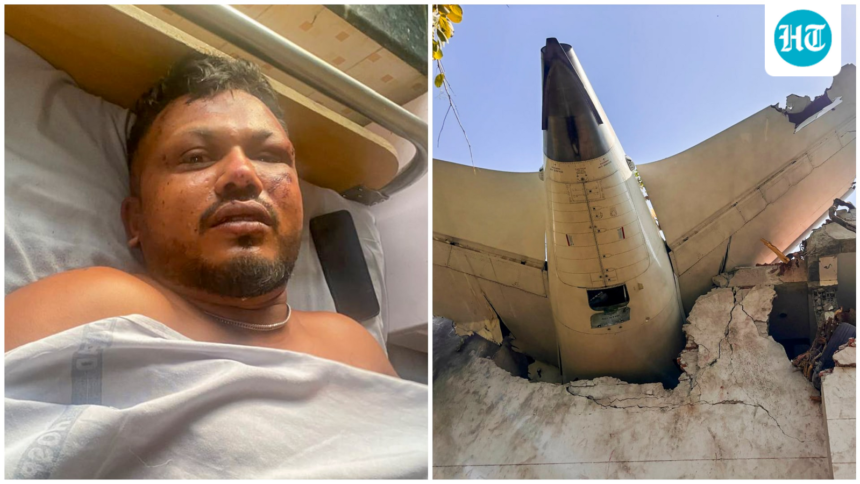
I asked the young man in front of me if he was on the plane. He nodded, then closed his eyes. He was wearing shorts, shirtless. I asked the doctor again to confirm. The man suffered minor physical injuries – injuries to his chest, eyes and feet – but was fit, the trainee said.
I introduced myself as a journalist and said I would like to talk to him. He looked at me and walked away. I started to leave. Then he called and asked if I had an iPhone charger. I carry a sling bag with a charger, books, pens, and documents. I gave it to him, and he asked me to put his phone in a safe place to charge it.
When I asked him if we could talk, he said his head was spinning and asked me to let him rest. I asked him how he managed to escape? He replied that he was on the plane, and that within about 30 seconds there was a loud noise and the plane crashed. He’s been fired. He closed his eyes again.
She gave him his phone back after it had been charged a bit. He made a call that appeared to be to his father – saying he was fine – and then I stopped trying to listen.
Shortly after, a young man and a woman came to meet him. They talked briefly and left hurriedly. I asked if they knew him. They said they were from Diu, that he was also from Diu, and that they were going to check on others from there.
On board were 15 people with roots in Diu, a Union Territory on the southern coast of Gujarat. Many members of her community settled in the UK were on board, returning home after visiting family in India.
I called my editor and told him I may have met a survivor, but wasn’t sure yet, and would update as soon as I learned more.
Then the man lying in front of me looked again and asked to borrow the charger again. I told him to go ahead, but I reminded him that I had work to do. I placed the phone behind him on an empty bed with a charging point. He asked me to make sure no one took it. I said no need to worry. Then he asked me what I wanted to know and where I came from.
He told me again what he remembered. Thirty seconds after take-off, a loud noise was heard and the plane crashed. The next thing he knew, he was outside, with pieces of the plane and bodies around him.
He stood up in fear and ran until someone caught him and put him in the ambulance to the hospital. He was sitting in 11A – emergency exit row. Police Commissioner Malik later confirmed to the media that the survivor was in seat 11A.
When the doctors came to examine him, they asked him to empty his pockets. He took out his wallet. Then he removed his boarding pass. That’s when I knew for sure.
His name was Vishwash Kumar Ramesh, 40, a British citizen who had lived in London for nearly two decades. Originally from Diu, his wife and child also lived in London.
He pointed to his passport, which was also in his pocket. I asked him if I could photograph my plane ticket, and he agreed. Then I asked him if I could take a picture of him, and he nodded.
For a brief moment, it reminded me of the movie M. Night Shyamalan’s “Unbreakable” — the idea of one man escaping such a disaster — but the idea didn’t stick.
Vishwash then asked me if I would check the other rooms in the hospital for more survivors. I said I would. “Please find my brother, Ajay Kumar Ramesh. He was with me. We visited Diu together and were returning to the UK. He was traveling with me and I don’t know where he is. Please find him. I am waiting here,” he said.
He said that Ajay was sitting in a different row from Vishwash when the plane went down.
He kept his eyes closed as he spoke, each pause stretching under the weight of what he had experienced—as if keeping them open was the only thing holding the moment together, and closing them might cause it to collapse again.
I sent the editors pictures of the boarding pass and of Ramesh, and started saving the story from my phone. Sixth, Shawash kept saying: “Please look for my brother. I am here.”
Shortly after, Commissioner Malik confirmed to the media that there was one survivor. One out of 242.
I wanted to go back and tell Ramesh how lucky he was, but that also meant telling him that his brother didn’t make it. The accident killed all 241 people on board the plane. He killed people on the ground who were simply eating lunch. She thought the woman looking for her sister would be devastated by now. I couldn’t find the courage to go back and say any of that.
So I went outside the hospital campus. In the noise and sadness that is just beginning to take shape. I didn’t want to go back again.