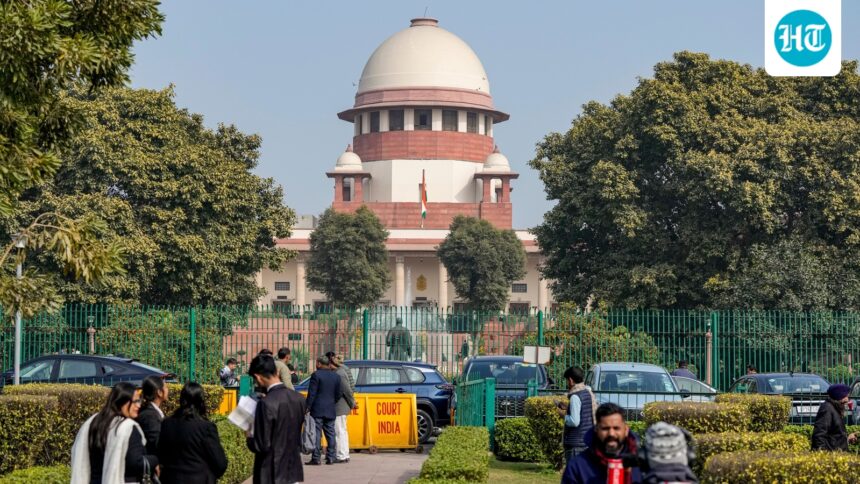
The Supreme Court stressed that a person loses the benefit of the presumption of innocence once convicted by a court of law, and cautioned appellate courts against reevaluating the evidence and suspending life sentences unless there are convincing indications that the conviction may not ultimately stand up to scrutiny.

A bench of Justices JP Pardiwala and KV Viswanathan made this observation while quashing the orders of the Allahabad High Court that stayed the life imprisonment sentences of three convicts in the 2017 murder of Meerut municipal councilor Arif and his accomplice Shadab.
“Once the accused is convicted, the presumption of innocence no longer exists,” the bench held in a recent order, emphasizing that this principle should guide appellate courts while considering applications for suspension of judgment and release on bail pending appeal.
The ruling was based on the appeals filed by the complainant Amer against separate orders of the Supreme Court granting bail to the convicts Shakib, Shariq and Kashif.
The ruling is significant because it rewrites the law governing suspension of punishment after conviction, particularly for serious crimes that carry a life sentence.
When a person convicted of murder requests suspension of sentence pending appeal, the Court of Appeal’s investigation is limited, the court said. The court must consider whether there is something “serious” or “highly appreciable” about the conviction that makes it prima facie clear that the convict has a fair chance of acquittal.
“It is the well-established position of law that where a person convicted of murder and sentenced to life imprisonment applies for suspension of the substantive order of life imprisonment and release on bail pending criminal appeal, the relevant consideration at the end of the Court of Appeal should be to see whether there is anything serious or something very concrete on the basis of which the Court of Appeal is more than prima facie satisfied that there are more than fair chances of acquitting the convict.” I noticed.
The bench stressed that appellate courts should normally remain “dismissive and cautious” while dealing with such applications. “The Court of Appeal should not normally re-evaluate the evidence and try to discover some gap here or there in the evidence,” she added.
These observations came as the court considered the reasons for the Supreme Court’s decision to grant bail to the convicts. The Supreme Court found, prima facie, the argument that there was a conflict between the eyewitness accounts and the medical evidence regarding the injuries sustained by the two deceased persons. It also expressed doubts about the applicability of Section 149 of the Indian Penal Code on the basis that the nature of the injuries suggested that only one weapon might have been used.
But the Supreme Court found this approach legally unsustainable. Referring to the doctrine of unlawful assembly, the bench said that once Section 149 of the IPC is activated, the prosecution is not required to attribute a specific overt act to each accused.
“Once the accused is a member of the unlawful assembly and his presence in the unlawful assembly is proven, there is no need for there to be any overt action on his part,” he noted.
The bench noted that the Supreme Court had actually engaged in an assessment of the evidence that was appropriate to be taken into account at the final hearing of criminal appeals and not at the stage of deciding whether or not the convicted person should be kept in custody.
Without expressing any final opinion on the merits of the appeal, the Supreme Court said that it was not convinced of the reasons set by the Supreme Court for releasing the convicts on bail.
The court was dealing with the murder case of Arif, a member of the municipal council in Meerut, and his friend Shadab, who were shot dead on July 9, 2017 in Meerut. According to the prosecution, the murders were carried out because both men were key witnesses in the 2016 murder case of a transgender person.