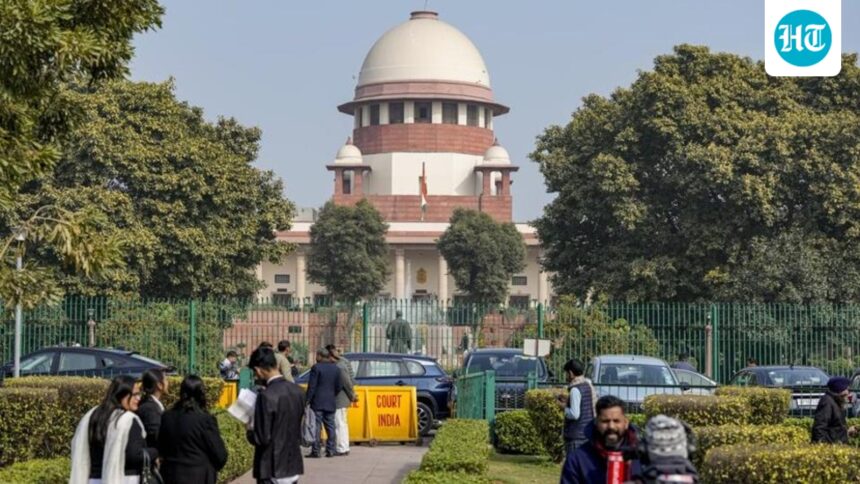
The Supreme Court held that where provisions of the Insolvency and Bankruptcy Code (IBC) conflict with the Supreme Court Rules (SCR), the IBC must prevail, stressing that procedural rules cannot be used to relax the strict timelines set by Parliament for insolvency proceedings.

A bench of Justices Dipankar Datta and Satish Chandra Sharma ruled that litigants cannot circumvent the strict limitations regime under the IBC by filing defective appeals merely to save the limitations and then remedy the defects at their convenience. The court considered that the insolvency law is “a complete law in itself,” and rejected the appeal filed by the liquidator after the passage of time, after finding delays in filing and re-filing the case.
“The SCR is the secondary legislation in this area, and when the IBC and the SCR conflict, the latter cannot override the express provisions of the former. The IBC being the statutory decree must prevail,” the jury held in a ruling released on Monday.
The ruling came in an appeal filed by a liquidator challenging the order of the National Company Law Appellate Tribunal (NCLAT). The appeal to the same Supreme Court was filed after the specified time, and was also accompanied by a significant delay in redressing the defects pointed out by the record. The Court was asked to decide whether such delays in resubmission could be condoned by resorting to the more flexible approach generally adopted under the High Court Rules.
The bench rejected this contention and said that an appeal under Section 62 of the IBC should be treated as validly filed only when it is filed in a flawless and actionable form by the registry. The court said that a defective appeal remains defective for all practical and legal purposes and cannot be used as a means of preserving the statute of limitations.
Court warning
The court warned that allowing litigants to remedy defects long after the stipulated period would be contrary to the very objective of the IBC, which was enacted to ensure speed and finality in insolvency proceedings. It noted that allowing such a practice would enable parties to delay resubmission for several months while still seeking leniency on the basis that procedural rules should promote substantive fairness.
Accordingly, the bench held that once the statutory period of 45 days for filing an appeal, the additional 15-day condonation period under Section 62 of the IBC, and the 28-day period available for curing defects under the Supreme Court Rules are exhausted, the right to appeal lapses.
Explaining the rationale, the court said that while courts typically adopt a more liberal approach to re-filing of delay applications than to the filing of delay applications in civil and criminal matters, the same principle cannot apply to insolvency claims because the IBC provides for a special, self-contained framework of limitations. “Section 62 of the IBC is a complete code in itself for filing appeals and is different from other laws,” the ruling said.
The bench also refused to invoke its extraordinary powers under Article 142 of the Constitution simply because the appellant was a court-appointed liquidator acting in the interests of stakeholders. It held that the IBC did not impose a different standard for these officials and the courts could not read into statutory exceptions that Parliament had not contemplated.
While appearing before the liquidator, senior advocate Sunil Fernandes said that the appellant was an impartial employee working under the auspices of the Supreme Court for the benefit of all stakeholders and the debtor company under liquidation. He emphasized that the delay was minimal and should be viewed liberally, especially since courts traditionally treat resubmission delays more leniently than delays in initial filing. He further asserted that the power of the Supreme Court to condone delay in resubmission of an application is not restricted by any external limit and that once sufficient reason is given, even a long delay can be condoned. Fernandes also relied on an earlier decision of the Supreme Court relating to the same parties where delay in refiling the appeal under the IBC was condoned in the interest of justice.