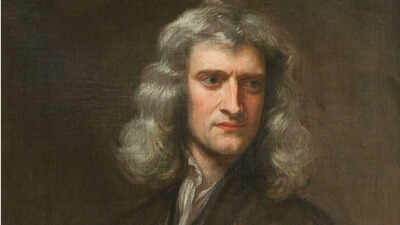
Isaac Newton (Image: Wikipedia)
Most people know Isaac Newton as the man associated with the story of the falling apple, although historians still debate how much of this tale is true and how much belongs to legend. What is indisputable is that Newton spent a large part of his life trying to answer a question that continues to challenge humanity today: How do we know whether something is actually true?This question lies quietly behind one of his lesser-known sayings: “A man may imagine false things, but he can only understand true things.”The sentence is deceptively simple. It does not contain complex scientific language or mathematical formulas. However, the more one thought about it, the more important it seemed. Newton was pointing out a fundamental difference in the way the human mind works. We can invent almost anything in our imagination. But understanding is another matter entirely. Understanding has rules. And it finally turns into reality.
Today’s quote by Isaac Newton
“A person may imagine false things, but he can only understand true things.”
The mind is a wonderful storyteller
Humans have always been storytellers.Long before satellites photographed Earth from space, people imagined what lay beyond the distant horizons. Before scientists understood lightning, many cultures explained it through myths and supernatural forces. Before modern medicine, diseases were blamed on causes that today seem strange or even ridiculous.These ideas were not created because people were fools. They were attempts to understand a world that still holds many mysteries.
Imagination is incredibly powerful. It helps people dream about the future, create art, invent technology and solve problems. Without imagination, there would be no novels, no great paintings, and no scientific achievements.But imagination comes with the catch. It doesn’t matter whether the idea is correct.Anyone can imagine a treatment that doesn’t work. An investor can imagine business success that never materializes.
A politician can imagine the policy will succeed despite evidence to the contrary. Being able to imagine something does not make it real.Here Newton drew the line.
Reality has a vote
One reason scientific discoveries are important is that they must stay in touch with reality.An engineer can draw a bridge on paper, but the bridge must ultimately support weight. A scientist can develop a theory, but experiments must support it. The pilot may believe that the aircraft design will work, but the final judgment comes when the machine leaves the ground.Reality has a habit of exposing weaknesses in assumptions.Newton understood this better than anyone else. He lived during a period when science was changing the way people viewed the world. Instead of accepting explanations simply because they seem convincing, he looked for evidence. Observation is important. Testing is important. Evidence is important.This approach helped change human knowledge in ways that are still being felt centuries later.His quote reflects the same mentality. Ideas abound. The truth is more demanding.
Why does Newton’s quote seem surprisingly modern?
Although Newton lived in the 17th century, his words seem strangely appropriate for the 21st century.Every day, people face thousands of claims online. Some are accurate. Some of them are misleading. Others are completely fabricated. Information travels extraordinarily quickly, often reaching millions of people before anyone can verify its authenticity.Social media has made imagination faster than ever.A rumor can become a headline. Guess can be presented as certainty. An opinion can spread widely despite little evidence to support it.In such an environment, Newton’s observation sounds less like a historical quotation and more like practical advice.It encourages pausing before accepting something as truth. It reminds people that believing a claim and understanding it are not necessarily the same thing.
The uncomfortable side of the truth
There’s another reason why this quote persists.The truth is not always comfortable.People naturally prefer information that confirms existing beliefs. Psychologists have spent decades studying this trend. We often gravitate toward evidence that supports our views and are less enthusiastic about evidence that challenges those views.History is full of examples.Many once believed that the Earth was located at the center of the universe.
Others were convinced that some diseases had supernatural causes. Time and again, widely accepted ideas have collapsed when faced with better evidence.This process may be uncomfortable. No one enjoys discovering that a long-held belief is wrong.However, progress depends on that desire.The growth of knowledge requires people to follow clues even when they lead somewhere unexpected.
More than one lesson about science
It would be easy to treat Newton’s quote as a statement about laboratories and experiments.
In fact, this applies to ordinary life just as much.Consider personal relationships. People often assume they know why someone behaves a certain way. They create explanations in their minds, fill in missing details and reach conclusions based on limited information.Sometimes these conclusions are correct. Sometimes they are not.The same pattern appears in workplaces, companies, and everyday decisions. People imagine outcomes, motives, and possibilities.
Sometimes, these assumptions match reality. Sometimes, they don’t.Understanding requires something more than assumption. It requires evidence, experience, and a willingness to revise opinions as new facts emerge.This principle is as useful at the dinner table as it is in the research laboratory.
Why is Isaac Newton’s quote still important?
Many famous quotes have survived because they seem clever. Newton’s words persist for a different reason.
They describe something people encounter over and over again throughout their lives.The gap between imagination and understanding never goes away.Children experience it. Scientists experiment with it. Business leaders are experiencing this. Entire communities suffer from it. Humans are constantly moving between what they think may be true and what can actually be proven.The process is rarely clean. Mistakes happen. Assumptions fail.
Expectations collide with reality.However, this is how knowledge grows.
Final thoughts on Isaac Newton
Isaac Newton spent his life studying the natural world, but this quote speaks just as much about human nature. The mind can wander almost anywhere. He can invent stories, possibilities and interpretations without limits. This freedom is one of humanity’s greatest strengths.At the same time, true understanding asks something more of us. It asks us to test ideas, question assumptions, and pay attention to evidence even when it challenges our preferences.Centuries have passed since Newton’s life, but the challenge he alluded to has not changed. People still imagine false things. They always will. The more difficult task is to recognize which ideas can survive contact with reality. This is where understanding begins, which is why this short sentence continues to have an impact long after the man who uttered it is gone.