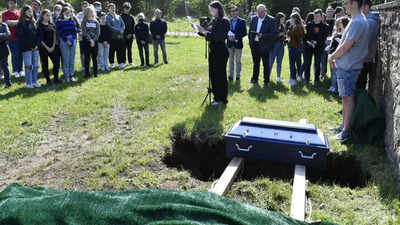
A coffin carrying the remains of a woman whose name no one knew was lowered into the ground in western Germany in 2022. Students, teachers and locals stood around it to pay their respects.
For decades, the woman has been part of the school’s biology class, helping generations of pupils learn anatomy. Most knew her only as a skeleton hanging in the corner of the room. The students then discovered that the teaching tool was not a replica, but the remains of a real person, likely from India. Their attempt to understand who led them into a forgotten global trade that once supplied classrooms around the world with human skeletons.
The forgotten journey from India to the German classroom
At the Johannes Stormius Gymnasium in Schleiden, Germany, the skeleton has been part of school life for decades. Generations of pupils have learned anatomy from him, and rarely give much thought to where it came from.That changed when students started looking into its history. The skeleton was not a plastic replica, but the preserved remains of an individual, and the trail eventually led them to a largely forgotten chapter of educational history.
Before plastic models became widespread, schools and universities relied heavily on real skeletons to teach. Throughout the nineteenth century and most of the twentieth, India emerged as one of the world’s largest exporters of anatomical specimens. Workshops, especially around Kolkata, prepared and shipped skeletons to institutions throughout Europe and North America.Demand has grown along with medical education. But records didn’t do that often.
Many specimens arrived with little documentation, making it difficult to identify the people behind them decades later.India’s emergence as the world’s largest exporter of human skeletons was closely linked to the era of British colonialism. Demand for anatomical specimens was rising across Europe as medical education expanded and universities searched for authentic human remains to teach. Even after the British Anatomy Act of 1832 allowed medical schools to use unclaimed cadavers, demand continued to exceed supply.
Colonial India gradually became part of this system, with the city of Kolkata developing into a major center for preparing and exporting skeletons to universities, hospitals and schools throughout Europe and North America.
At its peak, this trade reportedly supplied tens of thousands of skeletons each year.Many of these skeletons came from unclaimed bodies, cremation grounds and cemeteries, especially in eastern India. Historical accounts describe networks of bone dealers, middlemen, and workshop operators who collected remains and prepared them for export.
The people themselves did not die for the skeleton trade. Most died of ordinary causes, often in poor or marginalized communities where bodies were vulnerable to being stolen without clear consent or documentation.
While medical institutions searched for authentic anatomical specimens and oversight remained weak, Indian skeletons became a common sight in classrooms and laboratories around the world.
This trade continued until India banned the export of human remains in 1985.Researchers who investigated the school’s skeleton concluded that it most likely originated in India, linking a quiet German classroom to a global trade that once operated on a large scale.
When a biology lesson became a moral issue
Learning about the skeleton’s possible origins changed the conversation within the school.Students found themselves discussing questions that extended beyond anatomy. Should human remains continue to be displayed when so little is known about their history?The school community eventually decided that the remains deserved burial.
Teachers, students, and locals gathered together for a ceremony that marked the end of the skeleton’s role as a class specimen.The event attracted attention across Germany because it touched on a question that goes beyond science: How should societies deal with the dead when history has forgotten their names?
The legacy of a vanished industry
Long after this trade disappeared, its products remained spread throughout the world. Thousands of specimens remain in classrooms, laboratories and museum collections, often with little information about their former identity.For historians, these skeletons offer a glimpse into how medical education functioned before the arrival of modern teaching models. For others, it raises difficult questions about consent, ownership and treatment of human remains. Many institutions are now re-examining collections amassed decades ago, trying to understand where specimens came from, and whether they should be returned, reburied, or preserved.The skeleton found in Schleiden was one of many that survived long after the trade itself had disappeared. What made it unusual was that a group of students decided to investigate her past.
The debate goes beyond one school
The questions raised in Schleiden are being asked in museums, universities and research institutions around the world.Many collections contain human remains obtained generations ago under conditions that are not always fully understood.
Researchers continue to investigate questions of consent, provenance and ownership, while advances in DNA analysis sometimes help recover pieces of lost history.For the public, these debates reach far beyond academic circles. It addresses memory, dignity, and the lasting consequences of colonial-era practices that moved people and things across continents.The Schleiden case has become part of a much larger debate about how institutions handle human remains in the 21st century.
What happens when the lesson changes?
Modern classrooms increasingly rely on artificial models, digital imaging, and interactive software to teach anatomy. Future students may never encounter a real skeleton hanging next to the blackboard.However, the questions raised by German students are unlikely to disappear. Scientific education is often based on physical evidence, but every specimen has a history. Sometimes this history is carefully documented.
Sometimes they are lost and buried under decades of routine use.The students’ decision showed that learning does not end with facts and graphs. It can also include examining the moral choices that accompany knowledge itself.
The person standing behind Bones
The burial did not reveal the woman’s name or explain exactly how her remains moved from India to Germany. Much of her story may never be recovered.However, the students achieved something meaningful. Their investigation restored a measure of dignity to someone who had spent decades known only as a specimen.The irony is striking. A skeleton that had been used for years to teach anatomy ended up teaching something completely different. The most lasting lesson was not about bones, joints, or the structure of the human body. It was about recognizing the humanity of someone who had been reduced to a specimen so long ago.