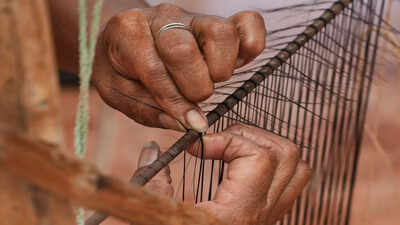
In her modest home in Guangopolo, east of Ecuador’s capital, Ligia Ipiales carefully separates strands of horsetail, weaving a fine mesh like the gauze from which she makes sidazo, a traditional sieve that clings to survival.The craft that made the village famous is now fading away. There are only nine cedacero craftsmen left. The youngest is Guido Pocar, 51, the only man in the group, while the eldest is Ipiales, 76.“This is the identity of our village,” Bukar said. “If it disappears, Gwangopulu will lose part of its identity.” “We are the last generation to make these sieves.”Fifty years ago, Baukar recalls, about 500 indigenous families made a living by making and selling sieves, transporting up to 600 units each month, at prices ranging from $6 to $30 depending on size.
But the advent of plastic sieves and cheap synthetic fabrics has meant that sieves have turned into a display of handicrafts that do not exist in everyday life. “Now we only sell up to 10 each week,” he added.Local records show that 1,500 Gwangopulu residents have been weaving sieves for 200 years. Designed in the shape of a drum, each sieve features a thin 15cm (6″) wooden rim to secure traditional ponytail weaving.
Until the turn of the last century, the tools were indispensable in Ecuadorian kitchens, where they were used primarily for sifting flour.Industrial growth and environmental shifts have made it more difficult to obtain horsehair and the wood of the indigenous Pomamaki tree.Until recently, horses were indispensable companions to agricultural work in the Andean fields. Today, farmers prefer motorcycles and tractors.
This shift forced artisans to look elsewhere, making southern Colombia and central Ecuador the main sources of horsehair. But this material comes at a high price, with 100 pounds (about 45 kilograms) costing about $1,000.After being washed and dried, the horsehair is sorted by length and stretched over a simple wooden frame known as a guanga. The artisans sit cross-legged on the floor, working so quickly that their fingers sweep, pick, stretch and knot individual threads into an intricate web.Making sidazu once provided women with additional income and sometimes helped pay for their children’s education.At the El Sidachero handicraft center, home to the remaining weavers of Guangopolo, efforts to train a new generation through workshops and classes have repeatedly failed.“From the age of six or seven, our mothers taught us how to weave sieves,” said Leonor Coji, 57, as he pointed to a table lined with sieves, bracelets and brushes made of horsehair. “Now they’re professionals and they don’t want to do it anymore.”