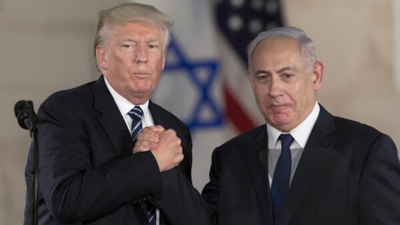
Donald Trump and Benjamin Netanyahu (Photo-AP)
TOI correspondent from WashingtonUS President Donald Trump is once again seeking to preserve a fragile ceasefire between Israel and Iran, insisting that a broader peace deal is within reach even as renewed missile exchanges, mutual threats, and deep mistrust continue to push the Middle East toward another dangerous escalation, leading to global frustration.The latest escalation over the weekend represents the most serious collapse of the US-brokered ceasefire that took effect in April. Israeli strikes on Hezbollah-linked targets in Lebanon quickly expanded into attacks on Iranian assets, including a major petrochemical facility, prompting Tehran to fire ballistic missiles at Israel and threaten further retaliation. Although the two sides stopped major operations on Monday, they did not provide guarantees that the truce would continue.Trump sought to project confidence, declaring on social media that “Both sides, Israel and Iran, look forward to an immediate ceasefire! Final negotiations on ‘peace’ are ongoing, subject to ignorance or stupidity getting in the way. The blockade will remain in place, in full force and effect, until a ‘final agreement’ is reached. Things must move quickly.”However, the president’s optimistic rhetoric increasingly contradicts the reality on the ground.
More than two weeks after Trump announced that a breakthrough deal with Iran would be unveiled “soon,” negotiations remain at a standstill, while military exchanges continue across the region.The main obstacle remains the vast gap between Washington and Tehran. Iranian officials reportedly want to release billions of dollars in frozen assets as part of any arrangement that would reopen the Strait of Hormuz and resume talks on Tehran’s nuclear program.
American negotiators resisted these demands amid fierce opposition from Republican hawks and pro-Israel conservatives.The political problem Trump faces is particularly acute because any agreement that includes easing sanctions or freezing Iranian funds risks drawing comparisons to the 2015 nuclear deal negotiated by former President Barack Obama, formally known as the Joint Comprehensive Plan of Action (JCPOA).
Trump based much of his foreign policy approaches on condemning this agreement as a surrender to Tehran before the United States withdrew from it in 2018.
Any deal that appears to resemble Obama’s framework would expose him to accusations of hypocrisy from allies and critics alike.These concerns have already surfaced publicly amid the ongoing mockery of the “taco” — Trump always gets the chicken out. Former Secretary of State Mike Pompeo reportedly compared leaked elements of the proposed agreement to the Obama-era nuclear deal, sparking an unusually sharp reaction from the White House, whose communications director, Stephen Cheung, said Pompeo “has no idea what he’s talking about.” In between all this, the president spent an inordinate amount of time talking about his favorite civic projects, including building a White House ballroom, resurfacing a reflecting pool in front of the Lincoln Memorial, and restoring fountains throughout the capital. On Monday, he is scheduled to attend Game 3 of the NBA Finals in New York City, days before the cage fight he will host in front of the White House on his 80th birthday next week.
Israeli Prime Minister Benjamin Netanyahu and other Iran hawks remain deeply skeptical of Trump’s approach. Their concern is that the president, eager to achieve a diplomatic victory and avoid a protracted military confrontation, might merely impose restrictions on Iran’s nuclear program while leaving much of Tehran’s missile infrastructure and regional proxy network intact.Trump’s governing style reinforces these doubts.
Throughout his political career, the president has demonstrated a preference for headline-grabbing ads over lengthy technical negotiations and fine print. His comrades often described his impatience with the arduous diplomatic processes, which he often described as “boring” or unnecessarily protracted. However, the Iran case is proving resistant to quick solutions. Unlike trade deals, arms control agreements require painstaking verification mechanisms, inspection regimes, and a complex sequence of sanctions relief and compliance measures.
These details are exactly where negotiations got stuck.At the same time, neither side trusts the other. Iranian leaders remain convinced that Washington could abandon any agreement, just as Trump abandoned the Obama nuclear agreement. For their part, US officials wonder whether Tehran will fully comply with inspection requirements or restrictions on uranium enrichment. The result is a stalemate that is broken by periodic military escalations.