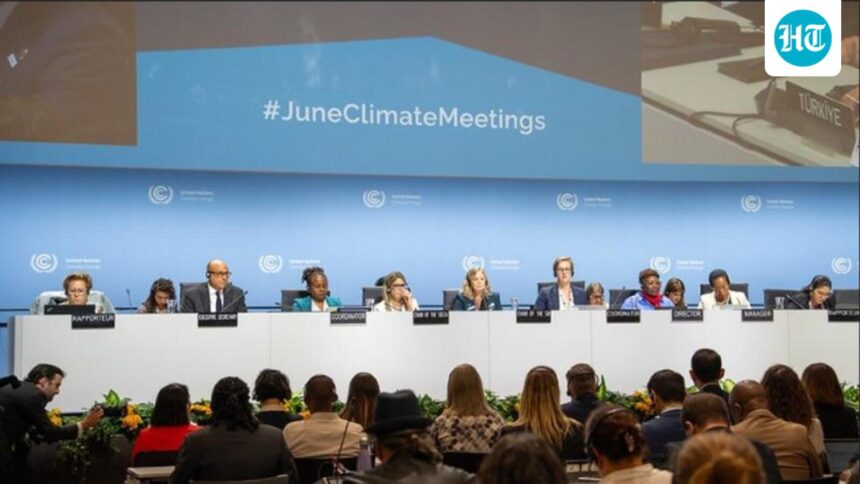
The June climate meetings began in Bonn on Monday amid major global disruption – a fuel crisis caused by the Iran-US conflict, and the approaching El Niño phenomenon that is expected to cause extreme weather in several parts of Asia.

The June meetings serve as a midway point to discuss key climate issues ahead of the annual climate conference (COP31) scheduled to be held in Antalya, Turkey, next November.
One of the main issues on the agenda is how to achieve the first results of the global assessment. Following the first global assessment in Dubai, countries agreed on three key issues, among others.
The UAE Consensus called on parties to triple global renewable energy capacity and double the global annual rate of energy efficiency improvement by 2030. relentlessly accelerate efforts to phase down coal power; Transition away from fossil fuels in energy systems, in a fair, orderly and equitable way, and accelerate action in this critical decade, to achieve net zero by 2050 in line with the latest climate science.
The Bonn Conference is expected to discuss the implementation of this agreement. They are also expected to discuss developing a fair transition mechanism to assist countries in the energy transition and, most importantly, to discuss climate financing for adaptation efforts.
The union environment ministry delegation, which will represent India, is attending the sessions virtually, according to people familiar with the matter. However, some representatives of other departments are attending in person, they said.
Some of the key issues for India are the global adaptation target, Belem adaptation indicators, and financing for adaptation.
Simon Steele, UN climate director, called on countries to redouble their climate efforts amid the economic instability caused by the climate crisis and conflicts.
In his opening remarks, he said: “Tackling the global climate crisis is the hardest thing humanity has ever tried to do together, but it is the most important thing humanity has ever tried to do. It is worth doing, because we have no choice. Every economy and population depends on it. All of you here have chosen to devote yourselves to this task. It is never easy. It is thankless at times. But together, you have navigated negotiations, overcome past setbacks, and found ways for countries that disagree on almost everything to come to an agreement.”
“As the effects of El Niño – reinforced by the climate crisis – promise more pain and inflationary shocks. And as war in the Middle East causes massive human suffering and ignites a fossil fuel cost crisis that is choking economies everywhere. It is abundantly clear: our continued dependence on fossil fuels means continuing to import inflation and economic instability, while exporting energy security, sovereignty and policy independence, leaving economies and societies vulnerable to climate catastrophes, devastating life and prosperity everywhere,” Steele noted as he He urged the countries to fulfill their Paris commitments and plans established under the agreement.
Coinciding with the opening of the Bonn meetings, a new study by the Council on Energy, Environment and Water (CEEW) said that three major climate negotiating groups – the Umbrella Group, the European Union, and the Environmental Integrity Group – made up mostly of developed countries – are collectively expected to fail to meet their 2030 and 2035 climate targets.
“These groups’ emissions are expected to be 9% above their 2030 NDC targets, and this is expected to rise to 19% in 2035 compared to their 2035 target levels,” the study said.
In January, the United States, the world’s historically largest polluter, completely withdrew from global climate change mitigation agreements, including the United Nations Framework Convention on Climate Change (UNFCCC) and the Intergovernmental Panel on Climate Change.
It also means that the United States will not do its fair share in mitigating climate change or in providing climate financing to developing countries for energy transition, mitigation, and adaptation.
In contrast, most countries in the core group, including South Africa, India, and China, are more aligned with their 2030 commitments, despite lower historical responsibility and greater development constraints.
The analysis is based on reports submitted by countries to the UNFCCC, including biennial transparency reports, datasets with a common tabular format, and common reporting tables.
“Ten years after the Paris Agreement, the world cannot continue to measure climate leadership by declarations alone. Implementation remains the ultimate test. South Asia and the broader Global South are showing that development and climate action can move together, but this requires fairness in how ambition is judged and support is delivered. We are confident that this will be the case,” Ravi S. Prasad, a distinguished fellow at CEEW, CEEW, and former chief climate change negotiator for India, said in a statement.
The Climate Action Network, a coalition of civil society organisations, set out its forecasts in Bonn on Monday. Developed countries should signal their commitment to at least triple adaptation financing by 2035, primarily through public grant-based financing, and agree on an implementation plan, they said.
China on behalf of the Like-Minded Developing Countries (LMDC) made it clear that the means of implementation or climate financing and the treatment of protectionist policies by some countries will be key for developing countries at the Bonn meeting and at COP31. LMDC is a group of developing countries including India who organize themselves as a bloc of negotiators in international organisations.
“The lack of ambition among our partners regarding mitigation and means of implementation and addressing the new challenges of unilateralism and protectionism. This poses barriers to our collective efforts and international cooperation in the second decade of the Paris Agreement. We have seen signals from our partners regarding means of implementation and highlighted the need to urgently close the financial gap,” China noted on behalf of the LMDC in the plenary session.
“The current replenishment of GEF resources is the lowest in the past 16 years. We are also hearing about some partners backing away from side contributions to the Green Climate Fund. We look forward to a meaningful discussion within the framework of the climate dialogue,” he said.
China also noted that the Climate Finance Action Program and the Climate Dialogue and Trade must be deliberately designed to achieve meaningful engagement and tangible outcomes.
The official representing the LMDC said: “Our main task here is to maintain the momentum of unity, solidarity and cooperation in tackling climate change. In this context, it is important to know the difference between consensus-based processes under the Convention and the Paris Agreement and initiatives outside this process. Global collective action and international cooperation should be agreed upon through consensus-based negotiations. Ensuring inclusiveness initiatives outside the Convention process should remain voluntary in nature.”
Experts said it may be a reference to the first international conference on the transition from fossil fuels (Santa Marta Conference) held from April 24 to 29 in Colombia.
Furthermore, work must begin to reach a COP31 resolution that will trigger the Just Transition Mechanism (JTM), among other things.
“Adaptation is about people’s rights and justice. Communities facing the harshest climate impacts, even though they contribute the least to the crisis, must have access to the financing and support needed to survive, rebuild lives and live in dignity. They must also have a real role in shaping decisions that affect their future. Adaptation is no longer a side issue in climate talks. Floods, droughts, heat waves, hunger and displacement are already destroying people’s lives, homes, livelihoods and entire communities. A. “An adaptation target cannot be just a political promise on paper, but must urgently provide real protection for people living on the front lines of the climate crisis,” Pooja Dev, adaptation policy coordinator at Climate Action International, said in a statement.
“Fossil extraction will also be discussed at the Bonn climate talks. For workers, indigenous peoples and communities on the front lines of fossil fuel extraction and climate change, the transition away from fossil fuels is not an abstract political debate. It is about jobs, health, energy and economic survival. In SB64, governments must show how commitments become action – through public financing, international cooperation and people-centred national transformation plans that leave no worker or community behind,” she added.