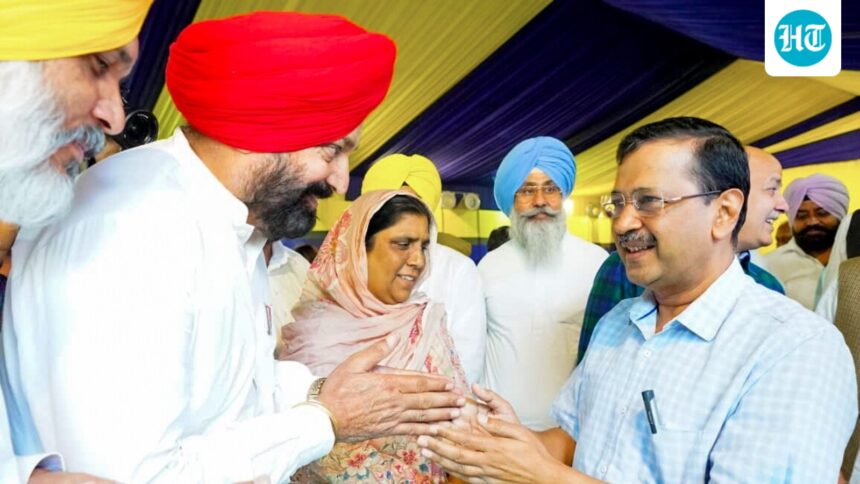
As the India bloc partners met in Delhi on Monday, the Aam Aadmi Party not only shied away from any new alliance with it, but also intensified its attack on the Congress, the largest opposition party leading the alliance.

AAP leader Somnath Bharti openly declared that the alliance — from which the party formally exited in 2025 except for issue-based support thereafter — “has no future” as long as the Congress leads it. “[Congress] On the one hand, he said that we will fight as an alliance and support each other, but behind the scenes [it] “He appears to be with the BJP,” Bharti said.
The India bloc meeting at the heart of the offensive took place in the national capital, but the fighting that has drawn the two sides apart is just to the north – in Punjab.
Grouses were cited in DC
Bharti’s stated grievances were specific to Delhi. Pointing out that the AAP and Congress had divided the seven Lok Sabha seats in the capital on a 3:4 formula in 2024, he said that while Arvind Kejriwal had openly campaigned for the three Congress seats, no Congress leader other than Rahul Gandhi had sought votes for the four AAP seats. The BJP won all seven.
“What kind of alliance is this?” Bharti said, also pointing out that after getting a blank result in the 2025 Delhi Assembly polls, Congress leaders celebrated AAP’s loss to the BJP. Bharti stressed that “Congress does not know how to respect the alliance charter.”
However, the Battle of Delhi evoked by Bharti is not the whole story. The only major state where Arvind Kejriwal and the Congress are still in live, direct competition is Punjab.
No agreement is possible in Punjab
The AAP took over Punjab in 2022, winning 92 of its 117 seats, ousting the incumbent Congress, which is now the main opposition.
Even in the 2024 Lok Sabha elections thereafter, while the two parties allied as partners in the India Bloc in Delhi, Gujarat, Haryana, Chandigarh and Goa, they fought separately in Punjab. Of the 13 Lok Sabha seats in Punjab, the Congress won seven while the AAP won three (one went to the Shiromani Akali Dal, two to independents). That competition in the council intensified through the opinion polls that followed. An agreement could not be reached later in the 2024 Haryana Assembly elections as well, with both blaming the other for the collapse of the talks.
The recent ruling has reinforced this pattern in Punjab. In last month’s municipal elections, the ruling AAP won nearly half of the 1,977 wards, with the Congress a distant second at 400. This came as a help because the AAP suffered a setback within its ranks after six of the seven Rajya Sabha MPs from Punjab – led by Raghav Chadha – switched to the BJP two months ago.
Both the RJD and the Congress are now gearing up for the 2027 Assembly elections, and for Kejriwal’s party, Punjab is its last major stronghold. Punjab Congress leaders have long claimed that an alliance with the RJD will only revive the Akali Dal or BJP and will erode the party’s base.
He officially left in 2025
The AAP was not among the parties that attended the Constitution Club meeting either as it formally withdrew from the bloc in July 2025, though it later joined in opposition to the BJP-led regime in Parliament. At some point before that, she had said that Congress should be expelled from the India bloc.
Congress leaders on Monday said those absent from the alliance meeting had effectively “merged” with the BJP and described them as weak. The Congress was portrayed at the meeting as the “glue” for the 23-party bloc.
However, CM Bhagwant Man of Punjab has repeatedly quipped that in Punjab and Delhi, “mothers can tell their children the shortest story: Once there was a conference.”
In conjunction with the risky formula of the India Bloc – together at the national level, not necessarily at the state level – the League last year joined a united opposition campaign against the revision of the electoral rolls. But she didn’t return to the block as such.
Punjab is among the states that are now witnessing a special, intense review of voter lists for the polls at the beginning of 2027. This is in about eight months or so.
Another party in a somewhat similar situation was the Trinamool Congress, with a complicated relationship with India during the three years of the bloc’s formation. However, TMC leader Mamata Banerjee attended the bloc meeting as she faces a massive rebellion within the party she founded in 1998, after losing power in Bengal to the BJP. Kejriwal visited her on her arrival in Delhi on the eve of the meeting. But they had their own reasons for attending the meeting or not.