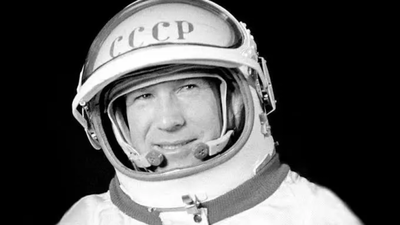
The first man to step outside the confines of a spacecraft was Soviet cosmonaut Alexei Leonov on March 18, 1965. What initially looked like a victory in the highly competitive space race very quickly developed into a battle for Leonov’s life.
While floating above Earth, Leonov encountered problems with his spacesuit expanding in outer space conditions due to the vacuum and he became unable to move, let alone enter the spacecraft through the airlock as he planned to do. Due to time constraints forcing him to act quickly or else die, Leonov released the oxygen from his suit and risked suffering decompression sickness in order to return to the spacecraft and survive.
Leonov’s story of courage is one of many, illustrating how daring people were during those pioneering days of space travel.
How Alexei Leonov made history with the world First space walk On board Voskhod 2
The Soviets launched the Voskhod 2 spacecraft, carrying cosmonauts Alexei Leonov and Pavel Belyaev. In simple terms, the main goal of this flight was to get someone out of the spacecraft and back safely.About 500 kilometers above Earth’s surface, Leonov ventured out using an inflated airlock, floating in the vacuum of space, connected to the spacecraft by a tether line.
The project lasted only about 12 minutes, making Leonov the first man to conduct an extravehicular activity in outer space.Recalling this incident years later, Leonov told Smithsonian Magazine:“I could hear myself breathing, and even hear my heartbeat in the silence of space.”This great achievement ensured that the Soviets remained one step ahead of their rivals in the Space Race, demonstrating that people could live and work in outer space.
Why did Leonov’s spacesuit inflate in the vacuum of space and almost trap him outside?
The celebration was short-lived. In the vacuum of space, Leonov’s Berkut spacesuit expanded much more than engineers expected. The suit stiffened significantly, making movement more difficult. His hands and feet moved inside the suit, and he struggled to bend his limbs. More importantly, the inflated suit became too large to fit into Voskhod 2’s cramped airlock.As the spacecraft approached the orbital darkness, Leonov realized that he might not be able to return before vision disappeared.
According to later accounts, he understood that he only had a few minutes to solve the problem.In his memoir published in Smithsonian Air and Space Magazine, Leonov recalled the exhilaration and danger of the mission, describing his feeling outside the spacecraft as:“Like a seagull spreading its wings and flying high above the ground.”However, beneath that wonder, a potentially fatal crisis was unfolding.
The release of dangerous oxygen that saved the life of the first astronaut
Unable to enter through the airlock, Leonov made a decision that was not authorized by real-time mission controllers. He manually opened a valve and lowered the pressure inside his spacesuit, allowing excess oxygen to escape. This procedure made the suit more flexible, but also exposed him to the risk of developing decompression sickness, known as “bends.”Indeed, it has paid off. By allowing the pressure inside the suit to equalize that in outer space, Leonov was finally able to press himself back inside the capsule.
There has been controversy over certain aspects of this maneuver later, but one thing remains constant: the spacesuit expanded in the vacuum of space, making it necessary to release some oxygen.However, the problem is not over yet. Further analysis will show that the Voskhod 2 spacecraft suffered several other malfunctions during its descent to Earth, resulting in the astronauts landing miles away from their expected destination in the jungle, with the pair having to spend nearly two days waiting for help to arrive.In hindsight, it appears that Leonov’s flight was not only the first spacewalk, but also one of the most remarkable acts of human courage and resourcefulness in the entire history of space exploration. Thanks to his efforts, aerospace engineers learned a lot about working in outer space, allowing subsequent generations to carry out more than three thousand successful EVA operations.