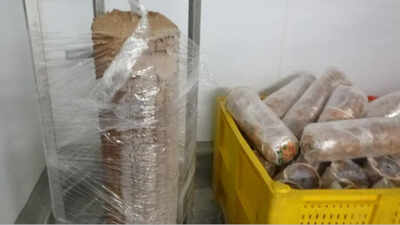
A major British kebab manufacturer has been hit with a huge financial penalty after a court heard it defrauded the public by selling “lamb” kebabs made mostly of skin, fat and cheap meat, the BBC reported.Kismet Kebabs Ltd, based in Chelmsford, Essex, has been fined £500,000 (about Rs 6.3 crore). The company supplies takeaways and restaurants across the UK. She was also ordered to pay £259,298 in prosecution costs.The case came to an end after Kismet Kebabs Ltd pleaded guilty to one count of fraud by false representation.The court heard that the deception came to light after a regional sampling exercise that began in late 2020 and early 2021.
Officers examined the meat content of kebabs sold in local restaurants and takeaway shops, and discovered that Kismet products failed to match the descriptions on their labels. Further laboratory tests confirmed that the actual meat content “varied significantly” from what was advertised.Lee Reynolds, on behalf of Swansea Council, told the court the company had “misled wholesalers, retailers and consumers” by manufacturing products with labels indicating specific amounts of meat which the company knew were incorrect.
“Most of what was described as lamb was actually skin and fat,” Reynolds said. “The company routinely and knowingly purchased goat, lamb fat, hide, lamb and sheep [sheep meat]“Once it was processed in their factory, they sold it as sheep.”The investigation expanded to include the National Food Crime Unit and the Food Standards Agency. It emerged that Essex Council had a long history of dealing with Kismet through the initial authority partnership, during which it received numerous complaints from other local authorities across England regarding anomalous labeling.
One example reviewed revealed that a lamb doner kebab that claimed to be 87% lamb was made up of only 51% meat and 40% fat.On 20 May 2021, trading standards officers raided the Kismet factory in Essex, discovering serious deficiencies in production, packaging and labeling. Company invoices proved that very little of the original mutton was purchased. Instead, the company was purchasing large quantities of low-quality goat hide, fat, and “meat” products that could not be called meat according to the legal definition.Furthermore, the plant was making a mechanically derived meat mixture consisting mostly of “neck trim, lamb trim, water and ice,” which counted toward the official meat content declared on the package.The first fine was proposed at between £15m and £24m, but prosecutors said this range was “completely unrealistic”.The company now has four years to pay the total fine.