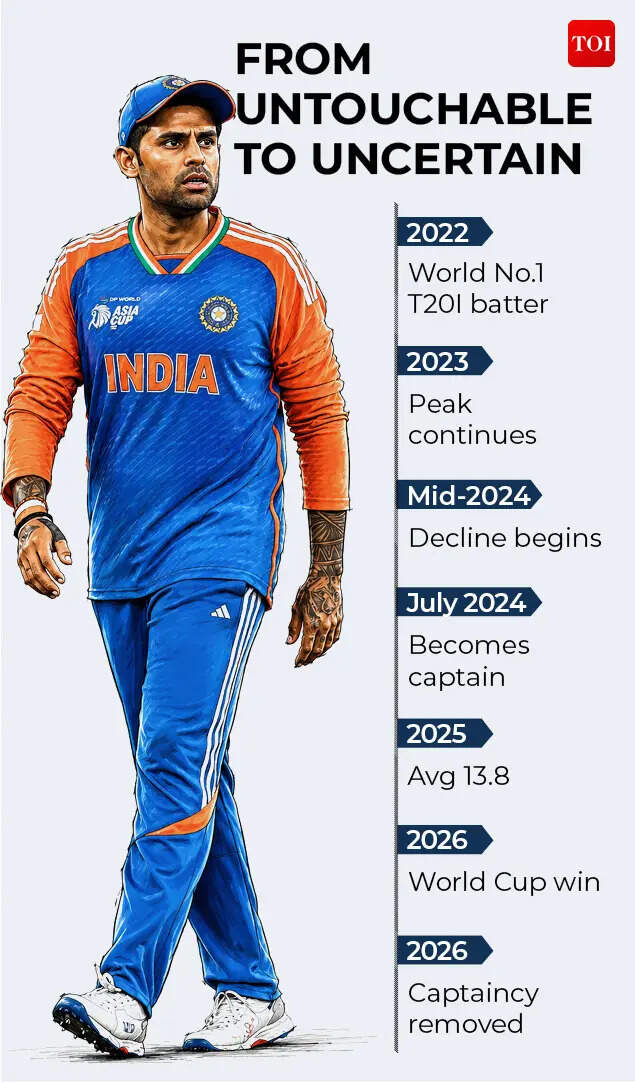
Three months after leading India to the T20 World Cup title, Suryakumar Yadav not only lost the captaincy but also lost his place in India’s T20I setup, with the selectors deciding that the 35-year-old no longer fit into the team’s plans for the upcoming tournament.Chief selector Ajit Agarkar revealed that the decision was driven by a combination of form and the need to look ahead to the next World Cup. “Regarding Syria, it’s obviously difficult having just won the World Cup. But as happens after most World Cups, we are trying to re-evaluate the best way forward.” Agarkar said after announcing India’s T20I squad for the Ireland-England series.
“It was partly his own form, but also given the next two-year cycle, or just over two years until the next World Cup, we thought that was the best way forward.” “It was great to replace a captain who had just won the World Cup,” he added, admitting “Not the easiest kind of discussion.”For a player who, at his peak, seemed untouchable and redefined T20 batting, the downfall has been swift. But was the decision just a matter of age and succession planning? Or have Suryakumar’s numbers already stopped justifying his status as India’s automatic No. 4 man?
A deep dive into his performance reveals that while the decline is not as obvious as it might seem, the selectors’ decision was rooted in a trend that has been building for nearly two years.
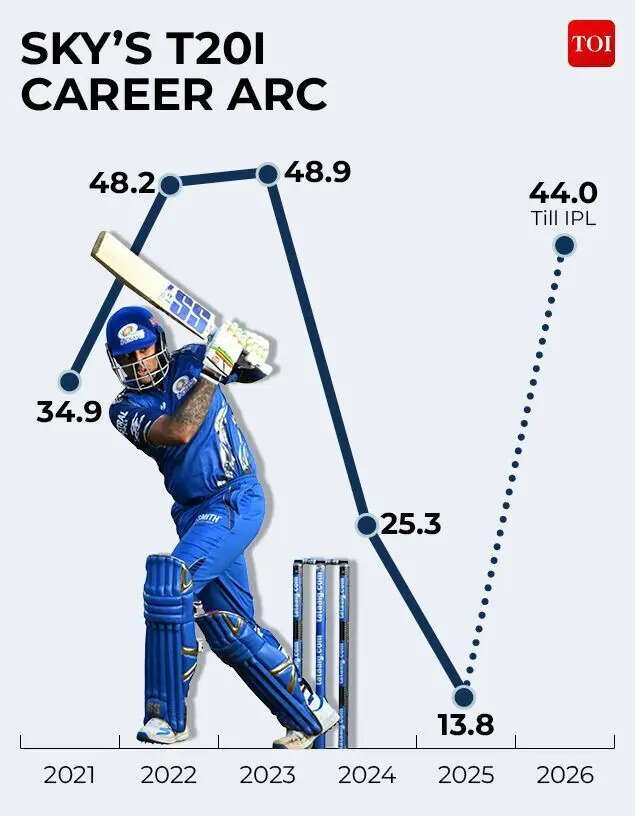
At first glance, it seems counter-intuitive. India has just won the World Cup. Suryakumar remains one of the most accomplished T20 batsmen of his generation. His record as captain is excellent. However, when selectors sit down to prepare for the 2028 T20 World Cup and the Los Angeles Olympics, emotions rarely enter the equation. They look at age. They look at fitness. They look at the track.Increasingly, those indicators pointed away from Suryakumar Yadav.The peak that made him untouchableBefore discussing why India is ahead, it is worth remembering how exceptional the Suryakumar summit was.Between 2022 and early 2023, there have been no more devastating knocks in T20 cricket.In 2022 alone, he scored 1,158 T20I runs at an average of 48.2 and a strike rate of 187. He followed that up with 733 runs in 2023 at an average of 48.9. Over those two seasons, he averaged 48.5 while hitting 173.6.This was the version of SKY who became India’s most important T20 batsman.
This was the version that became the captain. The problem for India is that this version of SKY has not been around consistently since 2023.
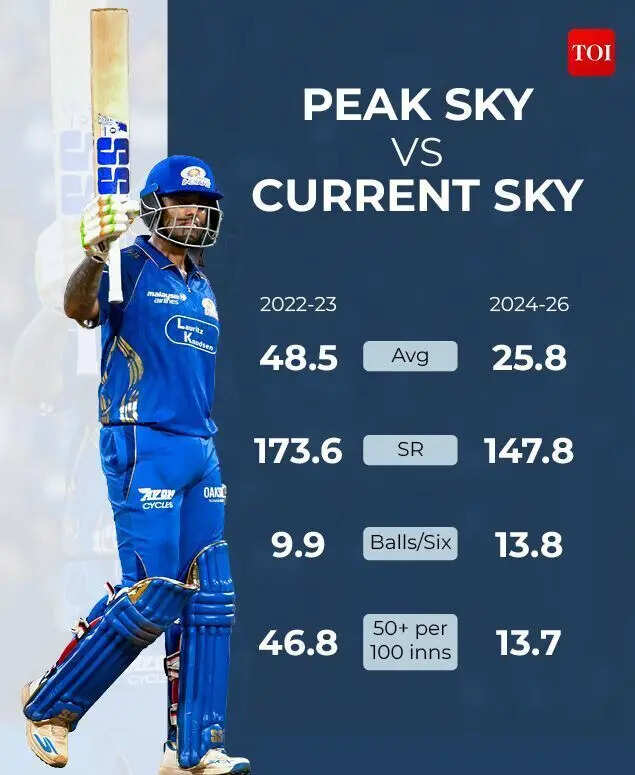
The decline is unimaginableOne bad series can be ignored, but so can a bad championship. But this troubling trend has been difficult to overlook. The numbers show a decline starting midway through 2024, then deepening throughout 2025. The comparison between SKY’s peak and current SKY is stark.The decline is evident everywhere. His average has nearly halved, his strikeout rate has dropped sharply, as has his six-hit average.
Most importantly, he no longer turns starts into innings to shape the game.The collapse bottomed out in 2025. Across 20 T20I innings, Suryakumar has managed just 221 runs at an average of 13.8 and has failed to score a single fifty. For a dough that holds the premium mid-tier position in India, these numbers are impossible to ignore.The captaincy could no longer protect himUsually, winning solves everything. India have certainly won under Suryakumar: the Asia Cup in 2025 and the T20 World Cup in 2026.The winning rate is close to 77%. But international cricket is not about leadership alone.
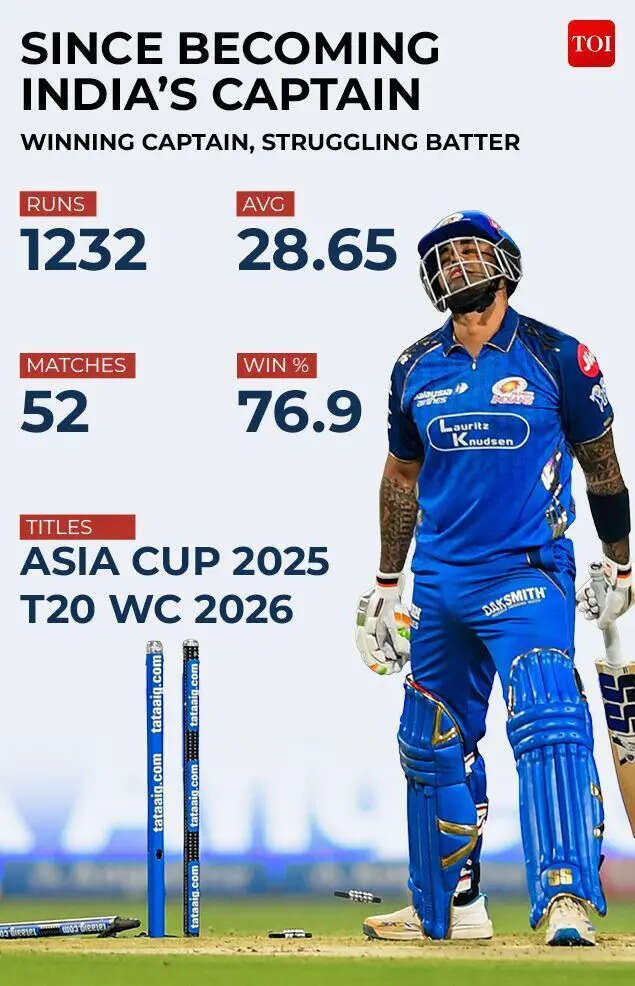
Captains must justify their status as players first. As captain, SKY scored 1,232 runs in 52 matches, and since taking full charge in July 2024, he has managed 932 runs in 45 matches while enduring recurring lean spells with the bat.The India captain was the winner, but the India captain was not performing like India’s best player.In fact, although his numbers for India in the middle order show that he has racked up the most runs by volume thanks to playing more matches, his impact per innings in victory has lagged. By contrast, he was right at the center of India’s victories during his peak.
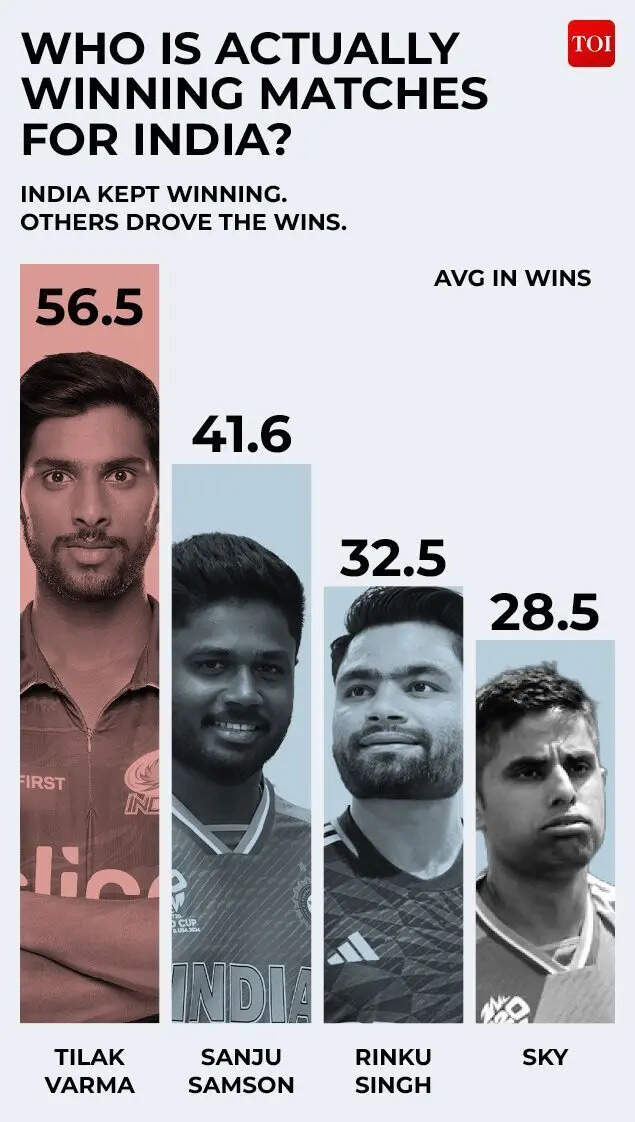
Batting averages of middle-order batsmen in India’s wins
And for the position that Suryakumar Yadav himself created – No. 4 – the successors have already arrived. With Shreyas Iyer coming into the line-up as captain, he will be India’s new No. 4, but even before that, SKY were already losing to his teammates. It is impossible to ignore the numbers of Tilak Varma, who has been in fourth place since January 2024. He averages 50.5 in T20Is compared to Suryakumar’s 26.6. In victories, the gap widens even more. The average tilak is almost twice that.
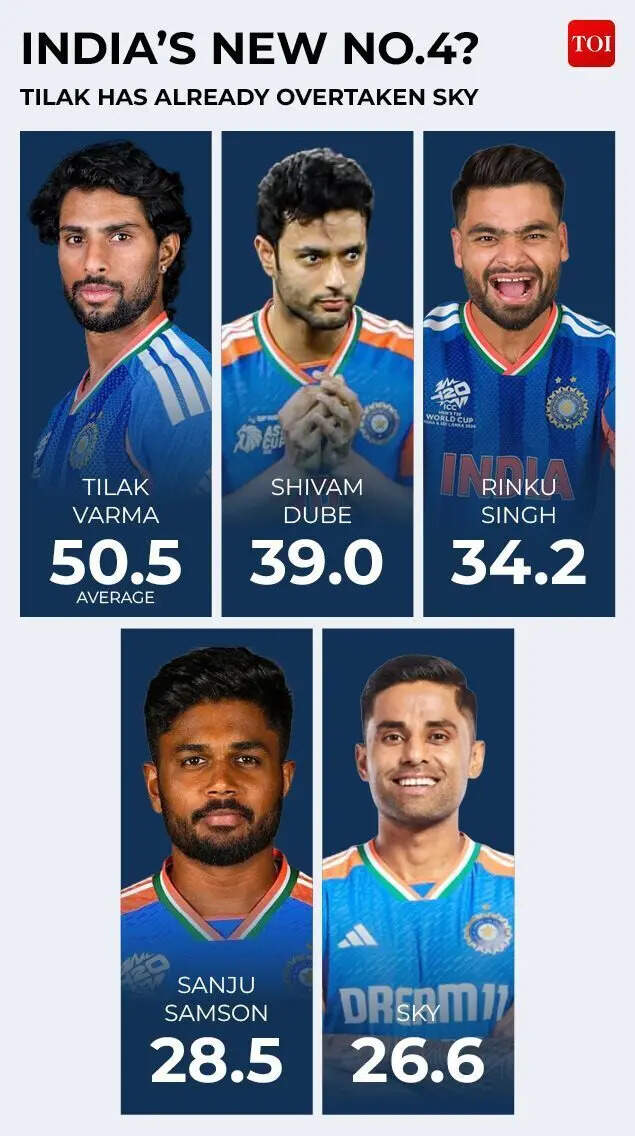
Shivam Dubey also outperforms him after 2024. So the selectors are not moving on from the player who clearly remains the best option for India. They’re moving on from a player whose rivals are starting to outpace them.Contradiction
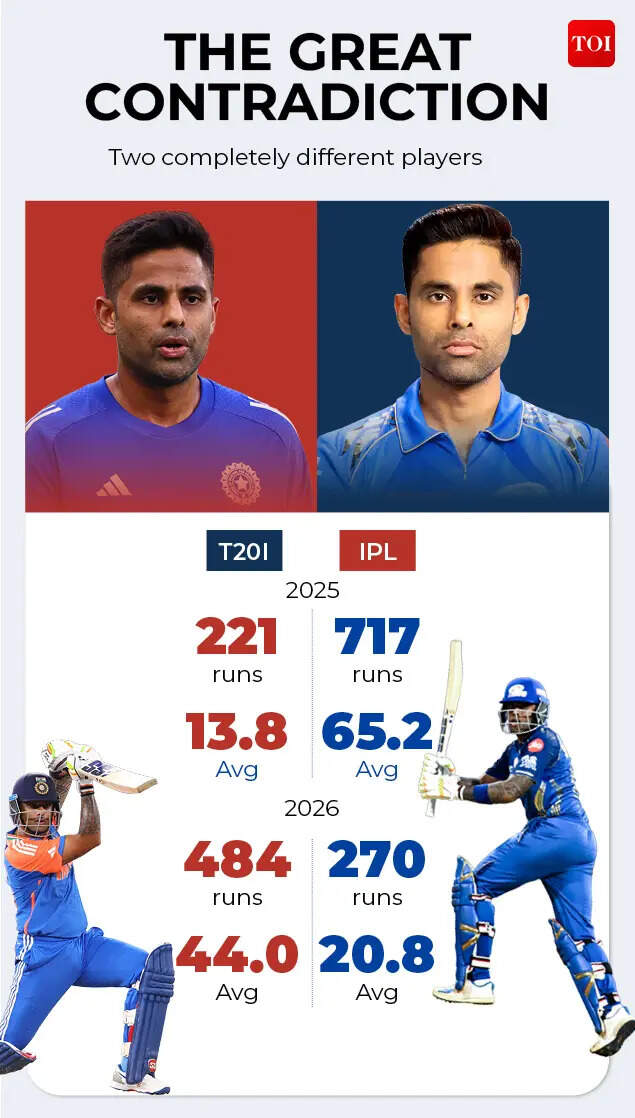
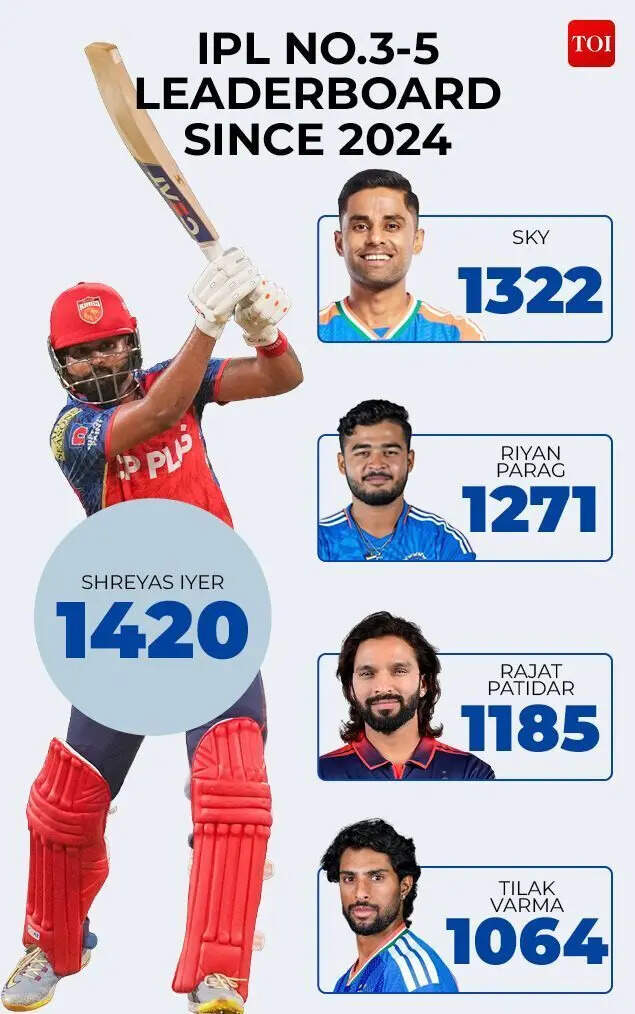
Suryakumar Yadav’s numbers in IPL give a ray of hope. It’s not a case of SKY completely losing his touch. His 2025 IPL season was arguably the best of his career: 717 runs at an average of 65.2 and since 2024, only Shreyas Iyer has scored more IPL runs among India’s middle-order batsmen.In 2025, he produced his worst T20I season and his best IPL season simultaneously. Then in 2026, he had a strong campaign in the T20 World Cup while enduring his worst IPL season in nearly a decade.Why Shreyas Iyer makes senseThe captaincy change ultimately says more about India’s future than it does about Suryakumar’s past. Shreyas Iyer is younger. He has built a strong leadership resume. It has proven its success across multiple franchises. More importantly, he is capable of realistically leading India through the entire next cycle. Currently, Suryakumar no longer offers that certainty.
The wrist no one wants to talk aboutThen there is the issue of fitness. Throughout the T20 World Cup campaign, Suryakumar repeatedly required treatment on his right wrist. Registration has become routine. Filling has become routine.
Medical care has become routine. Support staff in India have publicly downplayed these concerns, but the images tell their own story.At 35 years old, injuries carry a different significance than they did at 25 years old. The wrist problem alone may not justify moving forward. However, besides the decline in production, there becomes another variable that selectors must take into account in long-term planning.Peak SKY remains one of the greatest T20 batsmen the format has seen and his IPL numbers suggest the skill has not gone away.
But international cricket is ultimately about what comes next.Specifiers are seeing a 35-year-old with a recurring wrist problem. They see a 26.6 average since January 2024. They see younger hitters outperforming him in the same role. They see a leader who may not even be part of the next World Cup cycle.They see an opportunity to reset now rather than later.