

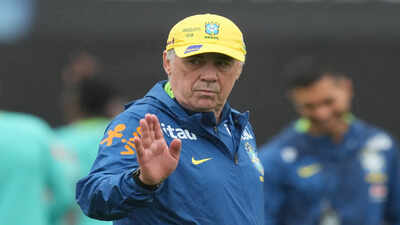
Brazil coach Carlo Ancelotti (AP Photo)
One could call it irony or just a simple twist of fate. The 35-year-old, who had just ditched his soccer kit for a coach’s tracksuit, was training with the Italian team at the Rose Bowl, Pasadena.It was the summer of 1994. Under Arrigo Sacchi, Carlo Ancelotti, one of Milan’s most famous sons, was learning the tricks to destroy Dunga’s Brazil. But as for the loss on penalties, Ancelotti’s first experience as a coach would have been an amazing success against the strength of Romario and Bebeto’s lineup.Thirty-two years later, and after five Champions League titles, Ancelotti will once again shine as coach of the United States. But this time, he was thinking about a return to the Seleção, a job no non-Brazilian has ever gone to in the long term.
History finds it difficult to remember the three players who coached Brazil, but the fourth has certainly entered the annals of history. actually.
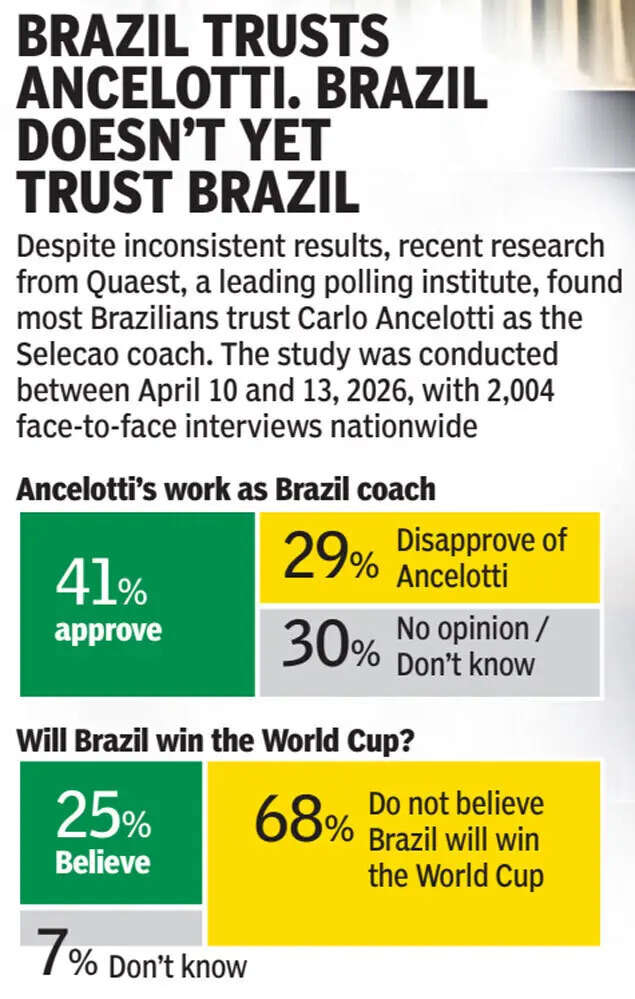
The Quiet Coach, as they now call him, has taken on the most emotionally challenging job on the planet. Ancelotti’s appointment was met with certain reservations from the native Brazilians. Even Brazilian President Lula questioned the Italian’s lack of experience with national teams.
Polite reference was made to the fact that Italy, who failed to qualify for a third successive World Cup, had never asked for Ancelotti’s help.
Undeterred, Sacchi’s more popular replacement took the initiative and led the yellow shirts through the playoffs and onto the big stage.For a generation, Brazil wandered aimlessly in the wilderness of world football. Memories of 2002, when Cafu lifted the trophy aloft in Saitama, Japan, are a kind of taboo secret club for the Brazilian Generation Z.
To them, the 1970 victory might seem like a yellow certificate hanging in the far corner of the wall.Repeated humiliation by France, the Netherlands, Belgium, Croatia and, more recently, arch-enemies Argentina in World Cup qualifiers and the World Cup in South America, has forced the CBF to finally look for the only remaining option, which is to sign a European player.Ancelotti was tasked with creating a football mythology, to buy back the soul of the footballer Mephistopheles.
Back in the United States again, this time Brazil’s path looks less like 1970 or 2002 and more like 1994. This team, coached by Carlos Alberto Parreira, remains one of the most misunderstood champions in football history. For many romantics, the 1994 U.S. national team represented the death of Goga Bonito; They were practical, physical, cautious and sometimes frank.However, he was also mentally indestructible. Brazil have conceded only three goals in seven matches.
They dominated matches rather than being dazzled by them. When the moment came, they trusted Romario, Bebeto, Dunga and an aging Branco to provide exactly what the team needed.Ancelotti may have to adopt a similar scheme.“Maybe we are a step behind this time, but we are ready and that is always a good thing,” declared Dunga’s successor, Casemiro, in Ancelotti’s plans.Brazil still possess immense attacking talent, but unlike previous generations, there is no clear and complete star at the peak of maturity.
Real Madrid’s Vinicius Junior is devastating in transition but less dominant in tight spaces for both club and country. Her raven could explode one day and disappear the next. Indrik remains more of a promise than a certainty.That’s why comparisons with 1994 are fascinating.Brazil doesn’t necessarily need the next Romario. Most importantly, they need someone capable of producing decisive moments under stifling pressure.
Romario scored just five goals in those World Cup finals, but almost every touch changed Brazil’s fate. His combination with Bebeto gave Brazil quality rather than spectacular performance.Today, Vinicius and Rafinha could theoretically become that partnership, but neither yet carries the cold-blooded inevitability of Romario. Perhaps Ancelotti’s greatest task is psychological: convincing his strikers to become the men who decide tournaments rather than simply entertain them.Then comes Dunga’s important question.No player symbolized the anti-romanticism of 1994 more than Dunga. It has been criticized for years for representing discipline over art. However, Brazil won the World Cup under his leadership. Dunga gave the emotional control side. He imposed a competitive advantage on a talented but fragile team.It can be said that modern Brazil lacks this number more than it lacks Romario. Midfielder Casemiro has huge shoes to fill.The current team has technical quality everywhere, but emotionally they look weak in tournaments. Collapses to Croatia in 2022, and to France in a recent friendly, have exposed a team that can become frantic when games stop flowing their way. Ancelotti’s history suggests he understands this deeply. His greatest Real Madrid teams were not always tactically revolutionary; They were emotionally stable.
They have weathered the storms.Perhaps this is the future of Brazil under his leadership: less chaos, less risk, and more control.This does not mean that football is ugly in the traditional sense. Ancelotti is too advanced to turn Brazil into a purely defensive machine. But international football increasingly rewards structure over beauty. Argentina won the 2022 World Cup through flexibility and tactical adaptability as much as through brilliance.
France reached two successive finals by mastering transitions and defensive balance.The era of winning through pure flair is largely over.Perhaps Brazil must accept this fact.Paradoxically, embracing pragmatism may liberate them psychologically. The burden of performing “like Brazil” has haunted several generations since 2002. Every failure is framed as a betrayal of identity. Perhaps Ancelotti, as an outsider, can separate the team from that historical prison.If Brazil succeeds on US soil, soccer may not resemble samba at all. It may seem like 1994: disciplined, strict, sometimes uncomfortable – but ultimately unstoppable when the pressure becomes unbearable.