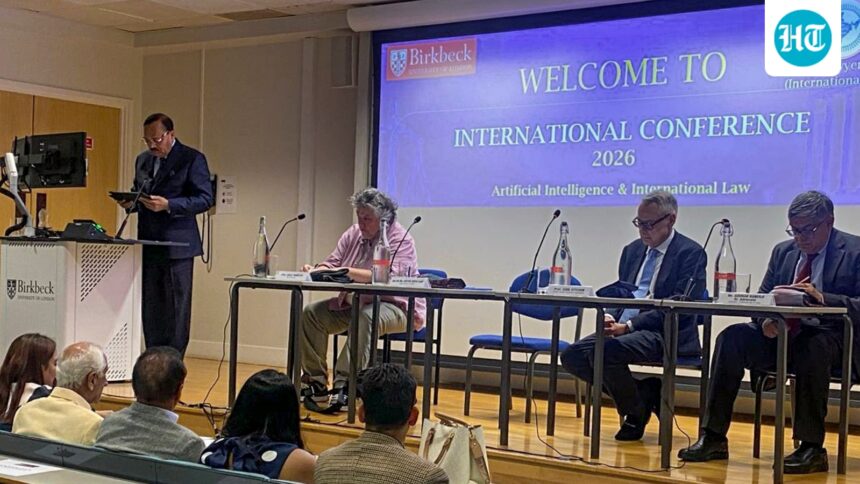
At an event held at a university in London, where the Chief Justice of India, Surya Kant, was the keynote speaker, a tense exchange took place between attendees who sought to ask him questions about dissent allegedly suppressed in India, and a female anchor who said such questions were beside the point.

CJI gave a lecture on “Artificial Intelligence and International Law” at Birkbeck College, University of London.
Video clips of the question asked and students shouting: “Respect us, please!” – Apparently during an interactive portion of the event after his lecture – Sourav Das, chief spokesperson for the Cockroach Janta Party movement, replayed it online.
The movement, which announced a protest on June 6 in Delhi over recent exam-related controversies in India, takes its name from the ICJ’s use of the words “cockroaches” and “parasites” last month while talking about fake degree holders and “unemployed youth turning activists.”
What was the question?
The tense exchange, as seen in clips shared by Das and others on
She then added: “We are now hearing from a number of legal observers within the country as well as internationally that there is a great deal of concern about the growing hostility to the opposition within India. This hostility appears to be reflected to some extent in His Lordship’s rhetoric and it has been very well publicised,” she said, apparently referring to his recent statements.
Before she could ask the question, one of the men on stage could be seen saying: “With all due respect, I’m so sorry, I won’t be able to take up this question because the topic is about artificial intelligence and international law. So sorry. I’m so sorry, I’m so sorry. We’re going to have to cut this question off.” The clip ends here. In another clip, one of the attendees appears protesting and demanding respect.
The incident echoed a similar encounter during Prime Minister Narendra Modi’s visit to Norway in May, his first to the country and the first by an Indian prime minister in more than four decades.
After concluding a joint statement with Norwegian Prime Minister Jonas Gahr Sture in Oslo without a question-and-answer session, local journalist Helle Laing shouted at Modi as he walked off the podium: “Prime Minister Modi, why don’t you take some questions from the freest press in the world?” Modi did not respond and walked away. She later emphasized this point further at a State Department press conference, raising questions about trust, human rights and freedom of the press.
Indian officials defended the prime minister, saying the event was a pre-arranged joint media statement rather than an open press conference, and that leaders were not scheduled to take questions at such briefings. They also cited India’s history and constitution to reject the journalist’s assertions.
What did the CJI say in his lecture
The choices made during this decade will shape the relationship between technology, power, freedom and justice for generations to come, the CJI said in his lecture on artificial intelligence.
“Technology in itself is neither inherently good nor inherently harmful. Its impact depends on the legal, political and moral frameworks through which societies choose to deploy it. It is, therefore, neither the responsibility of the law to resist technological progress nor to surrender to it unquestioningly. Its responsibility is to ensure that technological power remains accountable to constitutional values, democratic legitimacy, and human dignity,” she said, as quoted by news agency PTI.
He also said that artificial intelligence constitutes one of the most important tests of international law in its modern development. “Our main challenge is to ensure that, in the age of intelligent machines, humanity retains authorship of the principles that govern it. If international law can rise to this challenge, artificial intelligence may become not just a technological revolution, but an opportunity to reaffirm the values that lie at the foundation of democratic civilization itself.”
CJI Kant is on a six-day trip to the UK.
Thanking Birkbeck College for hosting the conversation, CJI said that in moments of profound technological transformation, dialogue between courts, universities, governments and civil societies becomes indispensable.
“Ultimately, the future of AI will be shaped not only by innovation, but by the legal and ethical choices that humanity collectively chooses to make,” he said, stressing that the challenge facing the international community is not just to regulate technological capacity, but also to maintain legal responsibility in environments where decision-making is increasingly mediated by algorithmic systems.
He added that if responsibility becomes too fragmented to be defined, accountability itself may become illusory.