For the 21 people who died, the fire that broke out at an illegal bed and breakfast in south Delhi’s Hauz Rani area was a cruel twist of fate. Due to the hotel’s proximity to a well-known private hospital, many of the victims were either caring for patients or were patients themselves.

Habib Abid (50), his son Haider and son-in-law Ali Aamer Musa (29) were staying on the fifth floor of the hotel for a week, as the 19-year-old received treatment for a brain tumor at Max Hospital, Saket, across the road.
The Iraqi citizen miraculously survived the fire, but lost his sister’s husband. “As the fire started spreading rapidly to the upper floors, it filled the corridors with thick smoke, reducing visibility. I escaped when some neighbors smashed the window of our room and placed stairs for me. But Musa ran out of the room looking for another way. He climbed the stairs, but could not escape,” Abid told HT at the morgue of the All India Institute of Medical Sciences on Sri Aurobindo Marg on Thursday.
According to the hospital’s forensic team, it has received 13 bodies since the accident. “Among these bodies, post-mortems have been completed. The rest will be completed by June 5, when five more bodies will be transferred from Max Hospital,” an official said.
According to Delhi Fire Services (DFS) and Delhi Police, at least 12 foreign nationals were killed. Among them were three from a family from Kyrgyzstan. Nargisa Khan (53 years old), who came to Delhi for a liver transplant and was accompanied by her grandmother Nukhbirat Khan (76 years old) and her son Humayun (26 years old).
Read also| Canada expresses its condolences over the Delhi fire
“Nargisa had just been discharged from the hospital on Saturday and they were about to leave India on June 8,” said Ghosal, one of her relatives. But a few hours was all it took to change everything. “She called me in a panicked voice at around 8:53 a.m. on Wednesday to tell me that the hotel was on fire and they were trying to escape. Within a few minutes, they stopped answering our calls.” The initial autopsy report showed that all three died from inhalation burns.
Esther, 53, from Nigeria, had just completed treatment for her tumor – on May 18. She and her son Devik, 30, were staying in the country to undergo some additional testing, according to embassy officials.
Janjay N Rowland, 61, a Liberian national, was staying at the hotel while her husband was receiving treatment at Max, her niece Maria told HT.
The fire occurred just before she was going to meet her aunt after she had not seen her for two years. “I am a student in Dehradun, and now that she was in India, we were finally going to meet this week, but instead I was the one who had to identify her body, because her husband is still in the hospital,” she said.
There was a clear undercurrent of anger among those who had arrived to collect the bodies. They blamed the deaths on lax enforcement of safety standards and building regulations.
Of the nine Indians who died, eight were from the same family. Police identified the victims as Vivek Agarwal (45 years old); Tarjani’s wife (43); Their daughters Jevisha (20) and Faria (18). Vivek’s mother Premlata, 71; Uncle Ashok; Her aunt Kamla Goyal and her husband Javeri Lal Goyal, who came from Ajmer in Rajasthan, were also killed.
Read also| An entire family was destroyed within a few hours, say grief-stricken relatives after the loss of eight people in the Delhi fire
They had all come to meet Vivek’s 77-year-old father, Radhe Shyam Agarwal, who was seriously ill and, doctors at Max told them, might not survive. “Vivek was the youngest among my cousins,” said 53-year-old Deepak Agarwal. “I still can’t believe this happened. He called me while he was trapped inside the building. He was screaming for help, asking us to call the fire brigade, and was telling us that he couldn’t breathe. It took the rescue officers about 25 minutes to open the door to the basement, where he was.”
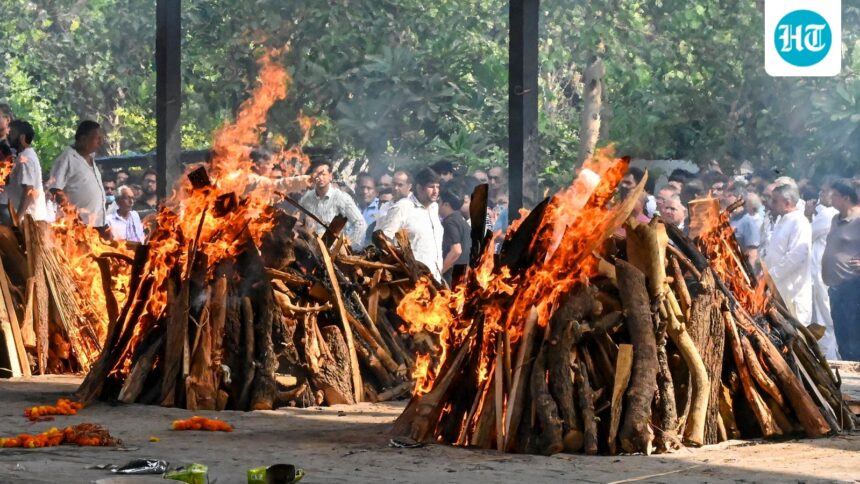
Back in Gurugram, the three-storey residence in Sector 46, built with the hopes and dreams of Vivek and his family, was filled with the wails of their relatives as they were cremated on Thursday.
“Vivek told his cousin over phone that the electronic lock on the basement gate was not working and he was begging to be saved,” said Santosh Bansal, Tarjani’s mother.
Family members searched dozens of hospitals for hours to find Tarjani, her two daughters and two other family members. She said while trying to hold back her tears: “We heard that three women jumped and were not found. I thought they were begging me and my granddaughter, but it turned out that they were the ones who died.”
Eventually, Tarjani’s body, charred beyond recognition, was identified by her earrings. Her mother added: “My children did not allow me to see her, even for the last time.”