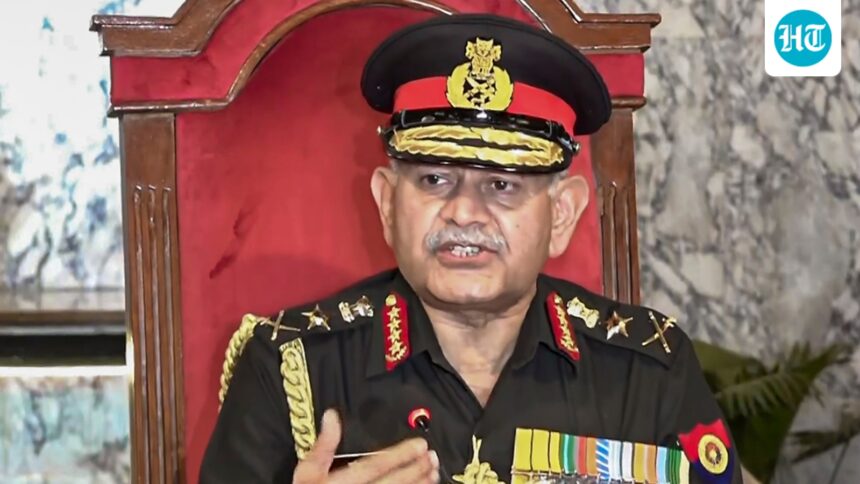
Army Chief General Upendra Dwivedi also said that the restructuring of the army is aimed at achieving more decisive results on the battlefield.

Army Chief General Upendra Dwivedi said drones have become a defining force in modern conflict, and outlined India’s plans for scaled and networked drone capabilities integrated with artillery, air defence, electronic warfare and intelligence systems.

In an interview with HT, he also said that the restructuring of the army aims to achieve more decisive results on the battlefield; The agreements concluded with China regarding disengagement along the Line of Actual Control have led to both sides showing greater responsiveness and sensitivity to the other party’s concerns. Operation Sindoor demonstrated that India’s responses in the future will not be limited by Pakistani nuclear blackmail. Edited excerpts:
How is the rise of drones and multi-domain warfare changing the battlefield, and how is the military adapting?
Recent conflicts have shown that drones are no longer niche platforms. They can hunt armor, direct precision fire, support logistics, relay communications, and influence information space. Hostile unmanned systems have also made detection, jamming, spoofing and neutralization a necessity on the front lines. So, when we talk about drones today, we should also be talking about unmanned aerial systems, electronic warfare, air defense, secure networks, and data fusion. Our drone capabilities will be scaled, role-based and networked. The real value will come when drone feeds are integrated with artillery, air defence, aviation, intelligence, electronic warfare and ground maneuvering through secure networks, enabling a faster cycle from sensor to shooter. In multi-domain processes, no single domain decides the outcome by itself. Ground operations, cyber effects, electronic warfare, space support, information operations, and precision fires must work in concert. Our effort is to move from domain isolation to domain consolidation, where the connections between services and domains are gradually reduced. That’s why we focus on joint doctrines, MDO (Multi-Domain Operations) war games, electronic warfare brigades, cyber electromagnetic activities, information warfare structures, and data-centric command systems.
What is the current state of theatre, and when can India expect a fully functioning integrated theater leadership? Do differences between services persist?
Theater is a necessity for fighting the wars of the future. Considerable groundwork has been completed in joint planning, command and control, areas of responsibility, logistics, communications, doctrine, training and human resources policies. The Army has begun rationalizing formations, streamlining operational aspects, and harmonizing logistics, communications and training structures so that formations can integrate seamlessly once theater commanders are notified. These commands will enable better utilization of national combat power by pooling sensors, shooters, logistics and support structures across the three services. Future conflicts will be short-course, high-intensity and multi-domain, where space, cyber, information and electronic warfare will be integrated with land, sea and air operations. In such an environment, the armed forces must be able to see, decide and act together. Theater commands, supported by integrated networks, joint targeting operations and interoperable systems, will help reduce duplication, improve the speed of decision-making and achieve more effective results. A reform of this magnitude cannot be rushed… Issues such as maintaining service expertise while ensuring shared priority, airpower employment, command and control, compatible equipment, integrated logistics chains and unified administrative policies require careful coordination. These are not differences in intent… The most important shift is the cultural and organizational shift – the move from service-centered planning to joint theater- and mission-centered planning. The trend is clear and irreversible. The future of Indian combat is joint, integrated and theatrical.
How is the army restructuring process carried out?
Future conflicts will be multi-domain, technology-intensive, and increasingly non-linear. Ground operations will not be viewed in isolation. It will be closely linked to air, cyberspace, space, the electromagnetic spectrum and the cognitive domain. Our restructuring process is about creating more flexible, integrated and responsive warfighting capabilities. Rudra Brigades are integrated all-arms formations that combine infantry, mechanized elements, armor, artillery, special forces, drones and support elements to achieve more precise tactical results. The idea is to give commanders formations that can respond faster, act more flexibly and deliver integrated effects in a compressed time frame. Bhairav’s battalions are designed to bridge the capability space between Ghatak and Special Forces platoons. It will give the army a more flexible and highly prepared option for difficult missions. At the infantry battalion level, 382 Ashni drone platoons will enhance surveillance, target identification, tactical drone use and battlefield awareness. Shaktiban Regiments and Divyastra Batteries will add greater accuracy, reach and technology-enabled effects. These structures are intended to ensure that technology is not only held at higher levels, but also made available to formations and units where it can directly influence battlefield outcomes. The IBG (Integrated Battle Group) concept aims to create agile, self-sufficient and mission-oriented formations. The concept has been tested, studied and improved, and the Mountain Strike Corps is scheduled to be reorganized with IBGs soon. To fight in a contested electromagnetic environment, electronic warfare brigades are also being raised. My focus has been to ensure that each new structure adds real operational value, strengthens the Soldier, empowers leaders, and enhances the Army’s ability to achieve decisive results.
What are the most important priorities for modernizing the army, and how important is localization in achieving them?
Our modernization is driven by the operational environment, the changing nature of warfare and the need to create a technology-savvy, networked and agile force. We don’t just look at the update as a hardware input. It is a combination of intellect, technology and self-reliance. Our top priorities are multi-platform and multi-sensor real-time surveillance, long-range precision fires including advanced artillery, precision guided munitions and air defence, and drone and counter-drone capabilities supported by AI-powered decision-making systems. Besides, we will continue to modernize tanks, anti-tank systems, soldier equipment, cyber and electronic warfare, logistics and communications networks on the battlefield. The goal is to achieve the right balance between traditional and specialized capabilities. India’s security context does not allow us to abandon conventional force, but future battlefields will also require drones, counter-drone systems, hypersonic weapons, directed energy options, electronic systems, autonomous systems, and resilient networks. Localization is essential in this journey. We need Indian solutions to Indian challenges because our terrain, threat matrix and operational requirements are unique. We follow a systematic process aligned with emerging threats, local design and development capabilities and available resources.
What’s the biggest takeaway from Operation Sindoor? How will Sindoor 2.0 be different if Pakistan causes problems again?
The greatest legacy of Operation Sindor is that it emphasized… Integrated, multi-domain, technology-enabled operations as a critical model for the future battlefield. It was a decisive moment that demonstrated the ability of the Indian Armed Forces to achieve rapid, precise and politically coherent military results in a compressed time frame. The operation demonstrated the effectiveness of integrated planning, real-time intelligence fusion, and decisive leadership at all levels. Air, ground, cyber and electronic warfare capabilities worked in tandem, while precision weapons, drones and loitering munitions enhanced the effect with minimal collateral damage. He also reiterated that future conflicts will be short, intense and technology-based, requiring rapid mobilization, seamless logistics and compressed decision cycles. As far as any future response is concerned, I don’t want to pre-define it as Sindoor 2.0. Each operation will depend on provocation and national goal. There will be no distinction between a terrorist and a sponsor of terrorism, and India’s response will not be limited to (Pakistani) nuclear blackmail. If the adversary continues to engage in anti-India activities, the response will be stronger, sharper and more calibrated to impose costs.
What is your assessment of the security situation along the Line of Actual Control?
The situation along the northern border is stable but sensitive. The disengagement agreements have contributed to enhancing stability on the ground, and both sides are now showing greater responsiveness and sensitivity to the other’s concerns. There were positive indicators of gradual normalization, including formation of an expert group for border demarcation, a working group for border management, resumption of the Kailash-Mansarovar Yatra and direct flights, consensus on resumption of border trade through three border corridors and visa relaxation measures.
At the military level as well, a number of steps have been taken to maintain peace and tranquility. More than 1,100 ground-level interactions are conducted annually between the two sides in order to reach a peaceful resolution of routine border management issues. Local issues are addressed through military engagements, hotlines, flag meetings and commander-level interactions. Our priorities remain clear: maintaining peace and tranquility, resolving local issues through dialogue, maintaining stability in order to advance the Expert Group and Task Force mechanisms, maintaining a strong deployment to deter any threat and continuing to develop focused infrastructure and capabilities. We will continue to engage where appropriate, but our position on LAC will remain firm, credible and capable.