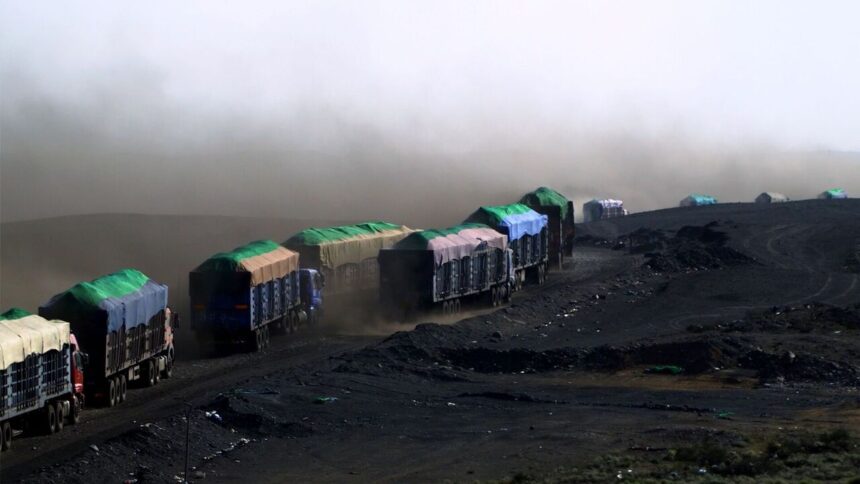
A determined truck driver is part of an endless metal snake winding through Mongolia’s Gobi Desert as she embarks on a perilous journey toward the Chinese border. This is life in Mongolia, as it is called. Now, a documentary by Khuruldorj Choijovanchij takes us into the experience of driving in the desert. meet White rock colorsworld premieres at the Tribeca Film Festival on Sunday, June 7 in Documentary Competition.
“Since its shift toward liberalism after the Cold War, Mongolia has opened its mines in the Gobi Desert to exploitation – triggering an onslaught of truck convoys transporting Mongolian coal to China,” highlights a synopsis for the film. “Within this drudgery of male-dominated work, Maiko – a taxi driver and former hairdresser – stands alone as one of the only female truck drivers working in the mining boom.” The stubborn and outspoken woman is also a single mother focused on the financial future of her young children.
White rock colors It is a cinematic journey into a world that will be new to many in the audience. The doc was executive produced by Chantal Perrin and produced by Tessa Louise Salomé and Luc Sorel. Choijoovanchig, who also handled the cinematography, co-wrote the doc with Perrin, Salome and Kate Keneally. The editor is Simon Le Bear. International sales are managed by MetFilm Sales.
Tribeca’s website promises “a deeply immersive work that showcases the stark human and environmental costs of ‘Minegolia.'”

Choijovanchij and Perrin spoke THR About the hard work that went into making the doc, the hard work of desert truck drivers and why it tells a universal story.
Just like the long, arduous journeys that truck drivers make across the desert, the doctor’s journey was not easy. “It started with a nine-minute short film,” Choijovanchij recalls. “I was doing some promotional videos for mining companies, and I saw this huge line [of trucks] With my own eyes. I was flying a drone, and this image was really inspiring – this big iron snake crawling in the desert.
When he talked to people, he also felt that “the drivers were really passionate about their jobs, but it was sad because they were so tired, like zombies, working really hard. So, I thought I wanted to make a film about this.”

Perrin asked him to put together a short video, which he really liked and was in awe of the female lead Maikhuu. “She’s amazing, she’s so street wise and so sweet,” Perrin says. THR. “I love her. She’s brave, fierce and very smart.”
White rock colors It still took seven years to complete, and the Covid pandemic was among the challenges the team had to overcome. There were hundreds of hours of footage. “Creating a story from 600 hours of footage was a challenge,” says Perrin. “We ended up with the 45th edition of the amendment.”
The document allows Maikhuu to become visible to a world that may be largely unaware of the social plight of Mongolian truck drivers, the harsh working conditions, and lack of health care to which they are accustomed.
Choijovanchij didn’t necessarily think of her story as either local or global. “I believe that every human story is a universal story, so, as a filmmaker, I never treat the story as local, foreign or global. I always treat the stories as human stories.”

But Perrin and other international collaborators helped him highlight the key points to audiences outside Mongolia. “Since coal is Mongolia’s main export commodity, it brings a healthy export income to the country,” explains Choiguvanchij. “But it also comes at a cost.”
Perrin was interested in aspects of human and environmental exploitation. “I’m always concerned about the environment and the environment, and I know this happens everywhere – we dig, we destroy, we cause damage,” she says. THR. “And of course, one of the reasons I wanted to get involved was because of this political and human rights side of the story.”
Among other things, White rock colors It touches on how many Mongolians moved from the countryside to the city, destroying the traditional nomadic lifestyle. “Because of natural disasters, we are exposed to drought, and pastoralists and nomads in the countryside are suffering and losing their animals,” says Choijovanchij. THR. “That’s why more people from the countryside are going into mining jobs, and some of them are driving these trucks.”
The director sums up his hope of obtaining the document in this way. “We hope this will raise awareness [among] Decision makers, so that the situation of these people improves a little. I hope this film will change people’s minds to help improve their working conditions. As a Mongolian, I know this [that] We live in a country that has been trying to develop for the past 30 years, since we became a capitalist country and a free market economy in the 1990s, but we are still sandwiched between two giants. [authoritarian] Neighbors, Russia and China. We’re trying to be a democracy, a free nation, but economically, as a mineral-rich nation, we’re really tied to them. That’s kind of the metaphor behind this movie.