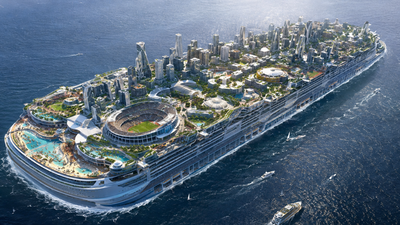
Imagine living in a city where you never stay in one place. Instead of being built on land, they float across the world’s oceans, carrying tens of thousands of residents while providing schools, restaurants, hospitals and even a stadium.
That’s the vision behind the Liberty Ship, an ambitious proposal for what would become the largest ship ever built. The floating city is estimated to cost $16 billion, is designed to accommodate up to 80,000 people and operates primarily in international waters. Although construction has not yet begun, the concept is still attracting attention as one of the most unusual urban projects ever proposed.
Inside the Liberty Ship: The $15 billion Floating city Designed to carry 80,000 people
The Liberty Ship is a concept of a giant floating city and not a traditional cruise ship. First proposed in the late 1990s, the project aims to create an independent community capable of supporting residents, workers and visitors while constantly traveling around the world.Unlike traditional ships that transport passengers from one destination to another, the Liberty Ship is intended to serve as a permanent residence.
People will be able to live, work, study and retire on board as the ship slowly circles the coasts of the world.Supporters of the project describe it as a new way of living, combining the infrastructure of a modern city with the movement of a ship.The proposed dimensions of the Liberty Ship are astonishing.Plans call for a ship about 1.6 kilometers long, making it several times larger than the largest cruise ships in the world.
The ship will have dozens of decks and provide enough space for residential neighborhoods, commercial areas and entertainment facilities.Developers estimate that up to 50,000 permanent residents could live on board, along with thousands of visitors and crew members. In total, the floating city can accommodate about 80,000 people at any given time.If completed, it will be the largest ship ever built by a wide margin.
Schools, restaurants and playground in sea
To function as a true city, the Liberty Ship would need more than just places to live.Plans include schools and educational facilities for families living on board, as well as shopping centres, banks, restaurants and office space. Healthcare services will be provided through a hospital and dedicated medical facilities.One of its most eye-catching features is the proposed 15,000-seat stadium designed to host sporting events, concerts and public gatherings.
The ship will also include parks, museums, entertainment venues, theaters and entertainment areas.The goal is to ensure that residents get almost everything they would expect from a major city on Earth.
How will people travel to and from the ship?
One of the biggest challenges facing the project is transportation.Due to its massive size, the Liberty Ship will not be able to dock in most traditional ports. Instead, residents and visitors traveled to the beach using ferries, small boats and helicopters.The ship will periodically position itself near major coastal areas around the world, allowing passengers to access nearby cities without the ship itself having to enter port.Some early concepts even included facilities for small aircraft operations.
The city that never stops moving
Unlike traditional cities, the Liberty Ship was constantly traveling.The proposed route would take the ship around the world, visiting different regions over the course of a multi-year cycle.
Residents could wake up near Europe a month later, and find themselves off the coast of Asia or South America months later.The project envisions spending most of its time in international waters rather than remaining under the jurisdiction of a single country.This travel city concept is one of the features that makes Freedom Ship stand out from other large-scale marine developments.
Can nuclear power keep a city running?
Recent reports indicate that the ship could rely on nuclear power to meet its massive power requirements.A city of this size would need electricity for housing, air conditioning, water treatment systems, transportation infrastructure, and business operations. Nuclear power has been proposed as a way to provide reliable, long-term power without the need for frequent refueling.However, detailed engineering plans have not been released, and the power system remains one of several aspects of the project that require broad regulatory approval.
Could the $15 billion floating city become a reality?
Despite the excitement surrounding the Liberty Ship, significant challenges remain.The first is financing. At an estimated cost of $16 billion, the project will require one of the largest private investments ever in a marine project.Engineering is another hurdle. No ship approaching this size has ever been built, meaning designers will need to overcome unprecedented structural and logistical challenges.Questions also remain about the legal jurisdiction, taxes, security, environmental regulations and emergency services of a city that operates largely outside national waters.
Could it really become a reality?
Proponents claim construction could be completed within three to four years once financing is secured. However, similar timelines have been proposed in the past without construction having begun.As of 2026, the Liberty Ship remains just a concept and not an active construction project. However, the idea continues to fascinate architects, engineers and futurists who see it as a potential glimpse into the future of ocean life.Whether it eventually becomes a reality or remains one of the most ambitious unbuilt projects in history, the Liberty Ship has already earned a place among the boldest visions of life at sea ever conceived.