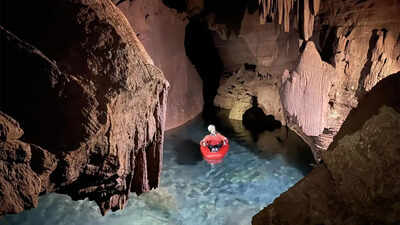
Computer: Northern Arizona University
Anyone standing on the edge of the Grand Canyon is usually drawn to what they can see: the sheer cliffs, the changing colors of the rocks, and the vast distances stretching toward the horizon.
However, some of the valley’s most important features are hidden from view. Beneath the dry landscape lies a network of caves, crevices and underground passages that quietly move water through the area. This hidden system provides springs that support wildlife, plants and the millions of visitors who arrive each year. As droughts increase across the American Southwest, and as water resources face increasing pressure, attention is turning to the land below.
Scientists are now trying to understand how water moves across these invisible landscapes and what might threaten them in the future.
Inside the insulated spring system that supports the Grand Canyon
For many visitors, access to drinking water within Grand Canyon National Park is easily taken for granted. Water stations along popular trails provide relief from extreme temperatures, especially for hikers traveling deeper into the valley during the summer.According to Northern Arizona University, much of this view lies behind Roaring Springs, a powerful spring that emerges from rock formations on the canyon’s northern rim.
It feeds infrastructure that distributes water across parts of the park while also maintaining habitats that depend on reliable year-round flow.Spring is located far away and remains largely out of sight. Although people passing by may hear the rushing water, getting to the source itself is not easy. This isolation has helped preserve the area, but it has also left many unanswered questions about how the water got to the spring in the first place.
Remote cave systems containing clues about the valley’s water supply
The caves connected to the valley’s spring systems are not tourist attractions. Many of them are difficult to access, hidden away from designated roads and protected from public access.To study it, teams from Northern Arizona University spent weeks navigating demanding underground environments. Equipment, food, and safety equipment must often be carried across rugged terrain before researchers can even reach cave entrances.
Once inside, the movement becomes slower and more complex. Passages may require climbing or crawling through tight spaces or descending vertical sections. In some areas, water fills parts of the cave, forcing researchers to float equipment through flooded chambers.
Conditions can change quickly, and mapping even a relatively small portion takes a long time.
How laser technology reveals underground canyon structure
Instead of relying solely on traditional cave surveys, scientists used mobile lidar technology to record the shape of underground passages with remarkable precision.
As researchers move through the caves, laser measurements pick up walls, ceilings, openings and geological features. The result is a digital reconstruction that allows scientists to examine spaces in ways that were previously impossible.Over the course of more than a month of field work, more than ten kilometers of cave passages and rooms were documented. The resulting maps reveal patterns that are difficult to recognize during a single underground visit.For geologists, these patterns are important. The arrangement of cracks, fractures and tunnels can provide clues about how water formed rocks over thousands of years and how it continues to move across the subsurface today.
Inside the underground water system hidden beneath the Grand Canyon
At first glance, the water source seems relatively obvious. Eventually, the snow falling on the Kaibab Plateau melts and enters the ground. Between the surface of the plateau and the springs emerging deep in the valley are multiple layers of rock, each with different characteristics.
Water does not simply travel downward in a direct line. Instead, it follows paths created by fractures, faults and dissolving limestone channels.Previous tracking experiments have indicated how quickly the movement occurs. The dye introduced into the gaps on the plateau later appeared in springs several kilometers away, sometimes over surprisingly short periods.
How decades of snow and climate data can reveal new water patterns
The next stage of research will shift attention from the caves themselves to the landscape above them.
Scientists plan to combine airborne lidar data with decades of satellite observations to study how patterns of snow accumulation and snowmelt are changing across the region. Disappearing streams, streams and other surface features will also be mapped in greater detail.Long-term records are especially valuable because snow levels in Arizona have shown a gradual decline over time. Changes in snowfall affect the amount of water that eventually reaches underground reservoirs and springs. By comparing historical trends with recent observations, researchers hope to get a clearer picture of how climate shifts will affect groundwater systems that rely heavily on seasonal snow.