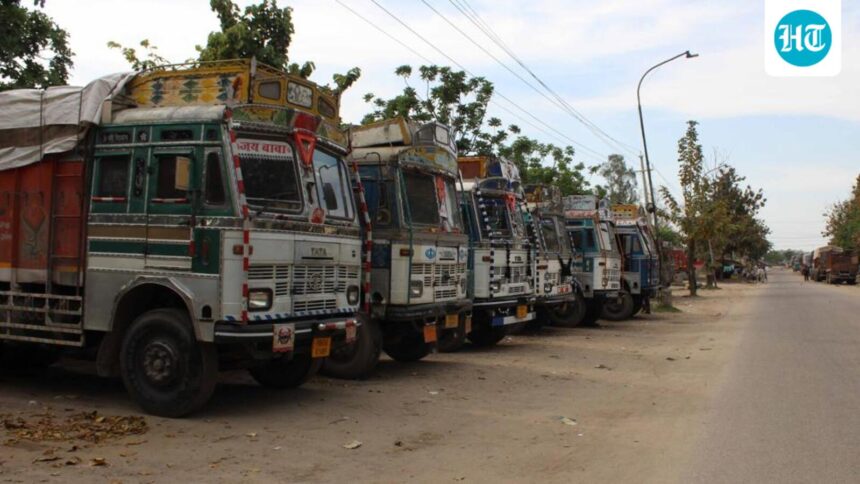
The Union Cabinet on Wednesday approved replacement of old trucks and buses with Bharat Stage VI (BS-VI) vehicles or electric vehicles in the Delhi-National Capital Region (NCR) region through $9,585 crore scheme as part of efforts to reduce air pollution.

BS-VI, the most stringent government-mandated standard for vehicle emissions and equivalent to Euro 6, seeks to reduce air pollutants.
The scheme approved on Wednesday offers a 5% interest subsidy on loans for five years and monthly fuel vouchers of up to $4800 for vehicle owners. Car manufacturers will offer a discount of 8% on the ex-showroom price of new cars purchased under the scheme. To avail the benefits, owners will have to dispose of BS-III and older vehicles at approved scrapping facilities.
BS-IV vehicles can be sold and operated in cities not covered by the National Clean Air Programme. The NCR Planning Board under the Ministry of Housing and Urban Affairs will fund the scheme. It will be implemented by the Ministries of Land Transport, Highways, Petroleum and Natural Gas.
The governments of Delhi, Haryana, Rajasthan and Uttar Pradesh will waive registration fees and give up to 100% motor vehicle tax concessions for new vehicles and 50% for used vehicles for 10 years. They will also waive outstanding liabilities on old vehicles as part of the scheme.
Union Minister Ashwini Vaishnao said that these measures will bring a huge change and create the possibility of replacing more than 200,000 vehicles.
Amit Bhatt, Managing Director, International Council on Clean Transport (India), described the move as a welcome step. “…Our study of real-world emissions in Delhi showed that pre-BS-VI vehicles had very high emissions, with commercial vehicles being the worst of all.”
He said that switching to clean fuel and electric power will definitely help improve the air quality in Delhi. “It is necessary to dispose of these vehicles to ensure that they are not reused or misused in neighboring states. Otherwise, they will continue to affect Delhi’s air and defeat the purpose of this policy.”
The air pollution crisis in the Delhi-NCR region extends beyond the winter months. Seasonal factors, such as burning tree stubble and adverse weather conditions, exacerbate pollution in October and November. Air quality remains poor during most of the year due to emissions from vehicles, industry, construction activities, road dust, and waste burning.
According to IQAir’s Global Air Quality Report 2025, Delhi remained the world’s most polluted capital for the eighth consecutive year, recording an annual average PM2.5 concentration of 82.2 micrograms per cubic metre, more than 16 times the WHO guideline of 5 micrograms per cubic metre.
Trucks and buses account for 36% of PM2.5 emissions in the region’s transport sector despite making up only about 3% of the vehicle fleet, the government said, citing a 2018 study by the Automotive Research Society of India and the Energy and Resources Institute.
“It is estimated that one pre-BS-VI heavy-duty vehicle emits as many as 14 BS-VI compliant vehicles. Even a BS-IV vehicle emits 2.7 times more than its BS-VI counterpart. Hence, the newer fleet is expected to reduce vehicle pollution significantly,” the government said in a press release.