

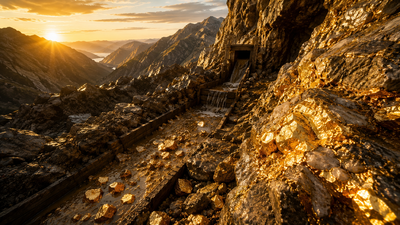
For decades, archaeologists suspected that the strange landscapes hidden in the Spanish Pyrenees were more than just a product of nature. Deep trenches, man-made ravines and massive excavated areas point to a forgotten human story buried beneath the mountains.
Now, researchers have confirmed that the site, known as Guilleteres d’All in north-eastern Spain, was once a Roman gold mine nearly 2,000 years ago. The discovery of an ancient reservoir preserved beneath layers of sediment has provided the strongest evidence yet that Roman engineers used sophisticated hydraulic mining techniques to extract precious metals, reshaping the entire mountainside in the process and moving millions of tons of earth without the need for modern machinery.
The Spanish mountain that hid the secret of the Roman gold mine
Located in the Cerdanya Valley near the border between Spain and France, Guilleteres d’All appears at first glance to be a rugged, mountainous region shaped by natural forces. Closer examination reveals something entirely different.Archaeologists have identified a network of narrow ditches, cut slopes and large pit faces extending across the site. One of the most notable features is the circular excavations some 300 meters across, an extent that immediately suggests human intervention.
Researchers from the University of La Coruña and the University of Barcelona concluded that these features were created by Roman miners who transformed the landscape in search of gold. Their findings suggest that the site was part of a carefully planned mining operation rather than a small-scale excavation effort.
The innovative water-powered system used to extract gold
Instead of digging deep underground tunnels, Roman miners relied on hydraulic mining, a technique that uses water as a powerful drilling tool.The process included collecting large quantities of water in tanks and directing it through canals towards gold-bearing sedimentary deposits. When released, the water loosens soil, gravel and loose rocks, washing away material on the slope. Workers can then separate small gold particles from the sediment.This method allowed the Romans to process huge amounts of land efficiently. It also reduced the need for extensive underground excavation, making it particularly useful in mountainous areas where gold was spread through ancient sedimentary layers.The newly confirmed mine demonstrates how advanced Roman engineering was at the height of the empire.
The buried tank that solved a centuries-old mystery
While archaeologists have long suspected that the site was Roman, proving its age has remained difficult.That changed during excavations conducted between 2010 and 2022, when researchers discovered an ancient reservoir buried beneath centuries of accumulated sediment. The structure is approximately 4.5 meters wide and 1.5 meters deep, and was reinforced with a dam built of large stone blocks.The reservoir stored and regulated the water used throughout the mining process. After the site was abandoned, layers of sediment gradually settled on its floor, preserving a record of its history.To determine when the reservoir was last used, the researchers used optically stimulated luminescence (OSL) dating, a technique that measures the last time quartz grains were exposed to sunlight.The results showed that the hydraulic system was abandoned between the late 2nd and early 3rd centuries AD, placing the process within the Roman era.
The Romans moved an amazing amount of land
The size of the mining complex is one of the most notable findings of the study.Researchers estimate that approximately 2 million cubic meters of land have been displaced during mining activities. Depending on the density of the material, that represents several million tons of sediment moved using little more than gravity, water, and human labor.Even today, the scars left by the operation are still visible on the mountainside.
Excavated ditches and ravines continue to shape the landscape nearly two millennia after Roman workers abandoned the site.Although smaller than Las Medulas, the most famous Roman gold mine in Spain, Guilletres Dahl shows that similar mining techniques were used in multiple regions of the empire.
Ancient texts alluded to Pyrenees gold
Historical sources have already indicated that the Pyrenees contain valuable gold deposits.The Roman writer Pliny the Elder described the mineral wealth of the area, while the poet Martial noted the gold associated with the area around the Roman settlement of Julia Lipica.The newly confirmed mine is located near Iulia Lipica, the only known Roman city in this part of the Pyrenees. Researchers believe that the settlement may have played an important role in organizing mining operations and managing the local economy.Additional archaeological finds support this connection, including a metal workshop found at El Castelot de Pulver and a gold bracelet found in a nearby Roman cemetery.This discovery offers more than just evidence of a forgotten gold mine. It provides a glimpse into the technological capabilities and economic priorities of the Roman Empire.Mining was a vital source of wealth, helping to finance military campaigns, public works, trade networks, and imperial administration. The ability to construct large-scale reservoirs, canals and hydraulic systems in remote mountainous environments highlights the extraordinary engineering skills developed by Roman societies.The discovery also shows the extent to which the empire fully exploited natural resources, expanding complex industrial activities into regions that may have seemed isolated from the ancient world.
A hidden chapter of Roman architecture comes to light
The mountains of northeastern Spain have hidden this story for nearly 2,000 years. What once seemed like an extraordinary landscape shaped by erosion is now recognized as a legacy of one of the most sophisticated mining operations of the ancient world.Thanks to the discovery of a buried reservoir and modern dating techniques, archaeologists have finally been able to confirm that Roman engineers turned this remote valley into a massive gold-mining complex. Their achievement is a reminder that long before modern machines existed, ancient civilizations were already capable of moving mountains in search of precious resources.