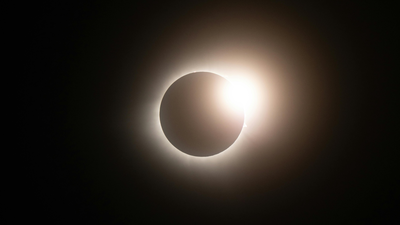
The longest total solar eclipse of the 21st century visible from accessible land masses will occur on August 2, 2027. At the peak of this stunning astronomical event, the sky will plunge into darkness for approximately 6 minutes and 23 seconds as the Moon completely blocks the Sun.
The rare eclipse of 2027 will be visible in Spain, Morocco, Algeria, Libya, Egypt and Saudi Arabia, among other countries, attracting many tourists, eclipse chasers and astronomers. This once-in-a-century astronomical event is expected to be one of the best events to watch over the next decade. According to experts, this long eclipse is due to the perfect alignment between the Earth, the Moon and the Sun.
People watching from within the path of totality will enjoy a stunning astronomical event featuring dark skies, a solar corona, and stunning views of the eclipse. The 2027 total solar eclipse is expected to be a historic event for lovers of astronomy, eclipse tourism, solar eclipse observation, celestial events and space science, providing a rare opportunity to view one of the longest total eclipses of the century.
Why will the 2027 total solar eclipse last so long?
A solar eclipse occurs when the Moon moves between the Sun and the Earth, casting its shadow on the surface of our planet. However, not all of these events last for the same period.The eclipse, scheduled for August 2, 2027, is expected to last for up to 6 minutes and 23 seconds, making it the longest eclipse visible on Earth throughout this century. According to the calculations provided by the scientist named Fred Espenak, who was quoted NASA website about the eclipse, the unusual duration of this phenomenon is linked to several reasons.According to the data of the official website of Eclipsophile, first, at the time of the event, the distance between the Moon and our planet will be rather small, so the Moon will appear relatively larger. At the same time, the distance to the Sun will be at its maximum due to the Earth’s position, referred to as aphelion, due to which the Sun appears smaller.As experts in this field point out, such an alignment of objects is rather rare, therefore, there are not many cases when the period of totality becomes extremely long.
Where this longest solar eclipse will be visible
The path of the total eclipse will extend over thousands of kilometres, starting in the Atlantic Ocean before moving through southern Europe, northern Africa, and parts of the Middle East.According to official eclipse calculations from Time and Date by the National Solar Observatory, AURA and the National Science Foundation, the total eclipse will be visible from parts of Spain, Gibraltar, Morocco, Algeria, Tunisia, Libya, Egypt, Sudan, Saudi Arabia, Yemen and Somalia. Egypt is expected to offer some of the best viewing conditions anywhere in the world.
The areas near Luxor and parts of the New Valley Governorate will witness the longest period of darkness, approaching 6 minutes and 23 full seconds. Astronomical calculations indicate that the point of the greatest eclipse will occur in Egypt, where observers will witness one of the longest periods of power outages during the day as a result of a solar eclipse in modern history.
What people will experience during a total eclipse
For just a few minutes, daylight will give way to dusk.
During the brief moment that the Moon completely eclipses the Sun, the temperature will temporarily drop, and the planets will appear bright.According to NASA, totality is the only phase in a solar eclipse when the outer layers of the Sun’s atmosphere, called the corona, become visible to the naked eye.Astronomers will witness other rare events such as Bailey’s beads and the diamond ring effect, caused by sunlight shining through valleys of the moon’s surface before and after a total eclipse.
The total eclipse event continues to arouse great interest among astronomers.
How to view the total eclipse safely
While a total eclipse can be observed without eye protection for only a short time, looking directly at the sun at any other stage of the eclipse may severely damage the eyes. Viewers should use internationally approved sunglasses. Ordinary sunglasses do not provide adequate protection.Viewers who are not in the path of the total eclipse will have the opportunity to view the partial eclipse in large areas of Africa, Europe, and Western Asia.
Based on time and date estimates, more than four billion people will get a chance to observe at least part of the eclipse.The total solar eclipse in August 2027 will be the most viewed astronomical event of this century. Given its duration of six minutes, the absence of clouds in some areas of North Africa, and the viewing path that passes through historical places between Spain and Egypt, it will provide a unique opportunity to watch the daytime sky turn dark. For many people, this may be the longest and most spectacular solar eclipse of their lives.