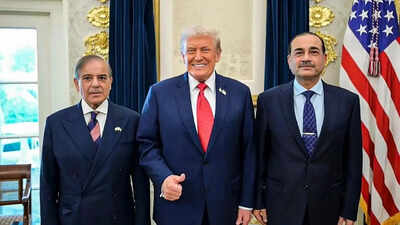
Donald Trump with Pakistani Prime Minister Shehbaz Sharif and Army Chief Asim Munir (PTI file photo)
Pakistan’s fragile economy spends an estimated $900,000 a month on lobbying efforts in the United States, bringing its annual spending to roughly $10 million to $12 million, according to public disclosures filed under the U.S. Foreign Agents Registration Act (FARA).This spending comes at a time when Pakistan faces increasing economic challenges. Besides the worsening water crisis after India suspended the Indus Water Treaty following the terror attack in Pahalgam, the country has also been hit by rising fuel and LPG prices in the wake of the Iran war.Pakistan still suffers from a heavy debt burden and remains dependent on support from the International Monetary Fund.
Despite securing bailout packages, the economy remains vulnerable to recurring fiscal pressures, foreign exchange shortages and slow growth.The FARA filings paint a picture of a wide-ranging influence campaign aimed at bolstering Islamabad’s position in Washington even as it faces economic and diplomatic challenges at home.These leaks reveal a network of lobbying firms hired to improve Pakistan’s position on issues ranging from security cooperation and trade to broader diplomatic outreach.
Foreign affairs expert Rupinder Sachdev told news agency ANI that the scale of Islamabad’s lobbying efforts reflects its determination to secure access and influence in Washington.“Recent reports of a $1.2 million contract are not unusual for Washington,” Sachdev said. “All foreign governments maintain lobbyists at different times.”“According to public FARA data, Pakistan currently spends approximately $900,000 per month on lobbying.
This includes a $50,000-a-month contract to hold meetings involving the Interior Minister and another company that charges $250,000-a-month to handle commercial issues.”Sachdev also mentioned that a lobbying firm hired in October for $25,000 a month recently saw its contract expand to $1.2 million, highlighting Pakistan’s growing need to boost its image and influence in Washington.The documents also raise questions about the claims of Pakistani Army Chief Asim Munir.
Speaking at a ceremony held at the General Headquarters in Rawalpindi, Munir claimed that India sought mediation through the United States during the military tensions between the two countries.“India expressed its desire to mediate through the American leadership, which Pakistan accepted in the interest of broader regional peace,” Dawn News quoted Munir as saying.However, FARA files reviewed by ANI indicate that Pakistan intensified its lobbying efforts in Washington at the same time that India was carrying out military operations under Operation Sindoor.Between May 6 and 9 last year, Pakistani representatives recorded nearly 60 interactions with officials and lawmakers across Capitol Hill, the Pentagon and the US Treasury Department. These clashes took place during Operation Sindoor, India’s military response to the Pahalgam terror attack.After suffering a major setback during Operation Sindoor, Asim Munir also made frequent visits to the United States in an attempt to gain greater recognition and earn a “pat on the back” from Donald Trump, seeking to be seen as MAGA’s “favorite field marshal.”While Pakistani lobbyists were actively interacting with American decision-makers, Indian armed forces were launching strikes on major terror centers harbored by Pakistan.Last year, India launched precision strikes on nine major terror hubs linked to Lashkar-e-Taiba, Jaish-e-Mohammed and other terrorist groups based in Pakistan. When Pakistan intervened in India’s counter-terrorism operation, New Delhi escalated its response by targeting major Pakistani military installations, including the strategically important Noor Khan and Rahim Yar Khan air bases.The Pakistan Armed Forces Registration Act leaks suggest that even as Pakistan’s military leadership publicly displayed confidence, its lobbying teams in Washington were working intensely behind the scenes during the period of military escalation.