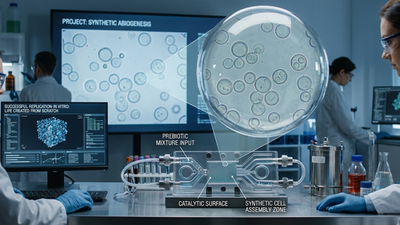
The problem of how life evolved on Earth has interested many great scientists for centuries. Now, according to an exciting study published in the Proceedings of the National Academy of Sciences (PNAS), scientists from Harvard University may be a step closer to knowing how life formed on Earth.
Using their skills and knowledge, scientists from this prestigious university were able to build cells that are not living in any way, but are capable of self-reproduction, growth and development without benefiting from any biological component of a living entity.
Their findings are expected to spark heated discussions about abiogenesis, artificial life forms, artificial cells, the theory of evolution, studies of the origin of life, and self-replicating systems.
how Harvard scholars Creating self-replicating cells using only non-living chemicals
Self-replication as an independent process of growth and reorganization in abiotic, synthetic, and fully synthetic cells has been performed by Sai Krishna Katla, Chenyu Lin, and Juan Pérez Mercader at Harvard University and the Santa Fe Institute.Scientists began their research using a completely homogeneous solution of non-living matter. After irradiating the material with green light, it formed vesicle-like structures similar to those found in primitive cells.
The artificial progenitor cells underwent autonomous development, reorganization, and proliferation.As noted in the paper titled “Self-replication as an autonomous process of growth and reorganization” in abiotic, synthetic, and fully artificial cells, self-replication has been “one of the main features of a biological organism.” In other words, experience has shown that structure has a characteristic of life.Unlike many other synthetic biology experiments, reproduction did not require living cells, DNA, RNA, proteins and membrane-like structures.
This was done by purely chemical means.
how Darwinian evolution It may begin before life existed
One of the most fascinating aspects of this experiment is its relationship to Darwinian evolution and the origins of life.The artificial cells created new generations of follicles and populations that could grow and diversify. Although they are not alive, researchers say these systems may be an intermediate step between the two states, the point at which chemistry turns into biology.“The ability to evolve in this way from completely homogeneous, nonliving materials to structures that can grow and diversify is completely unprecedented,” said Juan Pérez Mercader of Harvard University, lead author of the study.“This is the first time, to my knowledge, that anyone has done something like this, generating a structure with the properties of life from something that is completely homogeneous at a chemical level and devoid of any resemblance to normal life.”Moreover, the results suggest that life does not necessarily need all the sophisticated machinery found in biological cells to begin evolution.In fact, this theory seems consistent with previous scientific findings according to which selection and evolution occurred before actual living organisms emerged. A 2021 study from Ludwig Maximilian University of Munich showed that simple organic polymers can undergo selection in prebiotic conditions.
A breakthrough in the origins of life research
The results have attracted the interest of researchers working in synthetic biology, astrobiology and evolutionary sciences.Harvard’s Origins of Life Initiative called this work an important advance in understanding how simple chemical systems become living systems. According to astronomer Dimitar Sasilov of Harvard University, the study shows how a self-creating system could arise from non-biochemical molecules.Kermit Bateson, who was not involved in the research, commented in an article in PhysOrg that the work opens a new path toward engineering self-replicating artificial systems.The implications extend far beyond understanding Earth’s past. Scientists believe that similar chemical processes could occur elsewhere in the universe, expanding the search for extraterrestrial life.
What this means for the future of artificial life
Although artificial cells are not technically living, this work is a landmark achievement in the fields of artificial life and abiogenesis.Scientists have long sought to determine the chemical processes that give rise to biological processes. Through this new process, it is possible to see how organization, reproduction, and evolution can occur from more or less basic elements when certain conditions are present.This in no way creates life; However, it provides a reliable route for the transition of chemistry into biology. With continued progress from this breakthrough, it may become possible to recreate what happened to bring life on Earth.
![‘euphoria’-finale:-how-does-he-die-[spoiler]?-break-this-character’s-death](https://globalindiabroadcastnews.com/wp-content/uploads/2026/06/54037-euphoria-finale-how-does-he-die-spoiler-break-this-characters-death-150x150.jpeg "euphoria-finale-how-does-he-die-spoiler-break-this-characters-death | GIBN")