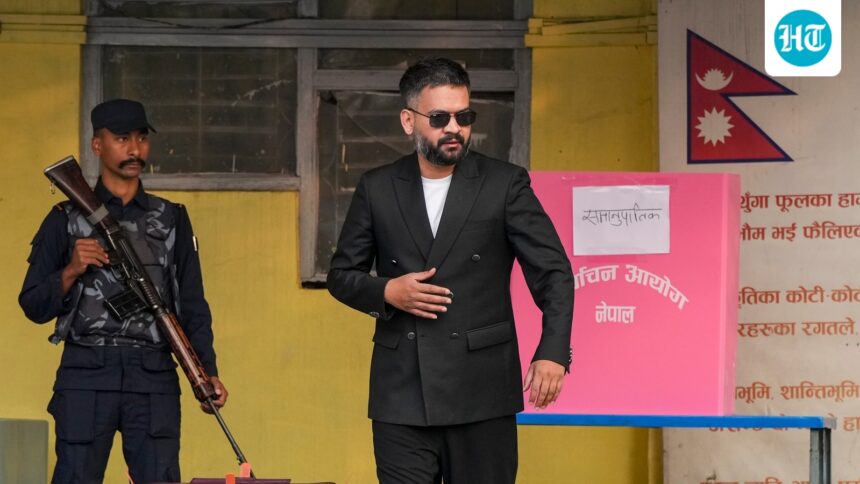
Nepalese Prime Minister Balindra Shah ‘Palin’ has sparked a political controversy at home after his remarks on the long-running border dispute with India during his first appearance in the ongoing parliamentary session.

Responding to lawmakers’ questions on the issue, Shah said the Lipulekh Corridor dispute could be resolved through diplomacy, revealing that his government had reached out to the UK and China. He said that since the conflict had its origins in the era of British India, the UK’s involvement was necessary. However, the Shah’s most controversial remark was his claim that territorial encroachments were not unilateral.
Read also | ‘The problem belongs to British India’: Nepal joins UK and China amid dispute over Lipulekh Pass
Shah said, “You will be surprised when you learn a fact that I did not know until after I became prime minister. It was not only India that encroached on Nepali territory, but Nepal also encroached on Indian territory in many places.”
He added that the two countries should examine the facts objectively and work together to resolve the dispute. He said, “Now the two countries must study the facts, sit together as friends, and resolve the issue.”
The comments sparked immediate backlash in Nepal.
Opposition lawmakers, including Basana Thapa of the Nepali Congress Party and Ramesh Malla of the Nepal Communist Party, demanded that these statements be expunged from the parliamentary record. They said that Shah must either provide evidence to support his claims or withdraw the statement.
Former Foreign Minister Pradeep Gyawali has reportedly sought an apology from the Prime Minister. Many social media users criticized Shah’s statements, while some experts denied his assertion.
Hours later, the Nepalese Foreign Ministry clarified that Shah’s comments referred to encroachments into “no-go zone” areas and cross-border occupations, and not any formal territorial claims by Nepal.
Read also | All about Lipulekh: The key corridor that left India and Nepal locked in a 210-year-old dispute | He explained
There was no immediate response from India. But earlier this month, New Delhi rejected Nepal’s objection to the upcoming Kailash Mansarovar Yatra project through the Lipulekh Corridor, terming Kathmandu’s claims over the area a “unilateral artificial enlargement” that India considers “indefensible.”
What is the controversy over the Lipulekh Pass?
The Lipulekh Pass has been a major point of contention between India and Nepal for decades, with both countries claiming the lands surrounding it. The dispute gained renewed importance in 2020 when Nepal, under then Prime Minister KP Sharma Oli, forcefully asserted its claims in the region amid mounting domestic political pressure.
The dispute escalated after Kathmandu unveiled a new political map that includes Lipulekh, Kalapani and Limpiyadhura within Nepal’s borders. Nepal says these areas belong to it under the provisions of the 1816 Sugauli Treaty signed with British India.
However, India has consistently rejected Nepal’s claims, maintaining that the territories form an integral part of India. The dispute has since remained a recurring irritant in bilateral relations, with both sides reiterating their positions on the issue.