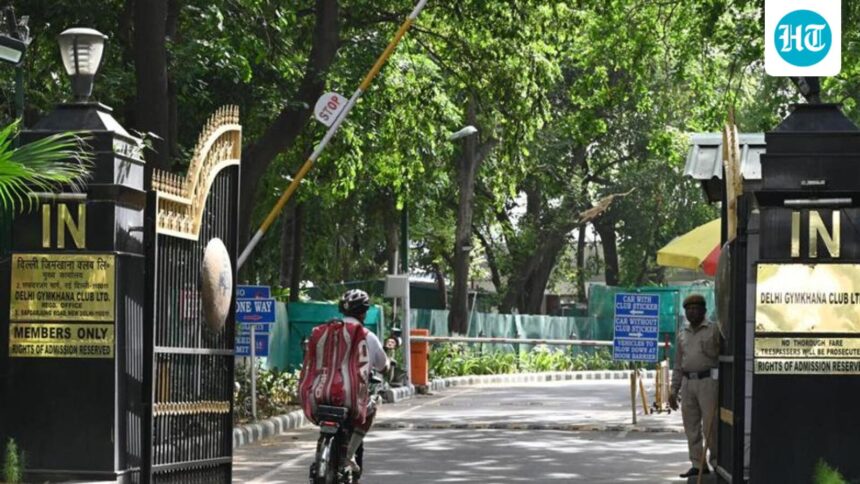
The proposed takeover of the iconic Gymkhana Club by the government raises questions about how the democratic state exercises its powers over leased land, defines “public good,” interprets “security,” and negotiates the complex legacies of India’s colonial past.

First of all, there is no doubt that the Government, as the undisputed owner of the leased lands, has the legal authority to reclaim these lands under certain circumstances. On this basis, the government’s right cannot be disputed.
But although this right may exist, the reasons given for exercising it can be debated. Governments in a democratic state are not monarchies that issue their decrees from the walls of certainty. They are responsible entities and their actions can be debated. In the case of the Gymkhana Club, invoking broad and non-specific expressions such as “security” and “public interest” could, in my opinion, benefit from greater transparency.
Read also: Just like that: the powerful role of cliques
Of course, state security is of the utmost importance, but one can only hope that “security” is not a convenient blanket phrase under which almost any executive action can be justified. In terms of the “public good”, if the government truly believes that this requires the resumption and redevelopment of prime urban land occupied by elite institutions, why does the Gymkhana Club alone become the target?
The entire Lutyens area occupies thousands of acres of some of the most valuable land in India. Ministers, members of Parliament, judges, senior bureaucrats and senior members of the armed forces often reside in sprawling bungalows spread over three to five acres each. In a capital with nearly 50% officially classified as slums, where millions live in cramped and unsanitary conditions, the question naturally arises: Would not the public good be better served by redeveloping the entire Lutyens area for low-income housing?
Once you start this process, where will you stop? Will the government then take over the management of the India International Centre, the Habitat Centre, the Delhi Golf Club, the Defense Officers Club at Dhaula Kuan, the Air Force Club, or even the Delhi Racing Club? Each of these institutions occupies valuable urban land. Each of them serves, in one way or another, a distinct segment of society. If exclusivity itself is the criterion for government intervention, it stands to reason that the principle should be applied consistently.
Does the Gymkhana Club represent a lingering Macaulian legacy of Anglophone elitism inherited from colonial rule? There is some truth to this criticism. For many decades after independence, clubs established under British rule were managed by an English elite who were the creation of the empire. The mental colonization of the previously privileged “natives” was evident. In the early 1990s, I was denied entry to the Gymkhana because I was not dressed appropriately even though, by my own culture’s standards, I was formally dressed in mincha pajamas and a silk kurta with closed Peshawari sandals, while others could walk in jeans and T-shirts. I protested vehemently, and I’m glad the club’s colonial dress code has changed.
Likewise, the Bengal Club in Kolkata – which ironically was Macaulay’s residence – did not open its doors to Indians until 1959, more than a decade after independence, and an Indian did not become club president until seven years after that! In Mumbai, another leading club kept this notice outside its headquarters for many years after independence: No dogs and Indians allowed.
There is a lot wrong with all this. Change has occurred, but perhaps it needs to accelerate. However, we must accept that every club is inherently elitist. The club exists precisely because there are barriers to entry. Whether these barriers are financial, professional, social, or institutional, the result is the same: inclusion for some and exclusion for others. For example, the Constitution Club is among the most luxurious and exclusive clubs in Delhi, but its membership is primarily limited to Members of Parliament and former MPs. Getting there is determined not by colonial lineage but by political position. The question is therefore not whether clubs are elitist – they inevitably are – but whether they operate within the law, whether they are managed responsibly, and whether they can evolve with changing social realities.
Let us also accept that inappropriate allegations of financial mismanagement and managerial ambiguity have often surfaced in the club’s performance. There are legitimate criticisms regarding its membership rules, especially the preference historically given to dependents and family succession. Such practices deserve review in a democratic society committed to expanding access and justice.
Read also:Exactly like this: Why deny the existence of Hindu civilization to counter political Hindutva?
But the government has already assumed significant control over the club’s management. Accordingly, could there not have been a process of dialogue with members and staff aimed at reform and not erasure? Could not the colonial orientation of the Club have been gradually transformed through political changes, increased inclusivity, transparent governance, greater permeability of Indian cultural heritage, and revised membership criteria? There is wisdom in the old English phrase: One should not throw out the baby with the bathwater.
My only worry is that the Gymkhana Club does not become a symbolic victim in a larger political project that remains insufficiently clear. If the government’s real concern is the public good, there must be a comprehensive and transparent urban policy that applies equally to all forms of privilege in Lutyens’ Delhi.
(Pavan K Varma is an author, diplomat and former Member of Parliament (Rajya Sabha). Views expressed are personal)