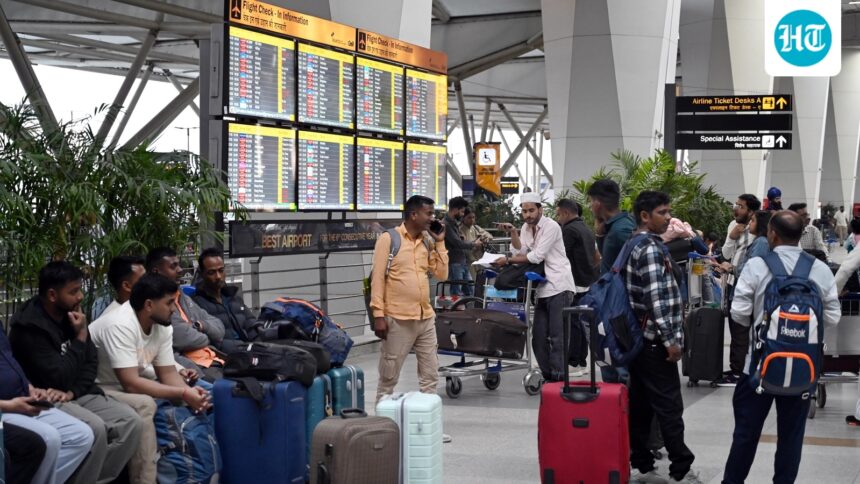
Airports in India may soon face financial penalties for failing to meet passenger service standards, as the government has reached the final stages of rolling out a performance monitoring framework, several officials familiar with the developments told HT.

Under the proposal, airports that fail to meet specified service standards could be penalized up to 5% of the passenger-related fees they collect – including user development fees (UDF), landing and parking fees. Of this, 4% will be linked to objective criteria and 1% to subjective criteria.
“This move aims to ensure the quality of service keeps pace with rising airport fees and modernizing infrastructure,” an official said.
The framework, which the Ministry of Civil Aviation is expected to announce this year, will be the first attempt to establish uniform service standards for major airports and formally link passenger experience to airport tariffs.
A draft consultation paper issued by India’s Airport Economic Regulatory Authority (AERA) – which regulates all airports handling 3.5 million or more passengers a year, about 35 passengers in total – notes that service quality assessments are currently largely carried out by airport operators themselves or by agencies they appoint, a system the authority considers inadequate.
As part of the exercise, external consultants visited airports including Delhi, Bengaluru, Hyderabad, Kolkata, Ahmedabad, Thiruvananthapuram, Patna and Jaipur over the past nine months to study passenger touchpoints, facilities and infrastructure.
The government will evaluate airports based on about 50 criteria covering objective, subjective and additional key performance indicators.
The AERA project proposes to classify airports under its jurisdiction into two categories based on annual passenger traffic: Category A for those handling 6 million passengers or more, and Category B for those below that threshold.
However, one official said the final framework may use three tiers – large, medium and small – with full implementation on large airports and selective application on medium airports.
The 16 objective criteria cover basic operations – passenger waiting times at entry gates, check-in counters, security checks, baggage delivery and arrival processing – as well as uptime of infrastructure, including flight information display systems, elevators, escalators, travellers, airport bridge availability, seating at boarding gates and automated services.
“Special focus will be on passengers with limited mobility and the facilities provided to them,” an official said.
Help desks, employee assistance and grievance redressal systems will also be monitored.
The 18 subjective criteria include airport cleanliness, ambiance, walking distances within terminals, staff friendliness, and value for money.
Another official said monthly surveys would be conducted by a third party, with penalties imposed every six months. The results of the survey will be made public, although a final decision has yet to be made on whether the airports will be officially ranked.
A third official said the government was also considering offering incentives to airports that exceed performance targets.
Officials said the framework will also track a range of forward-looking indicators — minimum connection times, passenger misconnection, transfer of passengers to landside, availability of cloak rooms, childcare rooms and unreserved wheelchairs — although these will not attract penalties initially.
“The aim is not just to punish airports, but to ensure improved quality of service along with expanding infrastructure and increasing tariffs,” an official said.
Similar frameworks linking service standards to financial consequences exist at Heathrow Airport in the United Kingdom and at airports in Malaysia.
Malaysia introduced a service quality framework in October 2016 to help airports operate efficiently while improving convenience for passengers, airlines, ground service providers and other airport users. The framework focuses on enhancing passenger comfort, prioritizing service standards, and improving the overall airport experience. It sets performance standards and key performance indicators (KPIs) for Terminal 1 and Terminal 2 at Kuala Lumpur International Airport across four categories. If an airport fails to meet the stipulated standards, it may be required to pay a rebate of up to 5% of its total turnover, payable quarterly to the Malaysian Aviation Commission (MAVCOM).
In its 2024 review of London Heathrow Airport fees, the UKCAA imposed service standards and set standards, and failure to meet these standards could result in rebates. In general, up to 7% of revenues could become payable if an airport fails to meet these standards. In addition, high performance on certain criteria may result in the airport operator being awarded a bonus of up to 1.44% of revenue