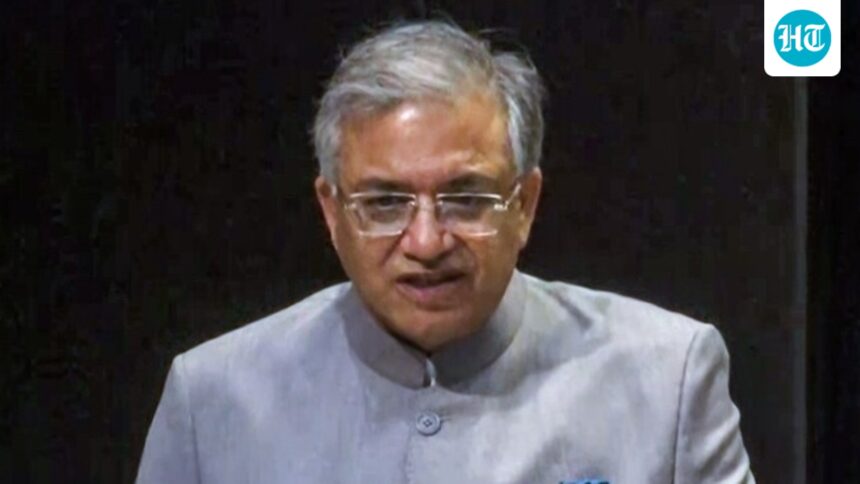
An extensive special review of electoral rolls has produced the world’s most accurate voter lists, Chief Election Commissioner Ganesh Kumar said on Saturday, rejecting opposition criticism of the practice, days after the Supreme Court upheld its validity.

Inaugurating the second national conference of IEC consultants at the International Institute for Democracy and Electoral Management (IIIDEM) in New Delhi, Kumar said the SIR was conducted by over 1.1 million booth level officials, assistant electoral registration officers and electoral registration officers – all state government employees on deputation to the commission.
Kumar said the SIR produced “the most pure and accurate electoral rolls in the world, ensuring that every eligible voter is included in the list and every ineligible name is removed.”
“Fair lists lead to fair elections. This is the moment India is in today,” he added while congratulating voters in Assam, Kerala, Puducherry, Tamil Nadu and West Bengal for their participation in the recently concluded Assembly elections.
These statements come days after a Supreme Court bench comprising Chief Justice of India Surya Kant and Justice Joymalia Bagchi held that the exercise of SIR reinforced the constitutional necessity for holding free and fair elections and that the measures adopted by the poll panel were lawful, proportionate and accompanied by adequate procedural safeguards.
So far, Assembly elections have been held in six districts where SIR was conducted and millions of names have been deleted. In West Bengal, 9.1 million names were removed and 2.71 million people – placed under the category of contentious inconsistency – were disenfranchised as the appeal process ran out of time.
Kumar stressed that the exercise was carried out “under the close watch of more than 15 lakh (1.5 million) agents and district and state presidents of all national and state political parties,” effectively arguing that the process has multi-party oversight at every level.
He praised these officials “for carrying full transparency in preparing electoral lists on their strong shoulders, despite the adverse pressures day and night.”