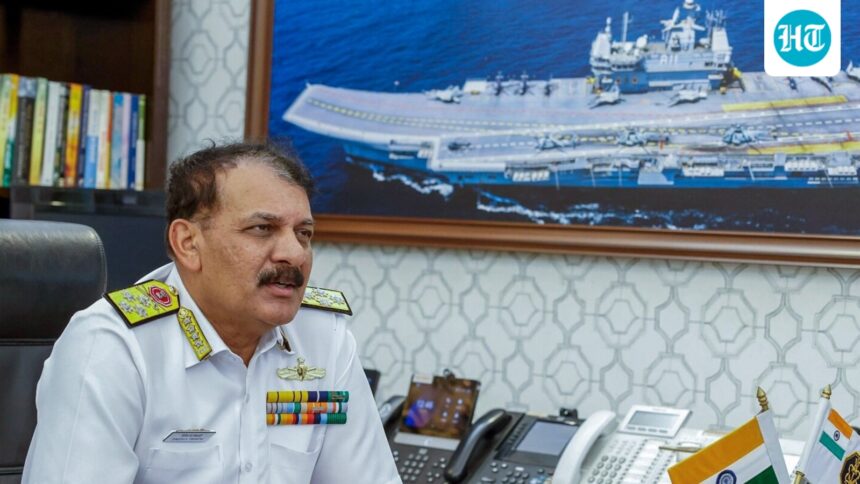
Navy Chief Admiral Dinesh K Tripathi on Saturday said that the Indian Navy’s aggressive stance during ‘Operation Sindoor’ forced the Pakistan Navy to remain confined to its ports and hurt Islamabad’s maritime economy by increasing shipping risks and insurance premiums.

In an interview with PTI, Admiral Tripathi said the Navy has maintained an “unprecedented operational tempo” across strategic waters, clocking nearly 11,000 ship days and over 50,000 flight hours in 2025 alone.
Admiral Tripathi, who participated in Operation Sindoor, said it demonstrated the Navy’s absolute combat readiness, operational range and deterrence capabilities.
Read also | The many successes of Operation Sindoor
He said the Navy’s immediate deployment of the aircraft carrier battle group and its forward operational posture in the North Arabian Sea forced the Pakistan Navy to remain confined to the port or near the Makran coast.
“This aggressive stance has reaffirmed our ability to quickly position combat power and successfully shape the strategic environment, while at the same time impacting the (Pakistan) maritime economy due to increased shipping risks and higher insurance premiums,” he said.
“Equally important was the tri-service synergy demonstrated during the operation, which underscored the growing importance of joint operational capability.”
In the wake of the terror attack in Pahalgam, the Navy quickly deployed its frontline assets including submarines, warships and almost all its aircraft with full combat readiness which maintained constant pressure on Pakistan.
“In an increasingly interconnected and contested maritime environment, the Indian Navy has maintained an unprecedented operational pace across regions of interest to us – logging nearly 11,000 ship days and over 50,000 flight hours in 2025 alone,” he said.
“At the forefront of these achievements was Operation Sindor, which demonstrated our absolute combat readiness, operational reach, and deterrence capabilities.”
“The immediate deployment of an aircraft carrier group and our forward operational posture in the North Arabian Sea forced the Pakistan Navy to remain confined to the port or near the Makran coast,” he said.
The Navy Commander’s response came when he was asked about the readiness of his forces and their contribution to national security during his term.
Admiral Tripathi said that enhancing capabilities and modernizing the force remain his key priorities as the maritime domain has become increasingly contested and technologically complex.
“Our focus is squarely on building credible deterrence by modernizing our fleet with capable multi-dimensional platforms. Since 2025, we have inducted two submarines – one of which entered service in the presence of the Prime Minister – and 18 warships, including destroyers, frigates and anti-submarine warfare ships,” he said.
Highlighting the Navy’s increased combat capabilities, Admiral Tripathi mentioned the multi-domain exercises carried out by his force including TROPEX and AIKEYME exercises.
“Our final biennial exercise, TROPEX-2025, successfully integrates conventional naval operations with a cyber and information warfare exercise under realistic conditions,” he said.
He added: “It operated across an expansive theater extending approximately 4,300 nautical miles from north to south and 5,000 nautical miles from the Strait of Hormuz to the Sunda Strait and Lombok, and witnessed the participation of more than 65 Indian naval ships, 10 submarines and more than 80 aircraft, achieving a very high level of operational synergy with the broad participation of the Indian Army, Indian Air Force and Indian Coast Guard.”
“In order to accelerate this integration, the Navy led the tri-service Trishul exercise off the coast of Gujarat in November, exercising combined effects-based operations on land and at sea,” he said.
The Navy chief also noted his forces’ efforts to realize Prime Minister Narendra Modi’s vision of MAHASAGAR or “mutual and comprehensive advancement of security and growth across regions”.
“Over the past two years, we have conducted or participated in 23 bilateral, 16 multilateral, and 70 maritime partnership exercises,” he said.
“Finally, our sustained presence has been demonstrated through humanitarian assistance and disaster relief missions, including Operation Brahma in Myanmar following the earthquake, and Operation Sagar Bandu in Sri Lanka after Cyclone Ditoa,” he said.
At the same time, anti-drug operations, in coordination with other national agencies, resulted in the seizure of a quantity of smuggled materials $43,300 crore, which has severely deteriorated the illicit transnational networks in our region,” he said in an email interview.
“Overall, these achievements reflect a naval force that is not only operationally ready on a day-to-day basis, but is also capable of generating deterrence, achieving integrated effects, and protecting Indian maritime interests anytime, anywhere and in any condition,” he added.