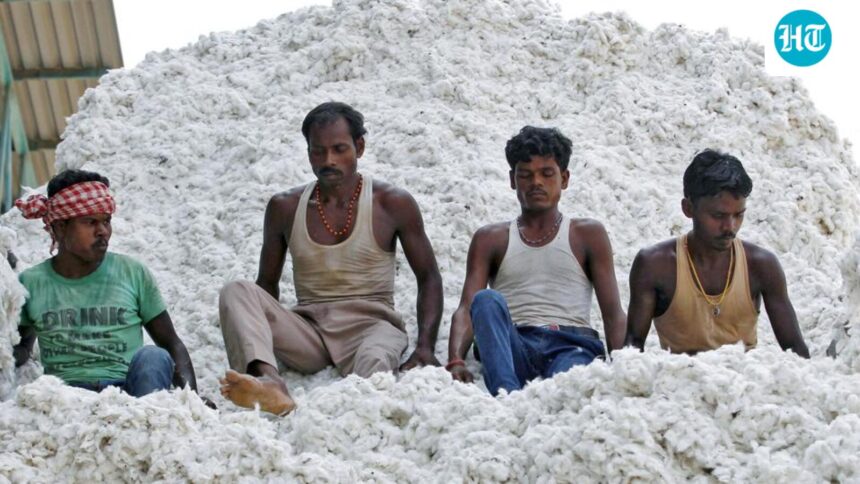
The Center announced on Saturday that cotton imports would be exempt from customs duties to ensure the availability of raw materials at competitive prices for local textile industries for a period of five months starting from Monday.

“This notification shall come into force from the first day of June 2026 and shall remain in force till the 31st day of October 2026,” the union finance ministry said in an order.
Import duties on cotton were reimposed on January 1, 2026, after a brief pause from August to December 2025.
The government has “temporarily” exempted all customs duties on cotton imports to increase its availability for the Indian textile sector, a government spokesman said.
“The temporary exemption from customs duties is expected to reduce input costs in the textile and apparel sector, thereby providing targeted relief to manufacturers and consumers, while also keeping in mind the interests of local farmers,” he said.
Overall, he added, this measure is expected to have a positive impact on the performance of the local textile industry, especially small and medium enterprises, ensuring better availability of cotton in the market.
Read also:Can regenerative agriculture secure the future of Indian cotton?
The Confederation of Indian Textile Industry (CITI) said the temporary removal of 11% import duty on cotton can help the Indian textile and apparel sector increase competitiveness in the international market amid global headwinds.
“Amid ongoing global volatility and uncertainty, the 11% import duty on cotton has been a major constraint on the Indian textile and apparel sector in raising its global competitiveness as our major Asian competitors already enjoy duty-free access to cotton,” said Ashwin Chandran, Chairman, CITI.
He said cotton import duties had led to higher costs across the value chain and had a detrimental impact on expanding India’s textile and apparel exports.
Cotton dominates Indian textile exports.
India competes with countries like Sri Lanka, Bangladesh and Vietnam in the price-sensitive international apparel market where margins are razor-thin.
Even as India aims to achieve $100 billion in textile and apparel exports by 2030, readymade garment exports (of all types) witnessed an annual contraction of 1.4% in 2025-26 to reach $15.8 billion.
Exports of cotton yarn, fabrics, makeup, and handloom products decreased by about 4% to $11.58 billion in the same period.
Overall, all textile and apparel exports fell 2.2% to $35.79 billion in the period.
“With this temporary relaxation in cotton import duties, India’s textile and apparel exporters can better leverage opportunities arising from free trade agreements,” Chandran said.
While the FTA between India, the UAE and Australia is in effect, the FTA with Oman will come into effect from Monday and with the UK very soon.