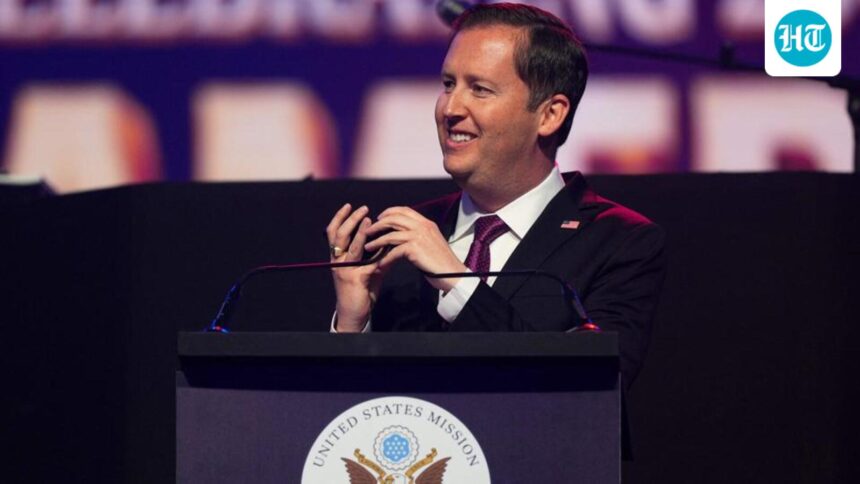
US Ambassador Sergio Gore said on Friday that only “1%” of the proposed India-US trade agreement has not been finalized yet, and Washington expects to sign the agreement in the next few weeks after a US team visits New Delhi for further negotiations.

Gore, a close aide to President Donald Trump, made the remarks while delivering a speech at the Indian Institute of Technology (IIT) in Delhi, during which he called for deepening cooperation between the two countries in the field of artificial intelligence, pharmaceuticals, quantum computing and critical minerals.
The Commerce Department announced this week that a US team led by the US chief negotiator is scheduled to visit India from June 1-4 to advance discussions toward concluding an interim bilateral trade agreement. This comes within the framework of a follow-up to the visit made by the Indian negotiating team to Washington during the period from 20 to 23 April.
“Our current interim trade agreement is on the table so that we can finalize it, and that will unlock prosperity for both our countries… India has sent a team to Washington, D.C., to finalize the last 1% of that trade deal,” Gore, while speaking on the topic “US-India Trust Initiative: Strengthening Partnership in Research and Innovation,” said.
He added: “Next week, we will welcome an American delegation here to continue those talks. We fully expect the trade agreement to be signed within the next few weeks and months.”
Gaut noted that Indo-US trade in goods and services has grown from $20 billion to more than $220 billion in just over two decades, reflecting “deeper and broader engagement and stronger economic integration.” Trump’s goal “is to facilitate bilateral trade in a way that creates unprecedented opportunities for American businesses and workers,” he said, and India is among the United States’ largest trading partners.
On February 7, India and the United States issued a joint statement agreeing on a framework for an interim agreement for mutually beneficial trade. The framework also confirmed the commitment of both sides to the bilateral trade agreement negotiations.
People familiar with the matter said there was a greater push from the US side to conclude the proposed trade deal in light of the Trump administration’s desire to achieve a major economic victory in the months leading up to the US midterm elections scheduled for November. However, they said the Indian side is unlikely to agree to anything deemed inappropriate for local producers and farmers, such as opening up the agricultural sector further.
The people also pointed out that no significant economic deals have emerged from Trump’s recent visit to China, increasing pressure to quickly conclude the trade agreement with India. “The Chinese side has given no indication that it will increase purchases of US commodities such as soybeans,” one of the people said.
According to the Ministry of Commerce, the Indian side looks forward to finalizing the details of the interim agreement and moving forward with negotiations under the broader bilateral trade agreement in areas such as market access, non-tariff measures, customs, trade facilitation and economic security alignment.
Gore also said that the growth of trade relations is driven by innovation, investment and high-value sectors such as digital trade, advanced manufacturing, energy and emerging technologies.
Noting that critical and emerging technologies are reshaping the global balance of power, he said: “I believe there is no partnership better positioned to lead this charge than ours… I want us to be ambitious and work to shape the US-India relationship into the defining strategic partnership of the 21st century.”
Gore said the Trump administration has identified “new centers of power” such as India, leading to initiatives such as “Transforming the Relationship Using Strategic Technologies” or Trust, which was launched when Trump met Prime Minister Narendra Modi shortly after the start of his second term. The goal, he said, is to “encourage innovation with our most trusted partners while ensuring the protection of sensitive technologies.”
Under the bilateral AI infrastructure roadmap, the US Department of Commerce has restored the flow of advanced AI chips to partners around the world and steps have been taken to build data centers in India. He said that the two sides also agreed to adapt regulatory systems to enhance innovation, encourage investments, and deepen cooperation within the framework of Pax Silica to support supply chains.
Gaur said the United States imports nearly 40% of its generic drug needs from India because of trust between the two sides, while the US embassy and consulates in India received $20.5 billion in new investments for next year, including $19 billion from the pharmaceutical sector. He identified space as another dynamic area of cooperation, noting that partnership in this area is of strategic importance because it “addresses emerging threats… provides a counterbalance to China’s influence and drives technological innovation.”
Gore said that while the United States has reset its export control policies to balance legitimate security concerns with enabling trade, Washington also appreciates the steps taken by New Delhi on modernizing export controls. “When our two countries have strong export control systems, it creates the basis for deeper technology cooperation,” he said.