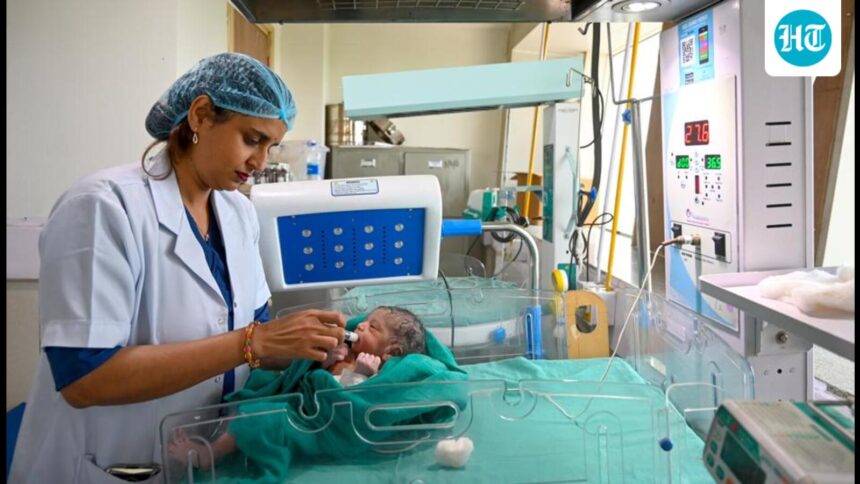
More women in India are choosing institutional births over home births than ever before, with a growing number of women preferring private facilities over government ones, according to the National Family Health Survey 6 (NFHS-6) released on Friday.

The report, which compiles data between 2023 and 2024, shows that institutional births in the country rose to 90.6%, up from 88.6% recorded during the previous NFHS-5 cycle (2019-2021). But there is a shifting preference towards private health care, with the share of births in public health facilities declining from 61.9% in NFHS-5 to 58.6% in NFHS-6.
The NFHS series provides information on population, health and nutrition in India. NFHS-6 (2023-2024) is the sixth in the series.
Institutional deliveries refer to the process of giving birth in a licensed health care facility under the supervision of professionals.
In addition to the increase in births in hospitals, the survey reported an increase in the percentage of births conducted under the supervision of skilled health personnel from 89.4% to 91.3%.
“Postnatal care coverage within 48 hours after birth also improved to 82.8%, enhancing continuity of care for both mothers and newborns,” the NFHS-6 report said.
Experts said that the increase in births in institutions has a direct impact on the decrease in the maternal mortality rate in the country.
“These improvements are also reflected in India’s continued progress in reducing maternal mortality, with the latest Sample Registration System (SRS) 2022-24 estimates putting the national maternal mortality rate at 87 per thousand live births,” said Union Health Minister Punya Salila Srivastava, who released the report.
A senior government official, speaking on condition of anonymity, noted that equipping several private hospitals under the Ayushman Bharat (AB-PMJAY) health insurance scheme may have a role to play in this transformation. “Several private hospitals are working under the umbrella of AB-PMJAY, which may have a role to play,” the official said.
The latest NFHS-6 results also highlight that prenatal enrollment in the first trimester of pregnancy increased from 70% to 76.2%, while mothers receiving four or more antenatal care visits increased significantly from 58.5% to 65.2%.
More than 95.9% of pregnant women now have access to antenatal care services, reflecting expanded awareness and stronger front-line systems, according to the Ministry of Health.
Srivastava said that these gains reflect the Indian government’s sustained investments under key initiatives such as Surakshit Matritva Ashwasan (SUMAN), Pradhan Mantri Surakshit Matritva Abhiyan (PMSMA) and Janani Suraksha Yojana (JSY).
“The contribution of ASHAs, ANMs, nurses, midwives and frontline workers has been key in improving overall maternal health care utilization in rural, tribal and underserved areas,” she said.
“India is increasingly leveraging digital innovation to enhance maternal health care delivery, beneficiary tracking, and continuity of care across the country. Platforms like the PMSMA portal, Kilkari, and the recently launched Integrated Antenatal, Delivery, and Neonatal Care (JANANI) journey enable real-time tracking of pregnancies, early identification of high-risk pregnancies, referral linkages, and data-driven decision making. It reflects the growing use of digital platforms within the framework of the national health mission,” she added. India’s broader vision is to bring Between technology, frontline healthcare delivery and community outreach to ensure that no mother or newborn is left behind.
The NFHS-6 report also points to an alarming health challenge: the sharp rise in lifestyle-related diseases, especially obesity.
The data shows that blood sugar levels among adults – 15 years and older – have been on the rise with people in the very high category rising from 6.3% in the 2019-2021 survey to 9.1% in the current survey, and the high category jumping from 6.1% to 7.5%.
The percentage of overweight or obese women also witnessed a jump from 24% previously to 30.7%. Among men, this percentage is 22.9% and 27.3%, respectively.
“Preventing lifestyle-related diseases is one of the government’s focus areas. Many programs are focusing on addressing this issue,” the Health Minister said.