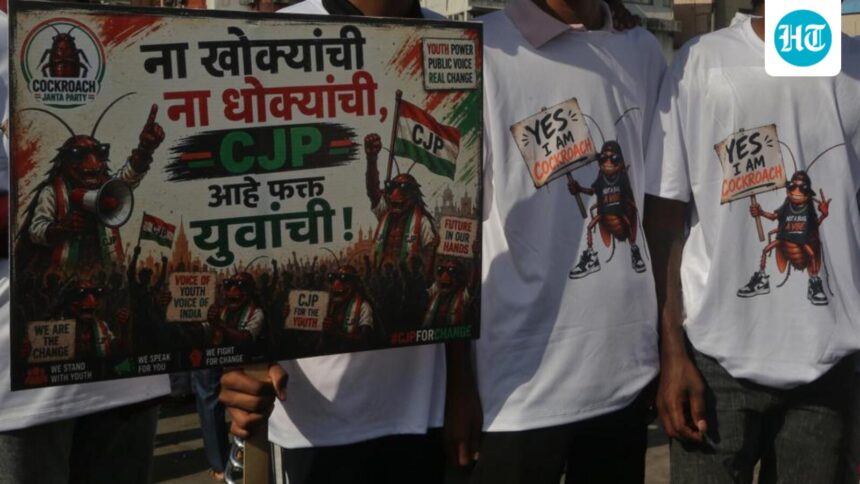
The Delhi High Court on Friday refused to immediately reinstate account ‘X’ of the online satirical collective Cockroach Janata Party (CJP), stating that the content on the page appears to be “mildly offensive”.

A bench of Justice Puruchendra Kumar Kaurav refused to grant interim relief while hearing the petition filed by RJD founder Abhijit Debke, saying the matter required “thorough consideration” and that any order would be passed only after hearing the Center and X.
The court noted that in previous cases it had ordered the restoration of accounts while directing the temporary blocking of the allegedly violating posts. However, in this case, after looking at the letter issued by social media platform ‘X’ to Dipke, the board noted that “the entire activity in itself is perhaps a bit offensive”.
However, the court issued notice on the petition and directed the Center and X to file a “comprehensive affidavit”. Debke was also given freedom to present his case before the Centre’s review committee under Rule 14 of the Prohibition Rules, 2009, which considers prohibitory orders.
Furthermore, the court directed the review committee to take a decision on freezing the account and present its decision before the court on the next hearing date on July 6.
“Mr. Sibal, in all these matters, we usually pass the interim order or the final order after hearing the other side. There seems to be little difference between this case and that case. In this case, perhaps the whole activity itself is a bit offensive. In your submissions, this requires consideration holistically. I am not saying no. We will hear the other side. These are far-reaching and broader issues,” the court noted.
She also said, “We will look into it. The entire law with regard to these proceedings is still at a nascent stage. Let us not be in a hurry. We will issue notice. The court’s attention is drawn to Rule 14 of the IT Rules which provides for a review committee to meet once in two months and record its findings. If it has an opinion, it may set aside the directions and pass an order setting aside the ban. Rule 14 clearly empowers the review committee to examine all the aspects sought to be raised by the petitioner.”
The observation came after Debki’s lawyer Akhil Sibal, along with advocate Nakul Gandhi, urged the court to order restoration of the account while allowing the allegedly infringing posts to remain temporarily blocked. Sibal said similar interim relief had been granted in five similar cases earlier.
The Centre’s counsel, Solicitor General Tushar Mehta, along with Additional Solicitor General Chetan Sharma and Standing Solicitor Avashreya Rudy, opposed the interim relief, saying such an order would effectively allow the petition to be filed at the interim stage itself.
The outfit emerged amid the controversy over statements attributed to Chief Justice of India, Surya Kant, during a hearing on granting the title of “senior” to lawyers, as “young people” were allegedly being referred to as “cockroaches” and “parasites”. The CJI later clarified that his statements had been misquoted and were directed at individuals entering the legal profession with “fake and fictitious degrees”.
Five days after its launch and rapid rise on social media, CJP’s account on DeBakey later shared a screenshot of the notice online, calling the move “expected.”
The blocking came at a time when CJP has emerged as one of the fastest growing online trends in the country. Hours later, the group resurfaced under a new title, “The cockroach is back,” with the post: “Did you think you could get rid of us? Haha.”
The controversy also sparked political backlash, with several opposition leaders amplifying the campaign online. Trinamool Congress leaders Mahua Moitra and Kirti Azad have publicly engaged with the movement and shared its leaflets.
Opposition party leaders said the campaign’s popularity reflected growing frustration among unemployed youth and accused the government of failing to address concerns about jobs and inflation. Many congressional and leftist social media users also described the campaign as a “digital protest” against the political establishment.