Computer: Guinness World Records
On the mudflats outside Mombasa, the tide does not stop for long. It pulls and pulls and leaves behind a surface that feels smooth but behaves like something less forgiving once you get into it.
Along a stretch of coast usually shaped by salt, heat and passing weather systems, one man spent nearly an entire day moving in a tight rhythm between holes already dug and bushes waiting to be put in place. The work did not stop much at daylight or night. It just kept going, with a small group around it and a line of small mangroves gradually taking root in the heavy sandy soil. What happened there later became a record, although in reality it looked more like a repetition than a spectacle.
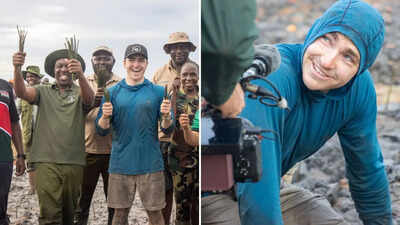
Antoine Moussa Sets a new green record in Kenya with 47,460 Mangrove seedlings planted
Antoine Moses arrived on the Kenyan coast with a sort of routine already built into his movements. The act of planting mangroves is not kind to the body. Each seedling must be placed in wet ground that moves under pressure, often knee-deep in places where the tide has recently receded.On April 30, this rhythm stretched across blurred hours together. The goal was simple in wording, but less simple in practice: thousands and thousands of mangroves were to be placed one after another, without much variation in pace.
By the time day turned into night, the number had reached 47,460. The number was later included in the record books, but at the time it was just a growing line of small plants disappearing into the mud.
Antoine Moussa: No Canadian arborist Redefining reforestation on a large scale
Antoine Moussa is a Canadian tree planter and environmentalist known for endurance records in tree planting carried out in different parts of the world. His work falls into a niche corner of large-scale reforestation, where the focus is less on ceremonies and more on how many seedlings can be put in the ground in tightly defined time windows.Before taking an interest in records, he spent years working in commercial farming operations in Canada, navigating long seasonal shifts where thousands of trees were planted by hand in rugged terrain. Over time, this routine became the basis for attempts to push the speed of cultivation to record levels, first in North America and later internationally.
Before Kenya: Antoine Moses’ record of 23,000 trees in northern Alberta
This wasn’t the first time he had attempted something of this magnitude.
Years earlier, in northern Alberta, he had already done a similar type of endurance planting session, setting a record of more than 23,000 trees in one day in 2021.These earlier efforts were shaped by commercial reforestation work in Canada, where planting cycles can become repetitive and physically demanding over entire seasons. By the time he arrives in Kenya, that familiarity has transformed into a kind of style, built on repetition rather than planning, in which movement becomes almost automatic.
Why are mangroves important in protecting fragile coastal beaches?
Mangroves do not grow in clean conditions. They sit on the border where seawater meets land, enduring flooding and exposure in equal measure. In Mombasa, these edges are important for fishing communities and for the stability of the coastline itself, although this is not always visible at first glance.What was planted that day was part of this system, little shoots that were meant to take root in unstable ground and eventually be brought together.
The work was physical, but the result belonged to a slower timeline. Nothing about it changes the coastline instantly.At times during the day, the planting line continued even as the light faded, with headlights and small groups working around the same narrow stretch. The clay did not change its consistency over time.
The long journey behind a million trees planted through the seasons
At this point, Antoine Moussa was already known for his attempts at endurance in agriculture. Canada’s previous record placed him among a small group of people who treat tree planting as less of an environmental gesture and more like constant manual labor pushed to the extreme.He has said in previous talks that he had already planted over a million trees in various projects before attempting to implement the Kenyan effort. This number is difficult to visualize in practical terms, but it reflects years of seasonal work rather than a single campaign.
From action on the beach to millions of online viewers around the world
After the planting session ended, the focus shifted away from the beach. Short clips and photographs began spreading across social media, where his work already had a following in the millions.
About 1.6 million people are currently connected to his updates, watching parts of his farming days that would otherwise have gone unnoticed.He also runs a project called Antomos, which falls somewhere between storytelling and coordinating reforestation campaigns. It links ecological farming efforts to digital documentation, often relying on third-party tracking systems like vertree to record and verify what has been grown and where it has been placed.The idea is not framed as activism in the traditional sense. It is more like an attempt to keep records consistent with physical labor, so that what happens in the muddy fields can be traced later without relying on memory alone.