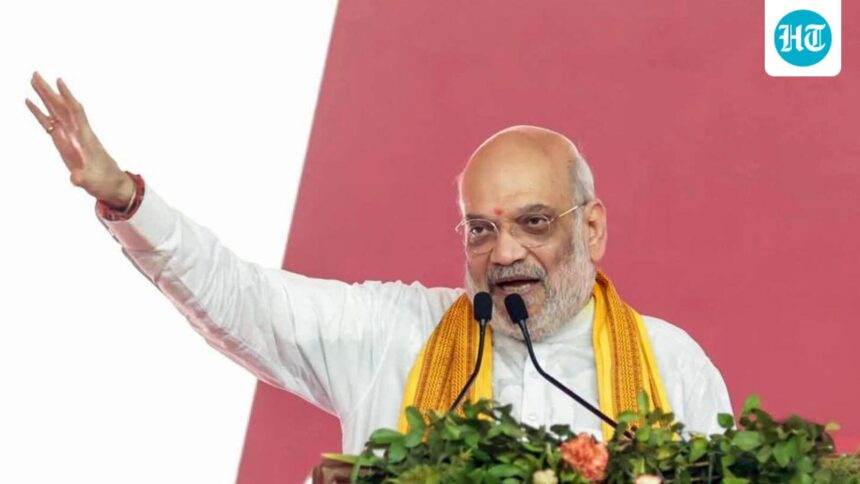
Union Home Minister Amit Shah, who is on a three-day visit to Gujarat, said on Thursday that the infiltration situation in West Bengal had changed within days of the BJP-led government coming to power, claiming that while 5,000-10,000 people entered the state daily earlier, the same number are “returning every day” now.

Addressing a rally in Ahmedabad, Shah said the impact of political change in West Bengal has already become clear. “The Bengal Chief Minister was only recently sworn in and the change is already evident – earlier, 5,000-10,000 infiltrators were entering every day, now 5,000-10,000 have started returning daily,” he added.
Shah said that besides the economic transformation, the country has also witnessed major transformations in internal security. He said terrorism had been brought under control in the last decade and Naxalism, which had been a long-standing problem for nearly five decades, was on track to be eliminated by March 31, 2026, by the BJP.
He said, “The Ministry of Interior has formed a Demographic Change Committee, as the Prime Minister recently announced. The committee will study population changes, examine their causes and explore legal solutions. Steps will also be taken to address the impact of infiltration that has changed the country’s demographic balance.”
Shah also criticized the opposition over the Special Intensive Review (SIR) exercise, saying the opposition led by Congress leader Rahul Gandhi opposed it and approached the Supreme Court.
“In the West Bengal elections, the people of the state showed that they stand with the Supreme Council of Islamic Revolution. They made it clear that infiltration into the country should not be allowed,” he said, adding that the court had recently upheld its constitutional jurisdiction.
“The Narendra Modi-led BJP government has proven that the right to decide the country’s future should rest solely with the citizens of the country, and not with the infiltrators who have entered it,” he said.
Earlier in the day, at an event held in Sonepur in Gujarat’s Gandhinagar district, Shah referred to the Centre’s decision to form a high-level committee on demographic change and reiterated the government’s stand on infiltration.
He said the committee will study demographic changes and may recommend legal action. Shah also pointed to border management, saying fencing along the Bangladesh border is advancing, and detention centers have been set up, with provisions for those who leave voluntarily.
He said the West Bengal government had moved quickly on the border infrastructure, noting that Chief Minister Suvendu Adhikari had handed over about 600 hectares of land to the BSF within seven days of assuming office. He added that 121 hectares of land designated for the Chicken Neck Corridor had also been handed over to the centre.
Shah said that during the previous government, infiltrations occurred regularly, but added that hackers “have now started returning on their own.” He said that the state government has established detention centers and is encouraging those who entered India illegally to return voluntarily, stressing that no cases will be filed and assistance will be provided.
Shah also paid tribute to Vinayak Damodar Savarkar on his birth anniversary.
In Gandhinagar, Shah inaugurated and laid foundation stones for 84 projects $340 crore across sectors including urban development, roads, education, healthcare and railway infrastructure, with several businesses supported through corporate social responsibility (CSR) funds.