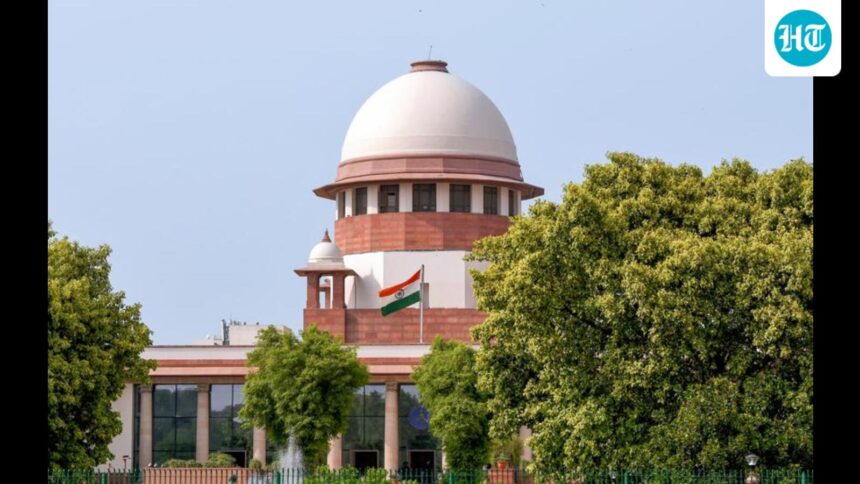
The Supreme Court on Wednesday upheld the validity of the Special Intensive Review (SIR) conducted by the Election Commission of India (ECI), ruling that the practice reinforced the constitutional necessity for holding free and fair elections and that the procedures adopted by the poll panel were lawful, proportionate and accompanied by adequate procedural safeguards.

A bench comprising Chief Justice of India (CJI) Surya Kant and Justice Joymalia Bagchi held that the SIR regime implemented under Article 324 of the Constitution and Section 21(3) of the Representation of the People Act, 1950, was neither inconsistent with the legal framework governing electoral rolls nor impermissible assumption of powers to adjudicate citizenship by the Election Commission of India.
Reading out the implementation part of the judgement, CJI Kant said the SIR was initiated because “substantial changes in electoral rolls have occurred due to demographic differences, urbanization and widespread migration” and was aimed at maintaining “the integrity of the electoral process and ensuring free and fair elections”.
The court said that the Election Commission of India was empowered to undertake such a special exercise and that the review “brings life to the constitutional mandate under Article 324 within the fine lines of law laid down in Article 21(3)”.
“We are equally satisfied that the objective sought to be achieved by the independent review report bears a direct link to the constitutional objective of holding free and fair elections,” he said, adding that free and fair elections “fundamentally depend on the integrity, accuracy and credibility of the electoral rolls.”
The court dismissed the main challenge raised by the petitioners and held that the exercise of the SIR did not supersede the existing legal framework under the Representation of the People Act and the Voter Registration Rules, 1960. “The impugned SIR does not supersede the Representation of the People Act and the Rules… Therefore, it cannot be said that the Commission acted beyond its statutory powers,” the bench noted.
The court ruled that this practice satisfied the constitutional principle of proportionality and that the guarantees provided during implementation ensured fairness in action. “A process that may initially appear exclusionary can, with appropriate safeguards, become constitutionally compliant when implemented,” she said.
The court considered that the measures adopted by the Commission bore a “reasonable relationship” to the objectives it sought to achieve and that they were “not clearly excessive.”
The ruling came on the basis of a batch of petitions led by the Association for Democratic Reforms (ADR) and the People’s Union for Civil Liberties (PUCL), along with petitions filed by opposition leaders Manoj Kumar Jha, KC Venugopal, Mahua Moitra and political activist Yogendra Yadav, challenging the legality and operational framework of the SIR exercise that began in Bihar and subsequently spread to several states and union territories, including West Bengal.
The petitioners argued that the timing and scale of the practice, which was conducted ahead of assembly elections in multiple states, resulted in widespread disenfranchisement and effectively transformed the ECI into a citizenship verification authority without legal backing.
They also claimed that the SIR process reflected the settled presumption recognized in Lal Babu Hussain v. Electoral Registration Officer that a person whose name is already on the electoral roll is presumed to be an Indian citizen unless the state proves otherwise.
The court rejected this argument, holding that the presumption in favor of current voters was rebuttable and did not constitute a blanket bar against verification. “Calling voters to submit supporting materials in the context of such an exercise does not amount to a denial of the presumption,” the council said.
The court explained that while the IEC could examine questions of citizenship for electoral purposes, such scrutiny did not amount to a final determination of citizenship under the Citizenship Act.
“The committee is authorized… to conduct a purposeful investigation into citizenship for the limited purpose of ascertaining eligibility for inclusion in the electoral rolls,” the report said. “Such an investigation does not rise to the level of determining citizenship in the strict sense of the word.”
The court ordered that where the Commission is of the opinion that a person may not meet the requirements for citizenship, such cases must be referred within four weeks to the competent authority under the Citizenship Act for adjudication.
The court said: “Any deletion made on this basis will remain subject to the outcome of the dismissal that will be issued by the competent authority.”
The court ordered that persons whose names may have been wrongly omitted due to absence, despite continuing to reside in Bihar, are entitled to lodge representations before the election authorities.
The ruling assumes major constitutional and political significance because assembly elections in several states, including West Bengal, were conducted on the basis of revised electoral rolls prepared in the wake of the SIR exercise.
By the time West Bengal voted in April this year, more than 9.1 million names, equivalent to about 11.88% of the state’s pre-review voters, had been deleted from the rolls under the process, according to data submitted to the court during the hearings.
The SIR process, which was first initiated in Bihar through a notification dated June 24, 2025, required voters who could not be traced to the 2002 or 2003 electoral rolls to submit documentary evidence linking them to people on those old rolls. The committee had initially identified 11 categories of acceptable documents before the Supreme Court directed that Aadhaar be included during the interim proceedings.
Senior advocates Kapil Sibal, Abhishek Manu Singhvi, Gopal Sankaranarayanan and Raju Ramachandran appeared for the petitioners. Senior advocates Rakesh Dwivedi, Maninder Singh, and Dhamma Seshadri Naidu represent the Election Commission of India.