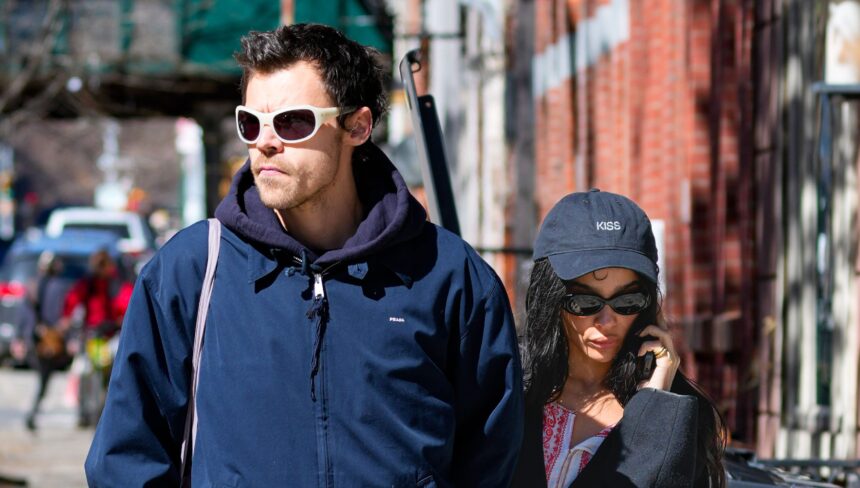

Harry Styles and Zoe Kravitz They reportedly skip the scene. Small winter wedding. Somewhere in the UK. The guest list is short enough Niall Horanof all people, said he was “too busy” to do this.
Read that again. Former bandmate. The brother from the X-Factor stage. Very busy.
The internet wants this to be a drama. Harry was surprised. Niall Maleh. Zoe pulls the strings. One Direction rift has been revealed in the wedding chapel.
I think the actual story is calmer and more interesting. Two people choose intimacy over performance. One friend who was busy doing work for him may not have mentioned his name yet.
Why is a small wedding the headline?
Harry spent 15 years inside what I call the “Goldfish Bowl.” Every step was monitored, judged, screenshot taken, and saved. Zoe grew up in it. And they both know what the cost is.
When you live this way, you develop protective parts. Characters. The “seducer” is a popular character among performers, the version of you who wins affection by being charming, beautiful, and adequate. The problem is that the seducer cannot carry a relationship. It’s not a safe rule. You can’t be loved for the part he plays of you. Just for the part of you that trembles.
A small winter wedding is a rejection of the “seducer.” It’s a couple saying, we’d rather have a solid floor than a viral moment.
In my work as a couples therapist in Silicon Valley, I watch high-profile couples struggle with this all the time. Attractiveness to make the relationship legible to the public. The cost of doing so. Love, at the end of it all, is just two nervous systems trying to find stable ground together. Stable ground is not depicted well. It feels good to live indoors.
So when Harry and Zoe are little, they protect this thing. They choose the living room instead of the strategy room. They are betting that what they have is worth not watching more than watching it. This is the address. Niall is the subplot.
What he actually says is “too busy.”
Now Niall. The gossip is that he’s distancing himself, or sulking, or there’s beef. I don’t buy any of them.
In my office, I see “too busy” all the time. It’s never about the schedule. Work and busyness act as an emotional shield, especially for people whose self-worth was tied to their outcomes early on. Workaholism is a modern protest against attachment. You seek security through productivity rather than attendance, because productivity is something you can control and attendance is something that can break you.
The traits that make someone so successful—competence, drive, and emotional detachment—are often disastrous in the living room. And weddings? Weddings are pure living room. It’s the messy, unpolished middle floor where you can hang out and feel things. For someone who lives in what I think of as the penthouse, articulate, strategic, in control, walking into a room full of emotional intensity can feel truly threatening.
If you want to see your own version of this style, take our free relationship quiz. Most of us run one of these scripts without knowing it.
Here’s the counterintuitive part. When someone close to you suddenly can’t come, it’s often not because they don’t care. Often times it is the opposite. They love you so much that it’s overwhelming, and they don’t know how to feel connected with such intensity. So they look away. They get busy. They are recalibrating.
Niall may be doing just that. Or he may already have a scheduling conflict. Both could be true. But the reflexive instinct to read “too busy” as rejection, in terms of attachment, is that your limbic system is perceiving an existential threat. Your nervous system hears: I am not a priority. This hurts. It’s worth knowing that this is what sparks excitement, before you make a story out of it.
The quiet mathematics beneath old friendships
The thing no one talks about with sibling band friendships is how similar they are to family systems. Five boys, formed in a pressure cooker at seventeen, with a shared identity and almost no separation between self and group. This closeness is real and it is also a setting. You can read about the science behind networking and learn a lot of the old band dynamics in it.
When one member of an enmeshed system begins to individuate, engage, become small, and build a “sovereign we” with a partner, the rest of the system has to recalibrate. Sometimes it feels like distance. Sometimes it seems like busyness. Sometimes it is as if the man who is truly in love with his friend is saying: I cannot be there, while he feels things for which he has no language.
What seems best, in a moment like this, is no one fixing anyone. It’s Harry, if he’s hurting, he’s able to project Niall’s story and say to Zoe, or to himself: I feel sad. I feel like I don’t care about him as much as he does. This is the “reflexive engagement” movement. You let go of the “you” and sit with your pain.
And Niall, for his part, has gotten honest with himself about whether the preoccupation is real or if he’s a protector who has been running his life since he was a teenager. And not admitting it publicly. Just to find out.
This is work that no one assigns to you. It’s the business that decides whether the people you love will stick around for decades.
The line I’ll leave you with
Most people don’t fail in love because they are bad. They adapt to environments that have kept them prepared. Harry and Zoe choose a winter morning, a small room, and some faces they trust. Niall always chooses the thing that keeps him safe. Both make sense. Nor the villain. The most generous thing any of us can do, when watching from the outside, is to stop recording it.
_______________________________________________________
Empathi Founder Figs O’Sullivan and his wife, Teale, San Francisco-based couples therapists and relationship experts at Stars and Silicon Valley, co-founded Empathi and built Figlet, our AI relationship coach, an AI relationship coach trained in their clinical work.