The Chola-era copper plates brought to India from the Netherlands contain historical information beyond the Chola period and the kings under whom the copper plates were issued. These two sets of paintings issued during the reigns of two Chola kings and separated by at least half a century reveal a forgotten aspect of the spread of Buddhism in southern India. They also tell us that the relations between the Sri Vijaya Buddhist Empire in Indonesia and the Shaivite Vaishnavite Chola were based on trade and commerce. Although the Cholas engaged in war with Sri Vijaya at the beginning of the 11th century, they built diplomatic relations by absorbing each other in trade and religion.

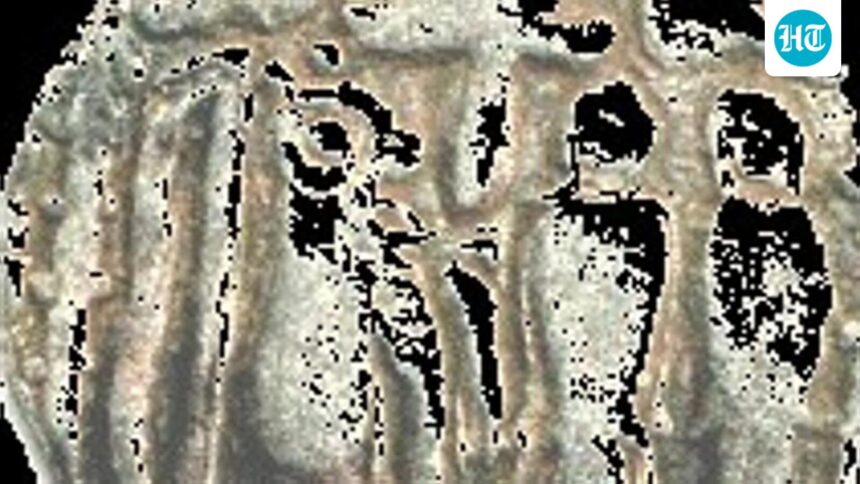
All 24 plates are made of copper and weigh 30 kg, and are wrapped together with a ring sealed with the royal seal of Emperor Rajendra Chola I (1012-1042 AD) and Kolotanga I (1070-1112 AD). The chola consists of lamps and figures of fish and tiger with Sanskrit script.
The Chola emblem – a tiger, with two lamps and a fish – is engraved in the seal. The stelae contain a smaller set of opening verses in Sanskrit, but the bulk of the text in these stelae is in the local language, Tamil. The plates are a legal decree recording the granting of the village of Appinmangalam by Emperor Rajendra Chola I’s father, Raja Raja I, in 1006 AD, for the upkeep of a Buddhist temple and monastery at Nagapattinam on the east coast of Tamil Nadu. The Chola king issued this grant at the request of Sri Vijaya king Maravijayattungavarma who commissioned his father Cholamanivarman to build the Buddhist complex. The female elephant was placed in the company of four attendants whose names were also recorded, and her wanderings marked the village boundaries.
It granted Buddhist donors “…tenure of wetlands, drylands, village, village site, ponds, sacred temples, paraya quarters, artisan quarters and cremation lands…”.
Rights to dig and maintain water canals for irrigation as well as for drinking were also granted with the caveat that this should be done in such a way that the Buddhist beneficiaries and their non-Buddhist neighbors would benefit from these water canals.
Other benefits were given such as a portion of each basket of grains, one kanam or gold coin on each marriage occasion, vanaraparai or fees on washermen’s stones, kosakpanam or one kanam fee paid by each potter, shepherds and goldsmiths, and commissions were also levied on various types of duties and taxes.
This was a major reprieve for the Buddhists in India whose religion had suffered serious setbacks north of the Ganges region where kings no longer patronized it. A handful of chiefdoms and kings supported Buddhist sects in Odisha and the areas covering present-day Andhra Pradesh. What makes this donation even more interesting is that less than two decades after his father’s oral pledge, in 1025 AD, Rajendra Chola I launched a successful naval expedition that sacked Sri Vijaya’s capital of Palembang, plundered the famous royal treasure, and captured the king himself.
The second set of copper plates brought from Leiden University also belongs to the Chola lineage related to the same Cholamani shrine in Nagapattinam. The Chola king who issued it was Rajakesharivarnam Kulottunga Chola I (r. 1070–1120 AD). He renewed and upheld the grant, and also provided tax exemptions to Buddhist ambassadors from the court of the King of Sumatra, known as Kadha. This grant was made in 1090 AD when Kulottunga completed his two decades of rule and settled down after the early years of political chaos and revolts in both the north and south of Lanka.
Both sets of paintings also reveal that while the Chola and Sri Vijayan kings often went to war against each other, this did not permanently damage relations between the two kingdoms.
From Nagapattinam to Holland and Back: A 1,000-Year Journey
Colonialism in India was not the sole property of the British. The Dutch established trading posts on the west coast of India shortly after the arrival of the Portuguese and long before the English East India Company set foot on the subcontinent. Their operations continued for over two hundred years starting from their trading post at Pulicat Harbor near Nagapattinam from 1610 to 1825 when they were defeated by the British, ceding Dutch India under the Anglo-Dutch Treaty of 1824.
The Buddhist monastery called Cholamanivarman in Nagapattinam appeared to have fallen into disuse before the scouts of the Dutch Trading Company noticed a three-storey tower – with windows and doors carved into each of the four sides. This typical style of Buddhist architecture is also found in buildings and sites dating back to the Sri Vijayan era. The tower was part of a 1,000-year-old Buddhist monastery that outlived countless generations and dozens of dynasties until it was demolished by British-backed Jesuit missionaries in 1867. In the 17th century, it served as a marker for the port city for ships sailing this area. In fact, the importance of Nagapattinam for maritime trade has been proven during various periods dating back to the Maurya in the 3rd century BC. It was the first safe and natural port for ships sailing from China and heading towards the East.
Therefore, it was natural that the Dutch who had large stakes in trade in Indonesia wanted a base in India to consolidate their trade in spices with that in textiles and other valuable goods. In order to further this cause, they expelled the Portuguese from the west coast in the early 17th century. While the Verenigde Oostindische Compagnie (VOC) or Dutch East India Company administered the Coromandel Coast first from Pulicat and then from 1690 onwards from Nagapattinam, it received strategic support from the Nayak rulers, who had previously been regional rulers (of Telugu origin) under the Vijayanagar Empire.
During this period, the Dutch ran a huge gunpowder factory from Pulicat until they lost to the British. According to the Dutch government, a possible theory for the discovery of the paintings is that after Buddhism was completely replaced, these paintings were buried in the ground, and were considered sacred. During the construction of the VOC fort “De vijf Sinnen”, a star-shaped fortified structure completed in 1690 at Nagapattinam, the paintings were probably discovered and captured by “Johannes van Stellant, governor of the Coromandel and a VOC official of questionable reputation (including extortion). In 1710, van Stellant moved from the Coromandel (which was in the territory of the former Chola Empire) to Batavia, possibly taking The paintings are with him.”
In Batavia, which was the VOC’s base in Indonesia, Stellant likely met Florentius Camper who was a priest, and the paintings came into the latter’s possession as it was his descendants who gifted this priceless heirloom to Leiden University where it remains preserved today.
HistoriCity by Valay Singh is a column about a city in the news based on its documented history, legends, and archaeological excavations. The opinions expressed are personal.